GRID 2025 Industry Trends Report
Introduction
As the recruitment industry weathered another difficult year, the most successful agencies stayed focused on gaining market share and protecting margin as they waited for job requisitions and market confidence to rebound. In spite of these global challenges and, perhaps more importantly, pervasive market uncertainty, some agencies saw success, and many are building a foundation for even better performance in the future. For our 15th annual GRID Industry Trends Report, Bullhorn surveyed around 150 recruitment industry professionals in the APAC region to uncover the most effective strategies in today’s business environment. We also interviewed seven industry executives to hear their firsthand experience with the trends revealed in the survey. Read on to find out how these insights can inform your strategic decisions in 2025.
 Click on any chart to enlarge

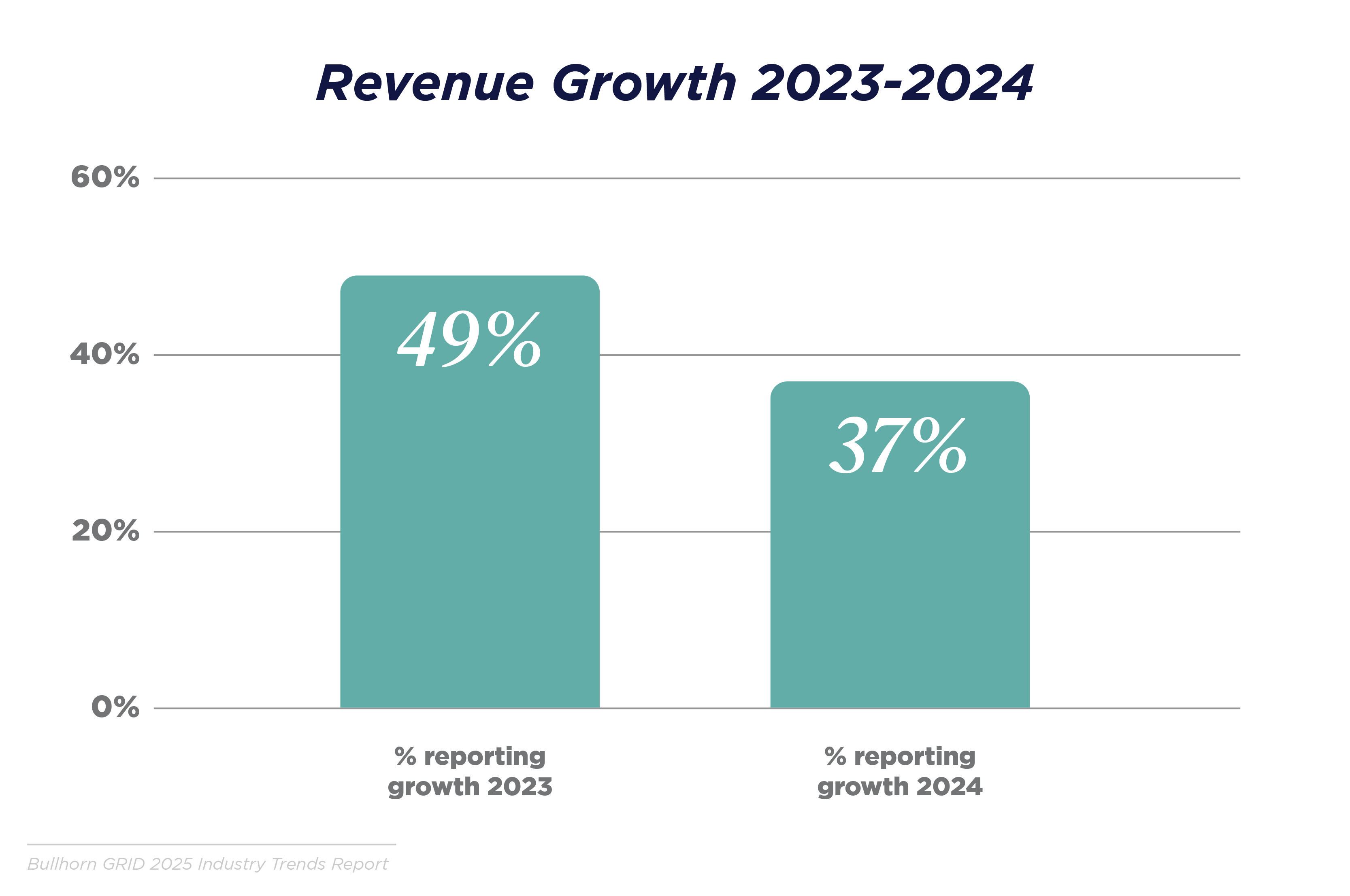
Revenue declined year over year
2024 was another tough year for recruiting. 37% of agencies saw revenue growth — 22% saw growth of 10% or more in spite of the challenging market. But one-quarter saw declines. And the number of revenue winners was down year over year for the second year in a row.
Agencies are optimistic for 2025, but hedging their bets
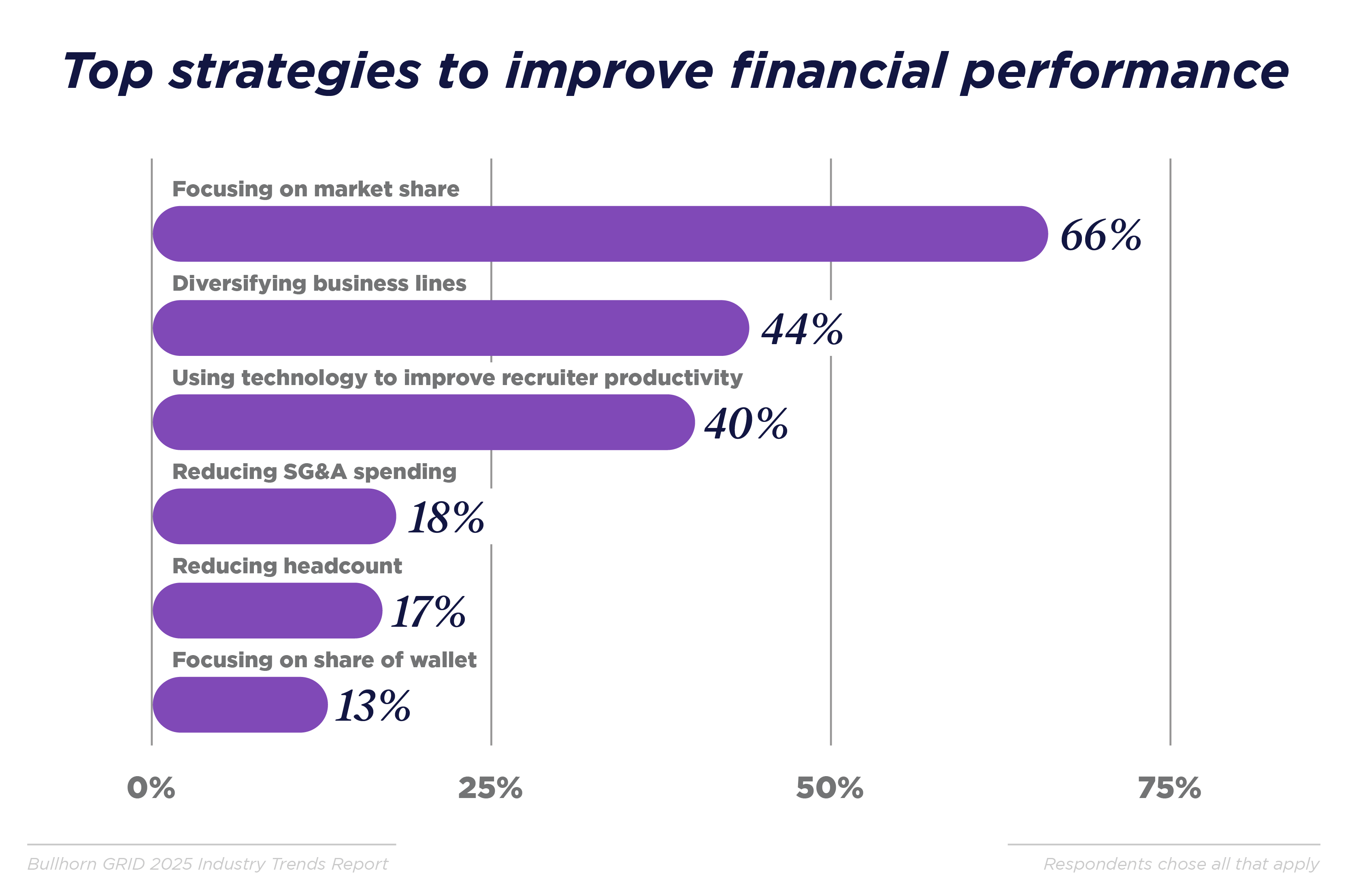
Most agencies remain optimistic about the future, with nearly 73% predicting that revenue will increase in 2025 — interviews with recruitment leaders suggested many anticipate growth in the second half of the year. The interviews also revealed that many now predict the recovery may not mean a full return to historical, pre-pandemic norms. It is worth looking at how agencies are positioning their businesses for success while facing an uncertain future. Although attracting new clients is the number one priority across the board for 2025, agencies have learned they cannot rely solely on revenue from new clients to drive performance, and they need to find new ways to add value through new solutions and services. 66% are focused on increasing market share to be well positioned when the market turns upward. The next two most popular strategies for driving financial performance are diversifying business lines and improving recruiter productivity using technology. The former typically means a shift to higher revenue or higher margin services, and the latter means reducing expenses, all of which boost the bottom line.
What are agencies facing in 2025?
Agencies across the world were concerned about the economy and the tight recruitment market that has persisted for nearly two years, leading most to prioritise attracting new clients over all other concerns. Beyond retaining and developing new business, agencies remained focused on accelerating and improving the talent experience, benefiting candidates while also enhancing productivity. To accomplish both, agencies are relying on automation and increasingly AI to achieve their critical priorities.
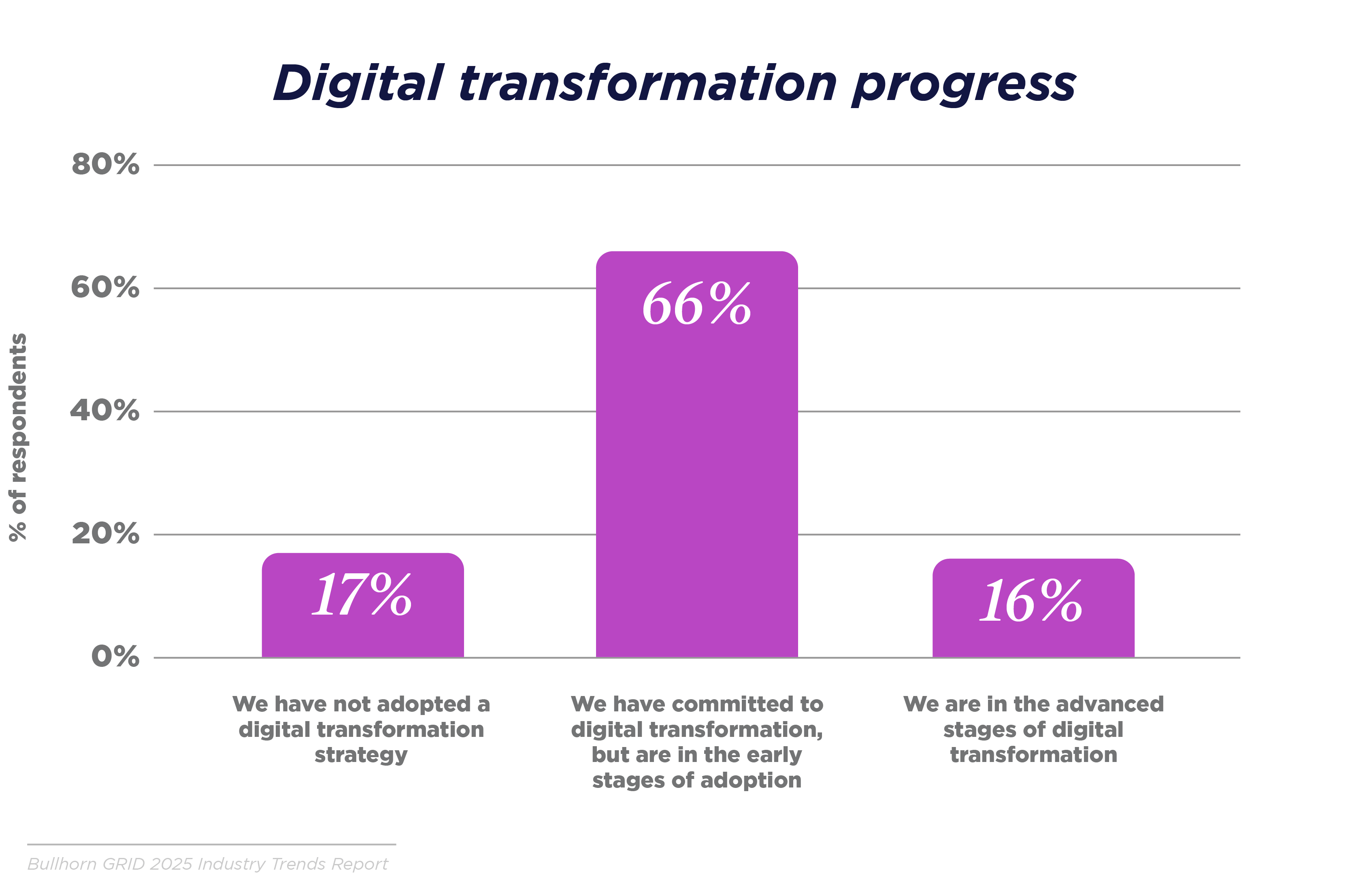
Digital transformation has stalled
Most agencies still remain in the early to intermediate stages of digital transformation, in spite of widespread acknowledgment that it is necessary to truly unlock the potential of recruiters and databases. For the first time since 2023, the number of agencies that say they are in the advanced stages of digital transformation has actually fallen, from 19% last year to 16% this year. This likely reflects the advent of AI technology, which has upped the ante on what digital transformation entails. It also reflects the difficult reality many of our interview subjects shared: that as part of their efforts to reduce SG&A expenses, they have had to reduce technology spend in 2024 — a trend that may continue in early 2025. But agencies remain committed to investing in technology that can improve productivity, as long as they see demonstrable ROI.
Still a long way to go in automation
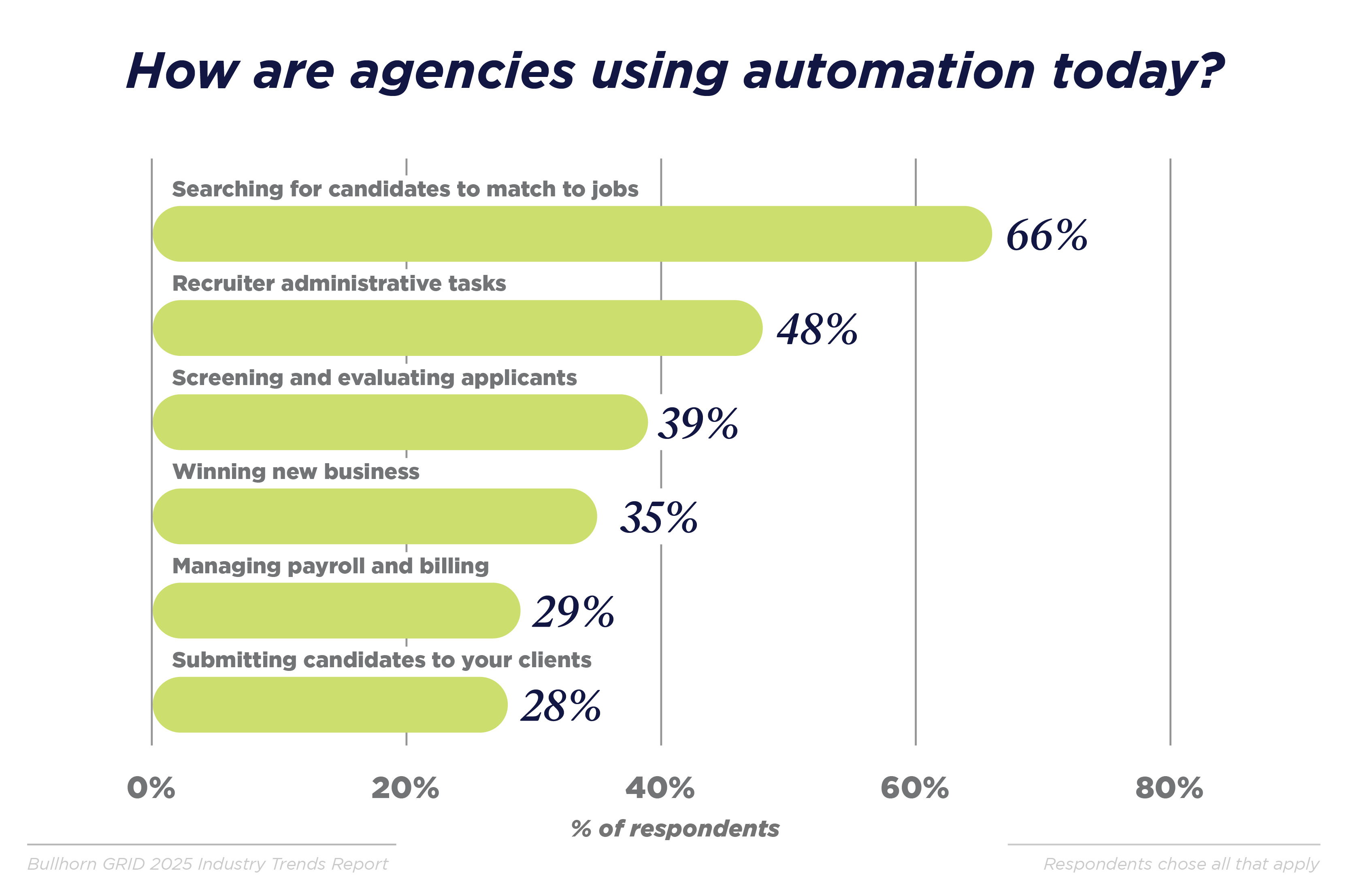
In spite of the operational and financial benefits, a substantial percentage of agencies still don’t have technology in place to automate tasks like search and match or candidate screening — and there is an even bigger gap for sales and middle office. This aligns with the finding that digital transformation efforts have largely stalled as the recruitment industry has slowed down. Now that the recruitment industry appears to be stabilising at lower volumes and a slower pace of growth, productivity and efficiency will be more important than ever. Technologies like these will offer an opportunity for teams to work more efficiently as the economy stabilises.
Automation critical to faster placement time
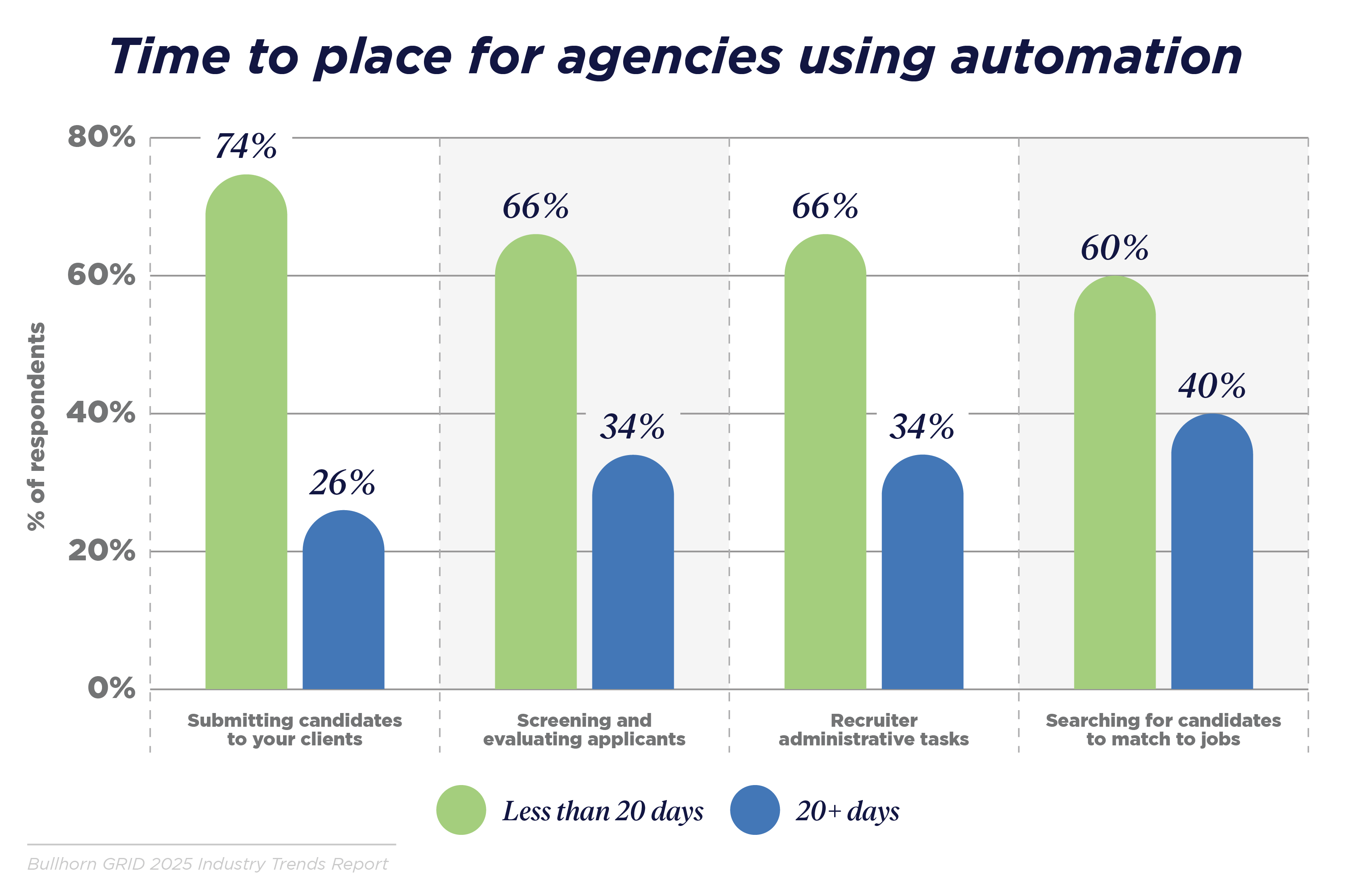
Automating key tasks in the recruitment process clearly results in faster time to first placement. Agencies that have automated searching for candidates were 50% more likely to have an average placement time under 20 days. And automating candidate screening correlates with a 94% greater likelihood of having placement times under 20 days. Across the board, automation seems to mean faster placement times, and that is with current automation tools — AI recruitment agents are only going to widen the efficiency gap.
Search and match tops the automation wishlist
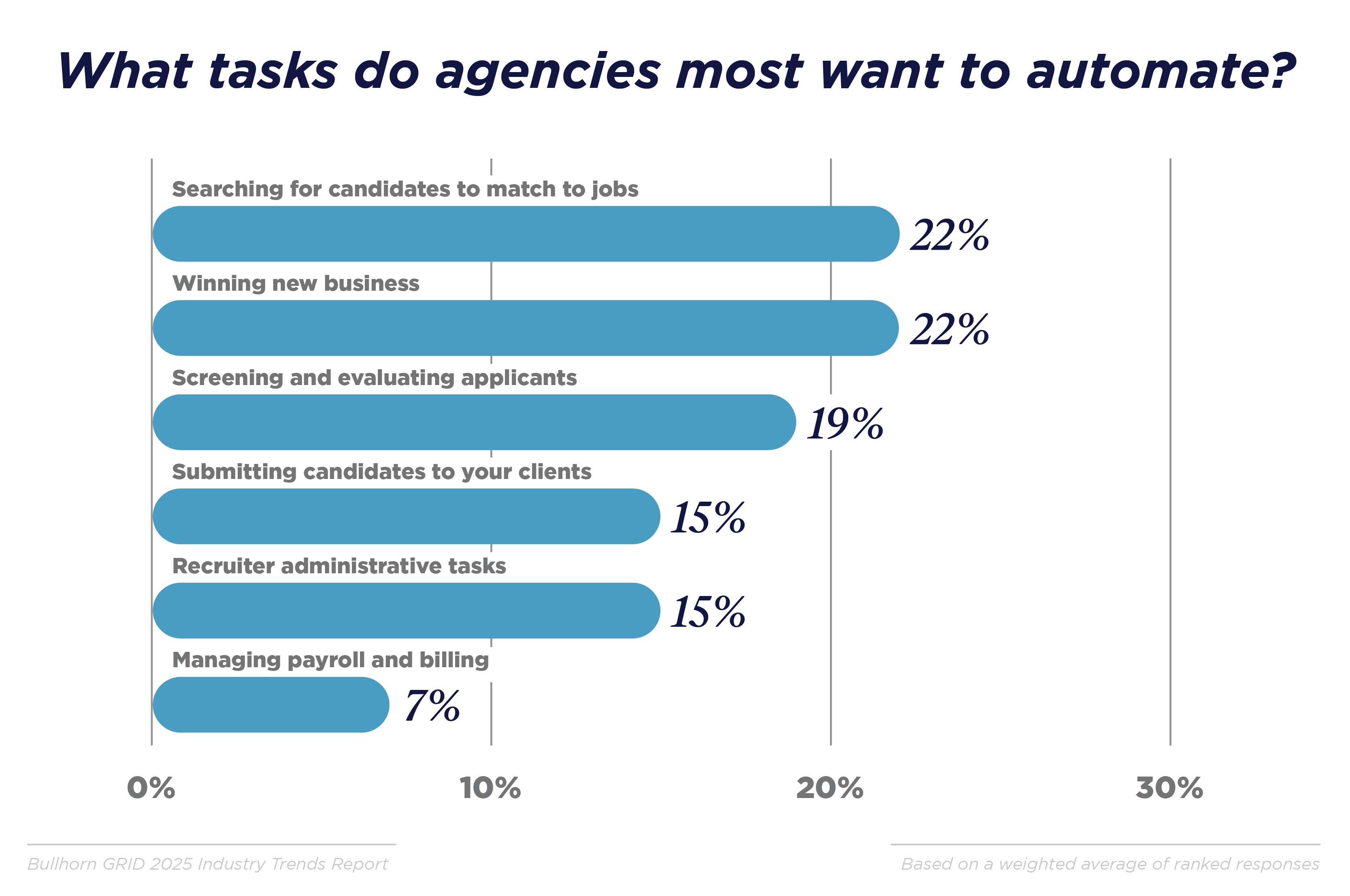
When asked to rank which of their day-to-day processes they would most like to automate, agencies chose searching for candidates and matching them to jobs and winning new business. Across the recruitment industry, search and match is largely seen as the most valuable use case for both automation and AI. Again, this is not surprising since respondents also list this as the most time-consuming task performed by their recruiters; the survey found that a recruiter spends 14.6 hours per week searching for the right candidates, based on a weighted average of the survey responses.
The 2025 GRID Industry Trends Survey showed clearly that early and extensive adoption of AI agents correlates with revenue growth and recruiter productivity. Right now, 18% of agencies have purchased or developed AI solutions of some kind, and another 56% are experimenting with generative AI on some level — so nearly three-quarters are using AI as part of their business. Only 12% say they haven’t yet begun using AI — down from 14% last year. And every single recruitment executive interviewed this year spoke at length about AI and how it has already become a necessity rather than an upgrade. One summed it up by saying:
Recruiter admin and search/match are top use cases for AI today
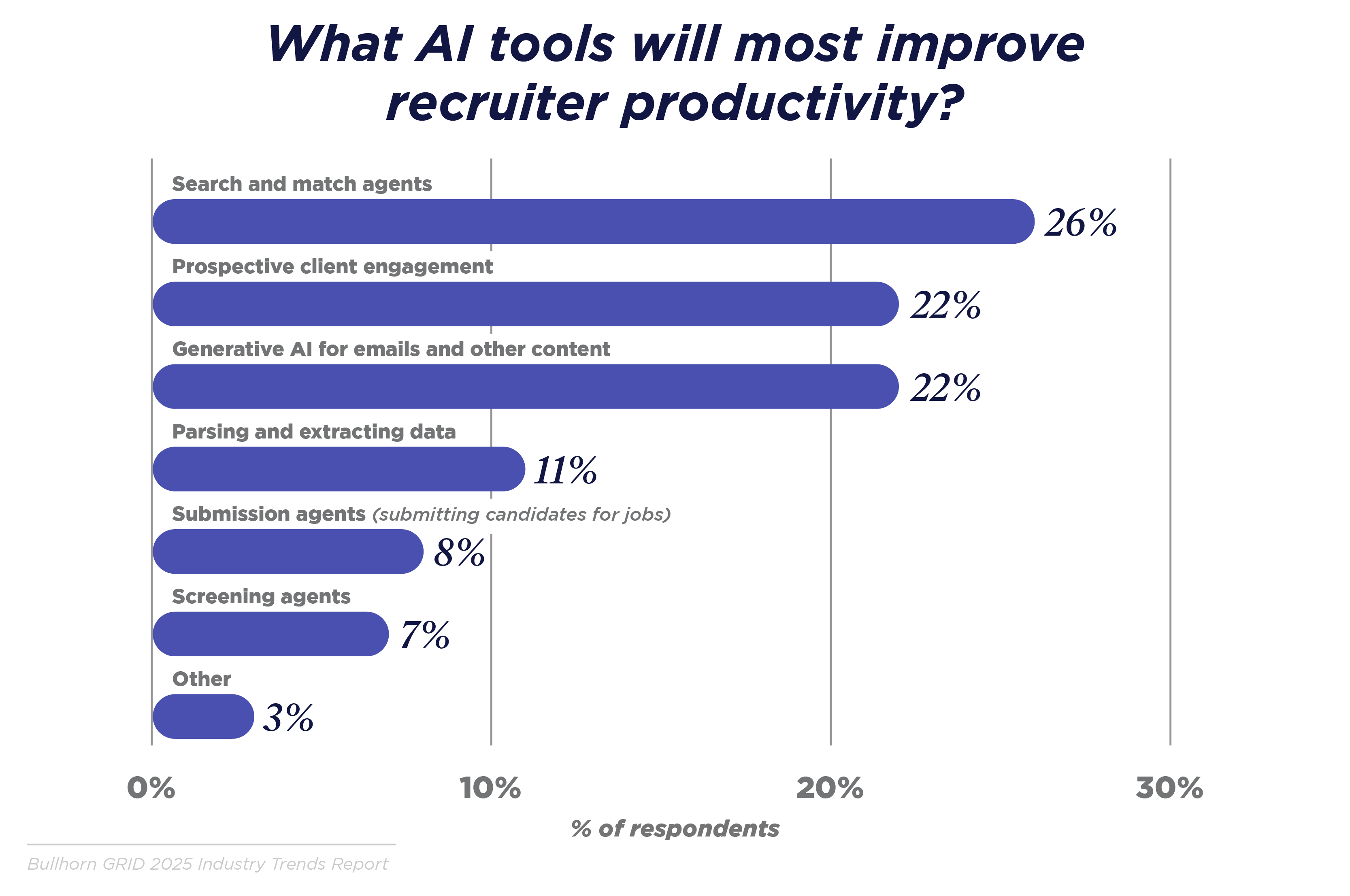
56% of agencies have been using AI tools like ChatGPT to help with recruiter tasks like generating emails and summarising candidate skills. And 48% of agencies are already experimenting with AI to sort through candidate resumes and submissions to find the best ones to screen for individual jobs. In speaking with agencies, most feel search and match is likely to be the first and perhaps best use case for AI, especially when recruitment-specific tools trained on their own data are available — 26% of those surveyed listed search and match agents as the future recruitment tool they expected to have the biggest impact on recruiter productivity, by far the most popular answer.
AI adoption correlates with higher revenue
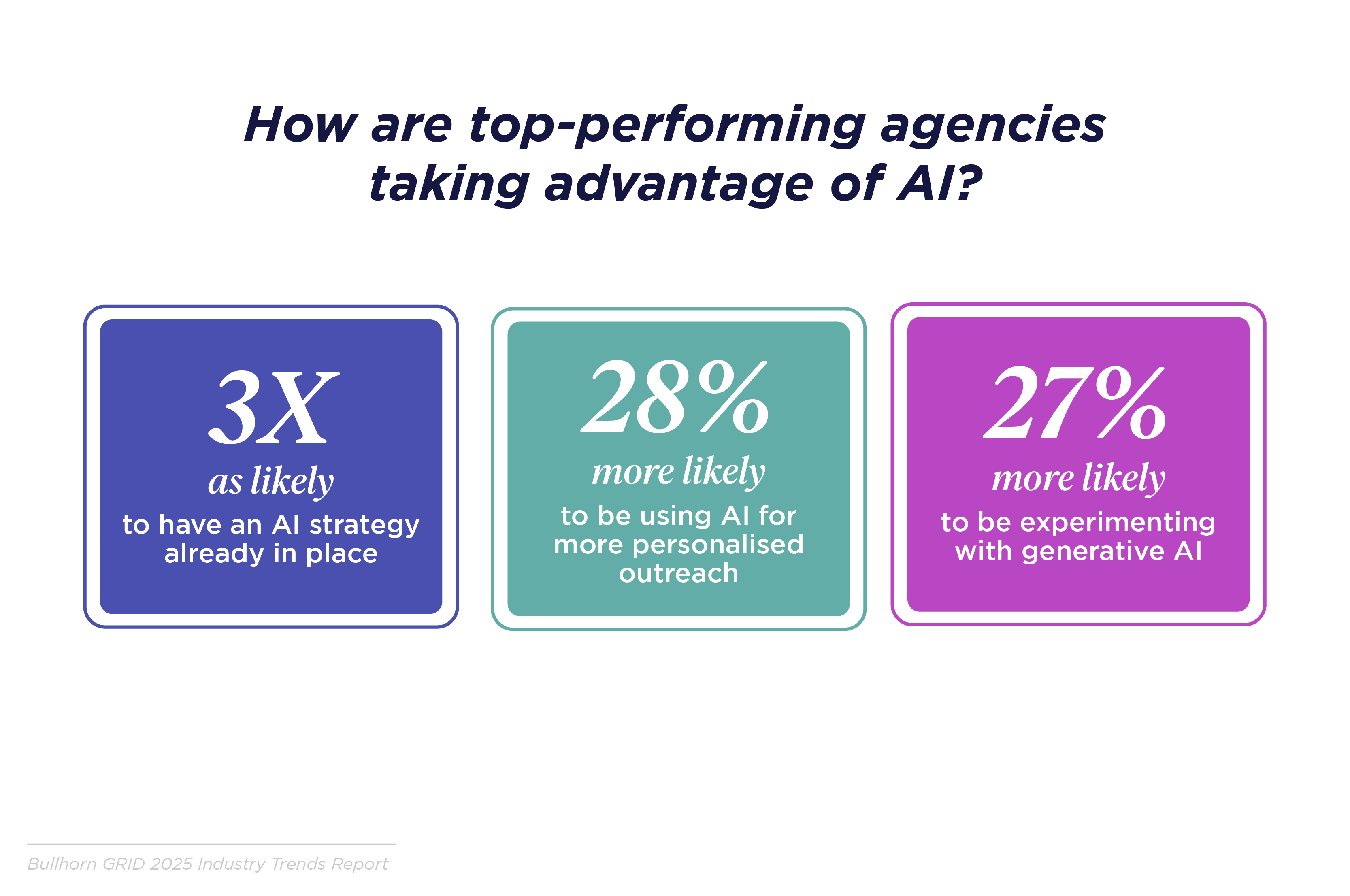
Agencies that reported revenue gains in 2024 were more likely to already have AI in place to help with key tasks like matching candidates to jobs and screening candidates. As AI for recruitment becomes more sophisticated, these differences will likely become even more stark, especially with 30% of agencies saying recruiter productivity is the biggest obstacle to reducing expenses.
Agencies that reported revenue gains in 2024 were more likely to already have AI in place to help with key tasks like matching candidates to jobs and screening candidates. And those choices are already yielding clear benefits. As AI for recruitment becomes more sophisticated, these differences will likely become even more stark, especially with 33% of agencies saying recruiter productivity is the biggest obstacle to reducing expenses.
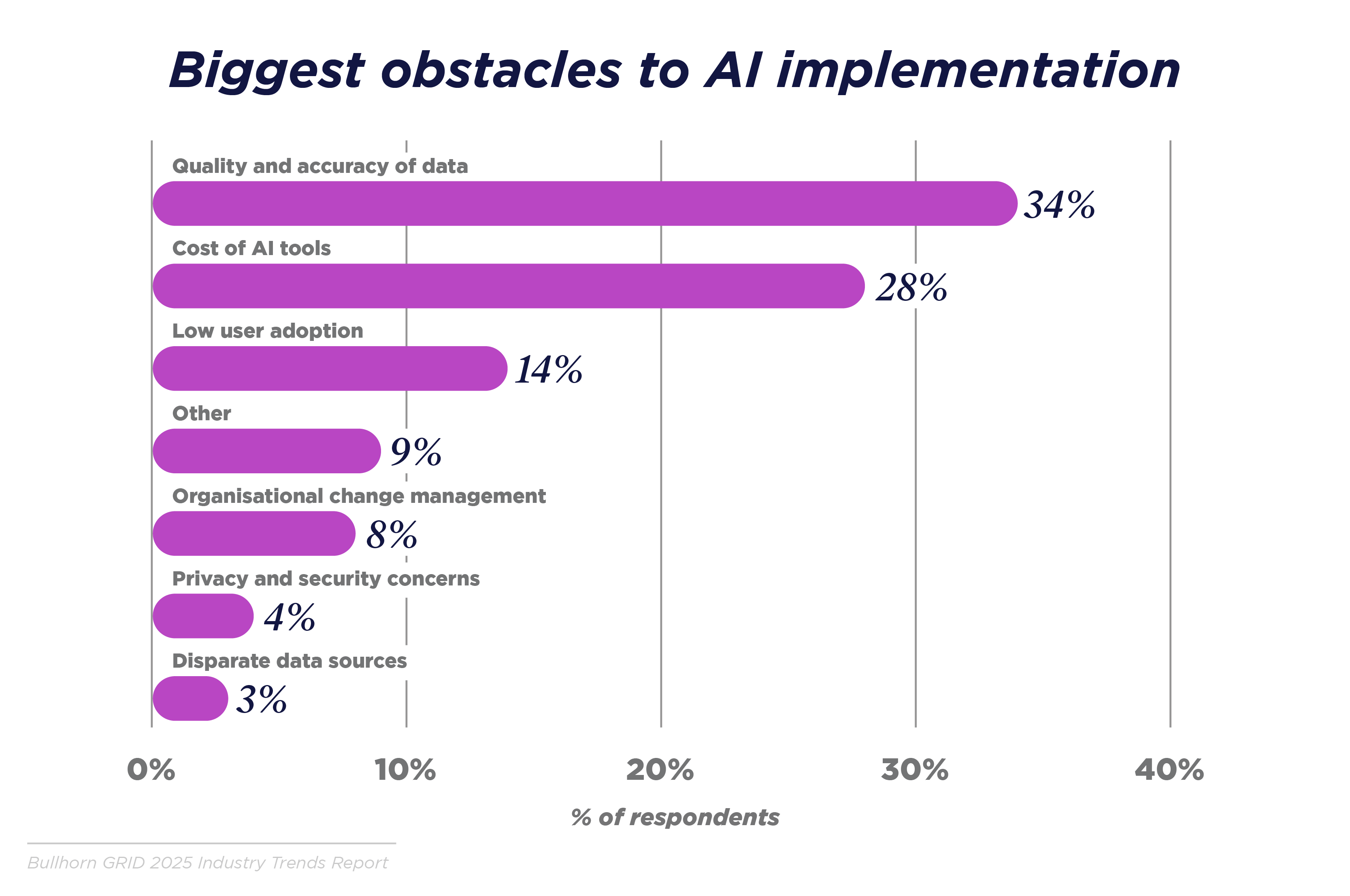
37% of agencies say data limitations are the biggest barrier to AI benefits
When asked what stands in the way of widespread AI implementation, agencies overwhelmingly cite data-related concerns, either siloed systems (3%) or the underlying data hygiene (34%). This echoes what customers have shared, that there is a lot of data clean-up and data governance work that needs to be done to really reap the rewards of AI in recruitment. It is likely that this work, driven by AI, will be the push the industry needs to make significant progress on its digital transformation journey.
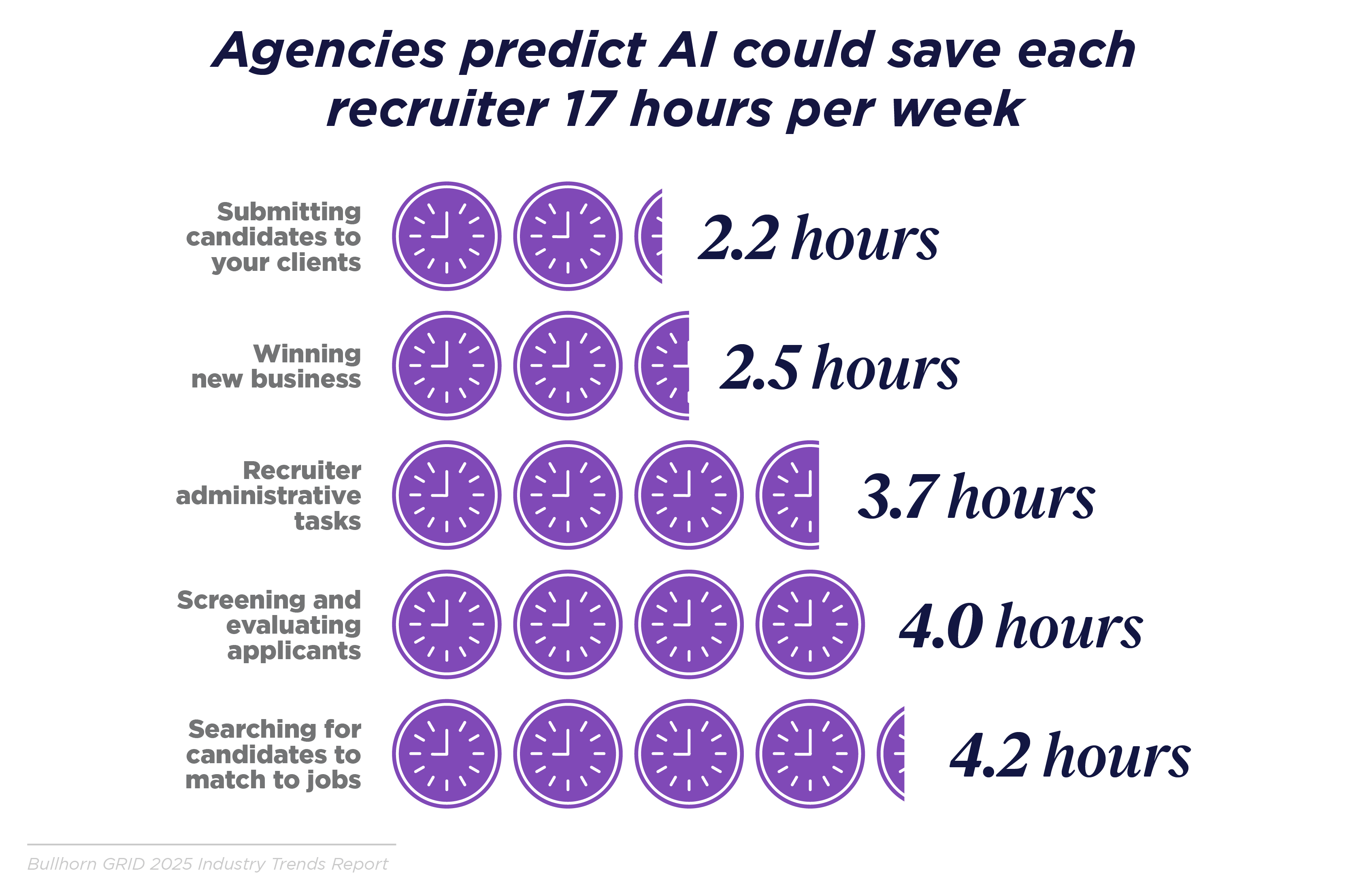
Agencies predict AI search and match could save each recruiter 4.2 hours per week
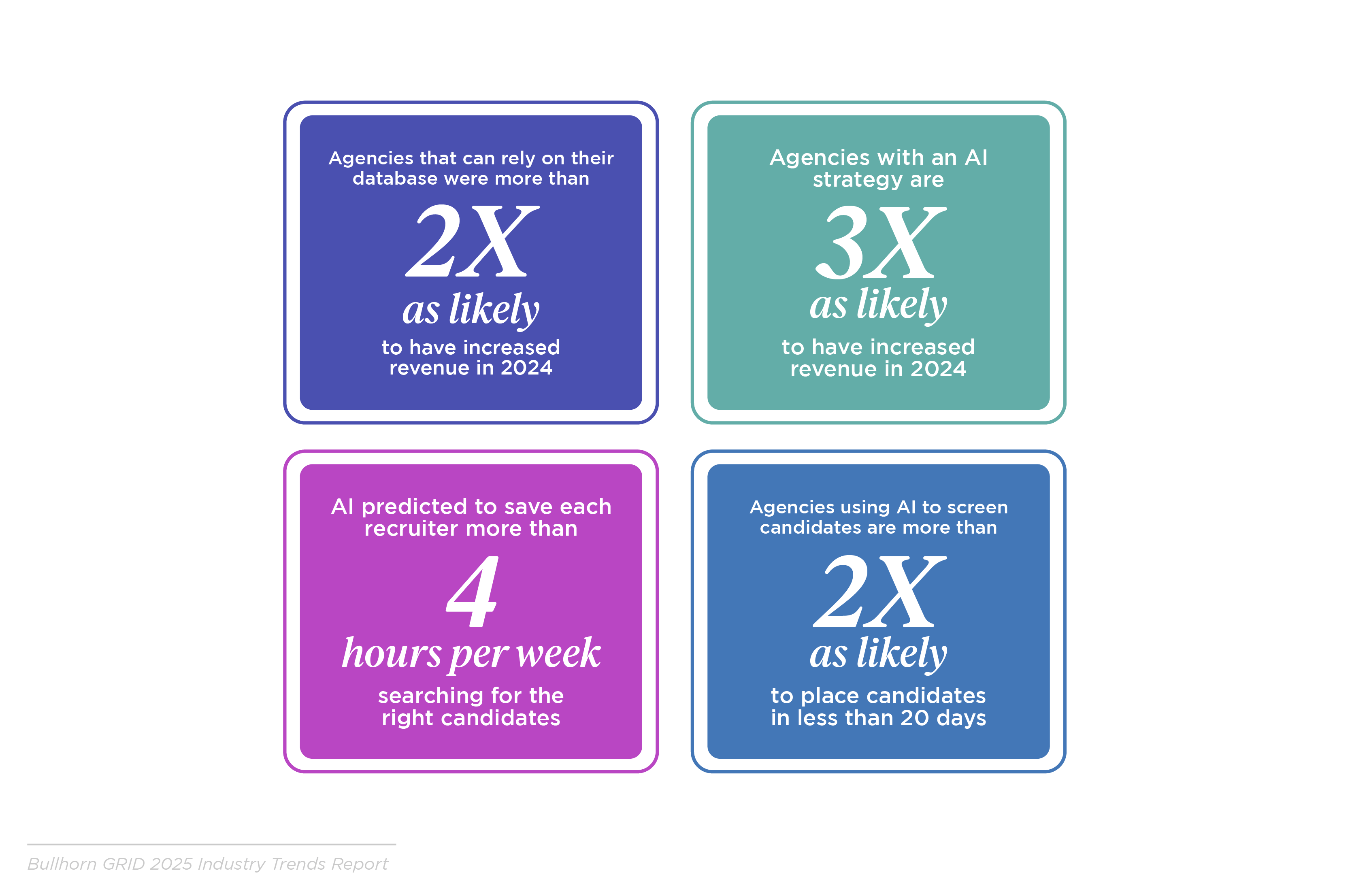
When asked how much time recruiters currently spend on common tasks and how much time AI could save them, it is clear that agencies expect a significant impact from AI tools. With responses suggesting 4.2 hours per week time savings from search and match, and 4.0 for screening, the effect adds up quickly. Agencies predict that AI infused throughout the recruitment workflow could result in an extra 17 hours per week for each recruiter — and we think that estimate may actually be low. The operational and financial benefits to be gained align perfectly with the value agencies indicate they expect to see from AI, with 22% saying they hope to see increased recruiter productivity and 21% looking to scale without adding headcount.
Agencies are clear that AI must enhance, not replace, the human aspect of recruitment
A recurring theme across all our conversations with recruitment executives this year was the importance of balancing technology with the human touch and specialised expertise. Several of the executives we spoke with made it clear that, in order for AI to work for them, it would have to be highly customisable and trained on their data, allowing each agency to leverage its own “secret sauce,” while accelerating and streamlining their workflows. Additionally, everyone was clear that AI is a tool to speed up how quickly recruiters can connect with the right candidates, so they can focus on the relational work that made them want to join this industry in the first place, preserving the differentiator that really attracts and engages talent for the long run.
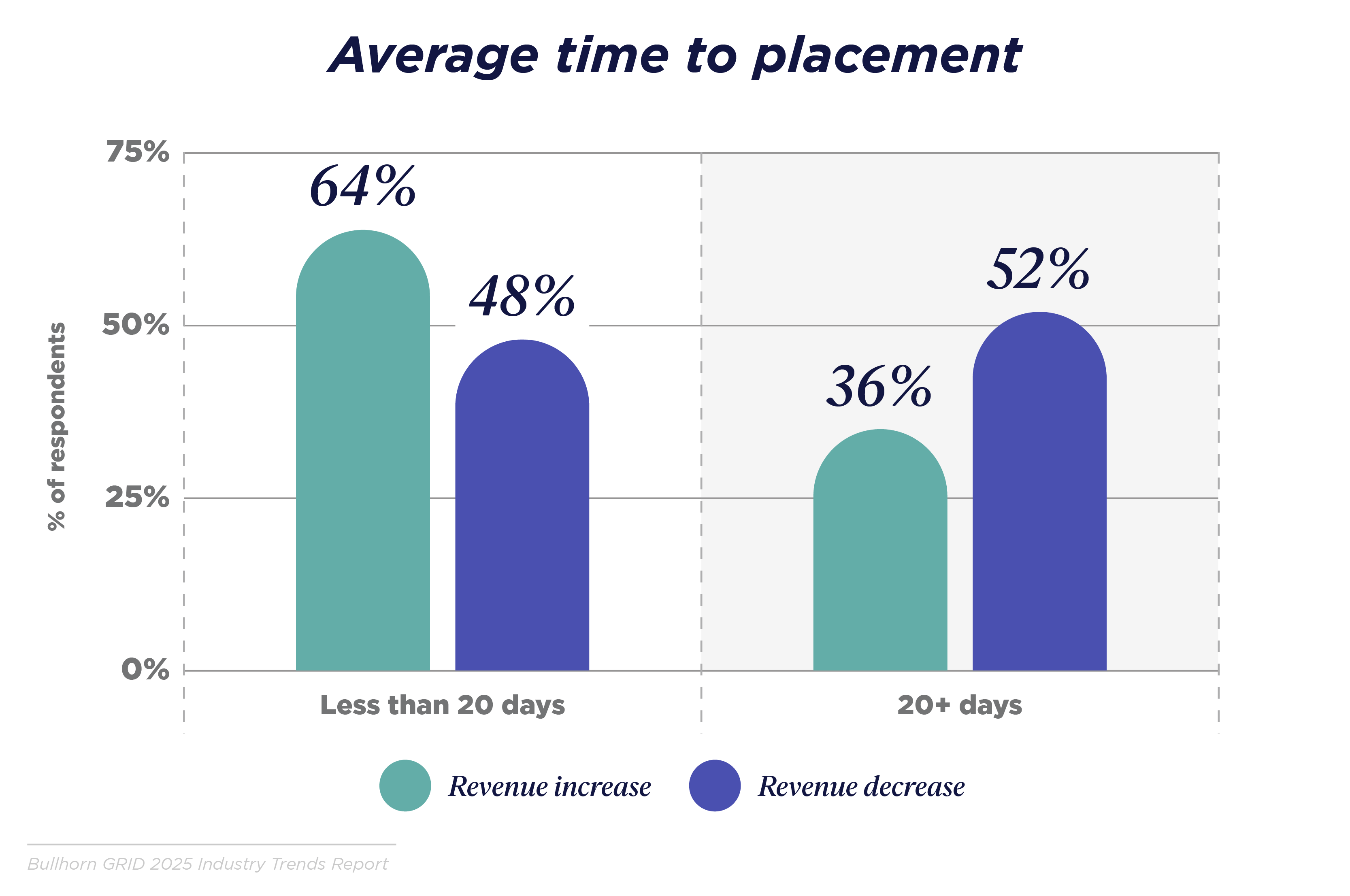
Keeping time to place under 20 days leads to revenue gains
According to the global GRID 2024 Talent Trends Report, 80% of candidates want to be placed in less than 20 days — and 39% in 1-9 days. But how are agencies doing at meeting that benchmark? 60% report an average placement time of less than 20 days, and 25% in 1-9 days. Revenue winners are 34% more likely to be under that critical 20-day threshold. On the other hand, more than half of agencies that lost money in 2024 were above the 20-day mark.
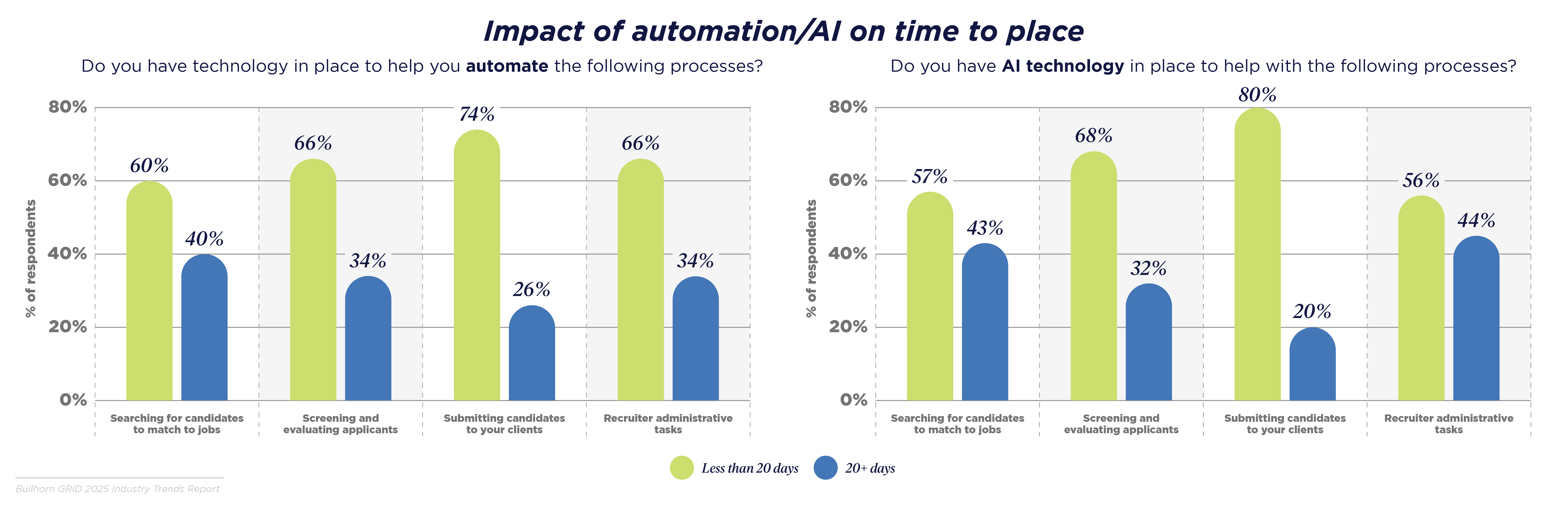
Automation and AI can make it 75% more likely that time to place is under 20 days
When we look at what impacts time to place, it is clear that the agencies that are getting it right are really relying on technology to drive productivity and efficiency. Agencies that have automated key tasks or that are infusing AI throughout their workflows were much more likely to be below the 20-day mark for time to place, in some cases making it four times more likely that they met that standard.
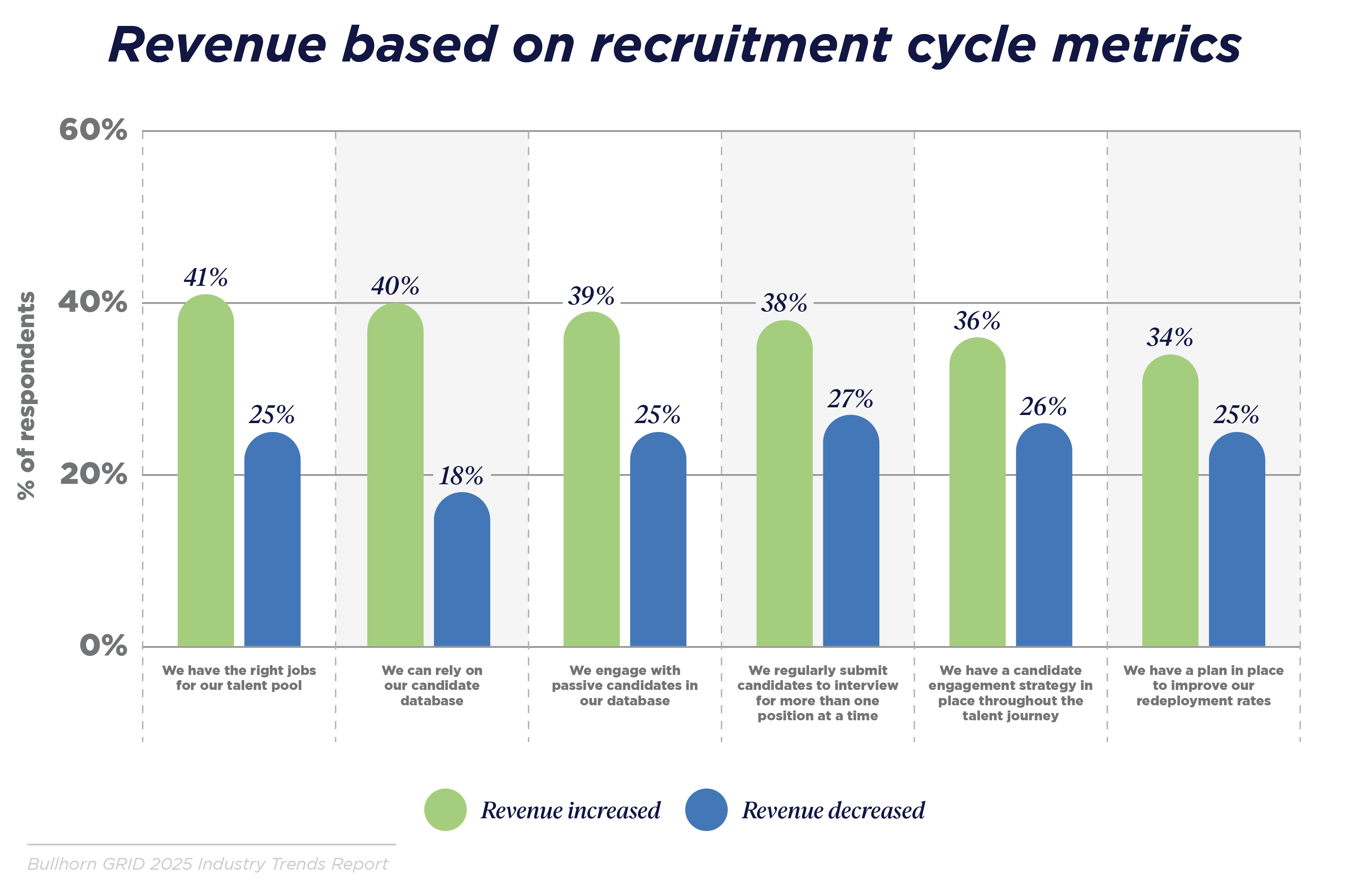
Agencies that delight talent throughout the cycle see higher revenue
Engaging candidates, having the right job matches, and readily redeploying top candidates clearly result in satisfied talent, but also yield decisive revenue gains. In every category, these engagement and productivity strategies make it at least 35% more likely that agencies saw revenue gains in 2024. Agencies that can rely on their candidate database were more than twice as likely to have increased revenue last year. The win-win is clear — and AI agents are just going to make these gains even easier to achieve.
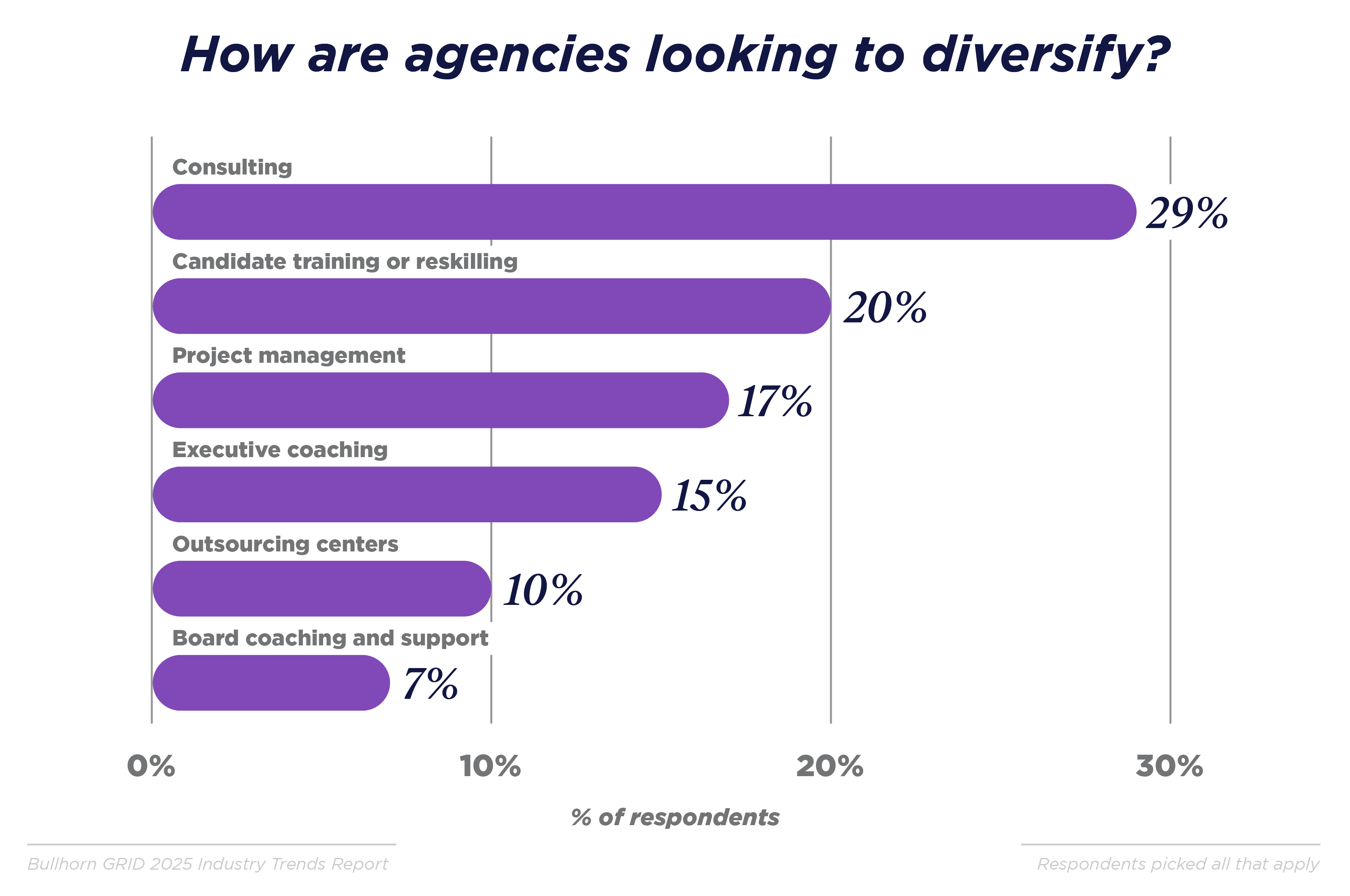
Project management and consulting top the list of new business lines
When we drill down to see how agencies are diversifying their business lines, the results support the notion that they are shifting increasingly toward higher-value, higher-margin services that create deeper partnerships with clients. Interviews with recruiting leaders revealed that agencies that wish to remain competitive are combining these solutions with their existing services to offer even more value to clients, like combining consulting, project management, and recruiting for end-to-end offerings that make them indispensable to clients. But they also made clear they are diversifying into business lines that still play to their areas of expertise. One agency mentioned building on healthcare-related MSP experience to expand into pharmaceutical recruiting. Another made clear that they were identifying all the specialist roles that they had placed successfully in the past and concentrating on expanding in those very specific areas. The most successful agencies are clearly focused on competing where they know they can win.
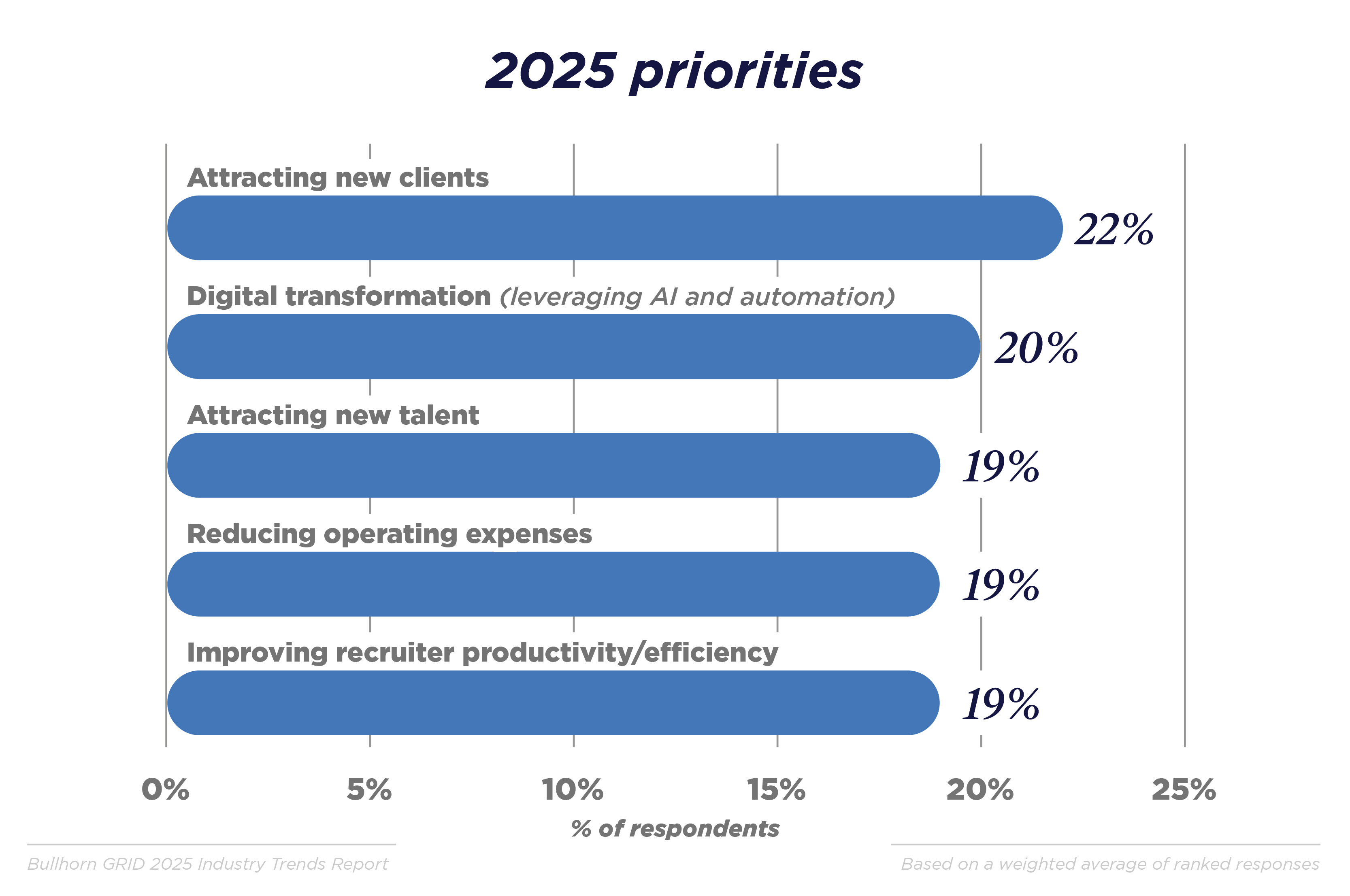
Attracting new clients remains top of the list
The top 2025 priority for 20% of agencies is digital transformation, which is not surprising given the huge focus on AI and recruiter productivity in the industry today. The next two priorities were reducing operating expenses and attracting new talent, similar to what was seen last year. As we have seen in the rest of this report, AI and automation remain some of the best ways to achieve these goals.
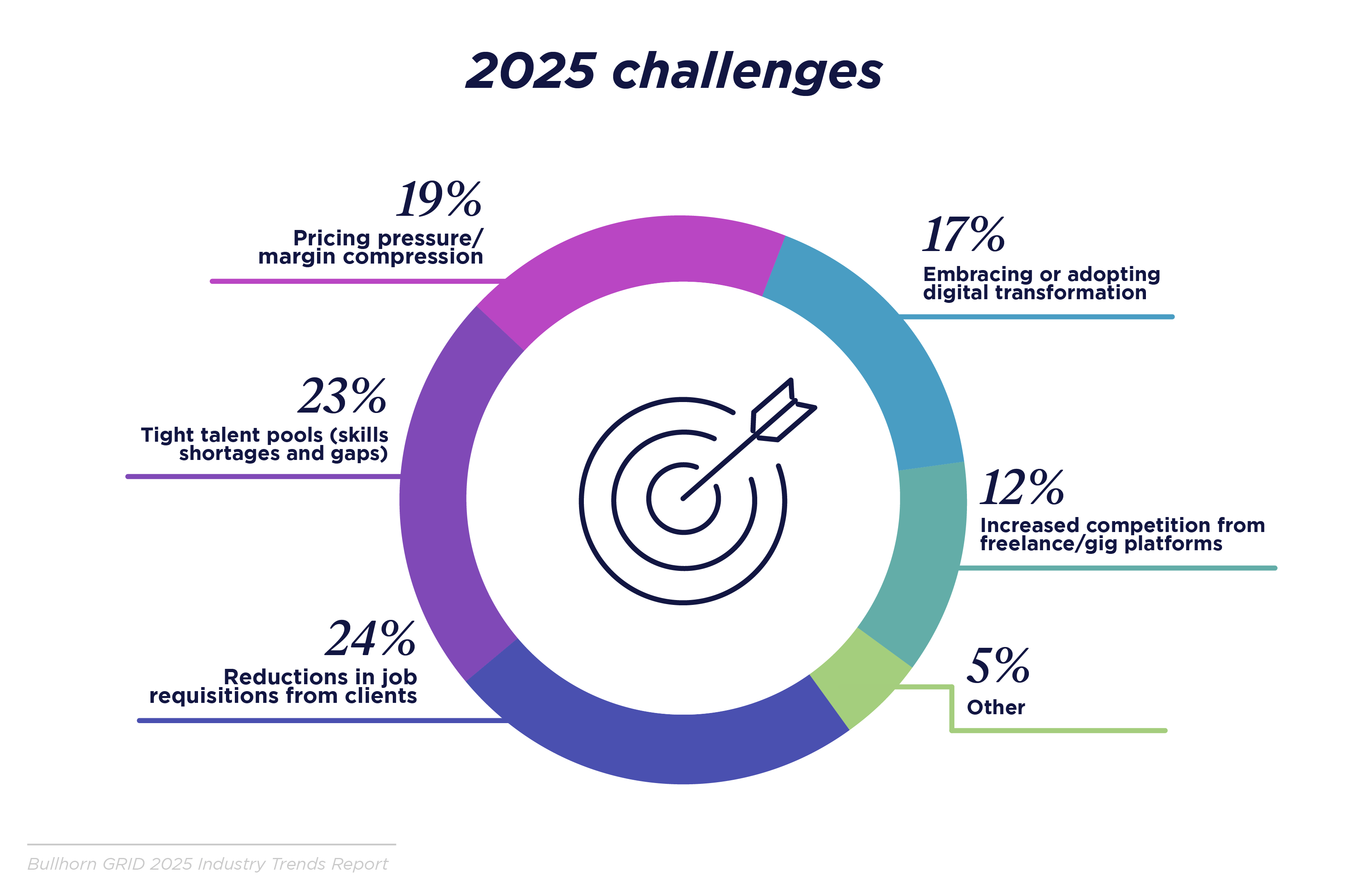
Tight talent pools remains highest concern in spite of fewer jobs
Falling job volumes and tight talent pools were the top challenges facing the recruitment industry in 2025 — an apparent contradiction that has persisted for two years now. Even in the face of fewer job requisitions and longer decision cycles, there are still not enough candidates with the right set of skills to fill the jobs that are out there. Lack of confidence among candidates is making them less likely to leave where they are, especially since offers don’t come with nearly the same salary hikes as were seen during and shortly after the pandemic. This market context, which includes significant pricing pressure from clients, makes it even more important for agencies to rely on technology to achieve the productivity and efficiency recommended in the rest of this report.
Conclusion
73% of agencies expect the economy to improve in 2025 — and 60% expect that to help the recruiting industry. 2024 tried the industry’s patience, with many expecting an economic recovery that didn’t come, but it also highlighted how the strongest agencies continue to weather the downturn and find pockets of success. These same strategies will position these agencies to thrive as recruitment finds its “new normal.”
In 2025, look for the most successful agencies to:
- Standardise and enhance technology tools to optimise recruiter productivity and operational efficiency
- Make huge leaps in the adoption of AI tools and agents, infusing AI throughout their workflows
- Further enhance the candidate experience in ways that cement loyalty while also improving the bottom line
- Continue to rely on diversification as a key strategy to protect margin and nurture client partnerships