
Introduction
In the midst of a tumultuous year and uncertain global economy, the staffing industry in 2023 focused on maintaining revenue and margin in the face of declining job requisitions and slower conversions. As a result of these challenges, firms seem to have stalled in their digital transformation journey. In 2020 only 25% of firms had a digital transformation strategy, but that rose to 84% by 2022. And by 2023, 29% were in the advanced stages of digital transformation. This year, for the first time, that progress slowed, with only 73% having made progress on digital transformation.
In spite of the economic and technological challenges, many firms were able to outperform their peers and find pockets of success. What were the secrets to their success? And how are they using technology to support it? Bullhorn surveyed more than 1,400 recruitment industry professionals across industries and across the globe to answer these questions and more in our 14th annual GRID Industry Trends Report. Read on to uncover the insights you need to make the best decisions for your business in 2024.
 Click on any chart to enlarge
What are firms facing in 2024?
Overall, the economy was the biggest concern for most firms, leading most to prioritize gaining new clients and nurturing existing client relationships. Beyond the focus on retaining and developing new business, firms remained focused on creating a talent experience that will allow them to serve their clients even as the talent shortage continues. In both cases, firms are relying on technology to achieve their critical priorities.
One concern that arose for the first time this year is competition from gig platforms and what this might say about changing employee preferences. Firms are thinking creatively about how to stay ahead of this market shift.
Key insights
What are the top-performing firms doing differently?
Heading into 2024 in the midst of an economic slowdown and ongoing talent shortage, staffing firms have to be more focused than ever on revenue generation and margin preservation. Looking at the industry’s priorities and the strategies of the top-performing firms (those that saw year-over-year revenue growth of 10% or more), we identified some key insights to help navigate the challenges and opportunities ahead.





High-performing firms relied on automation to improve productivity and efficiency
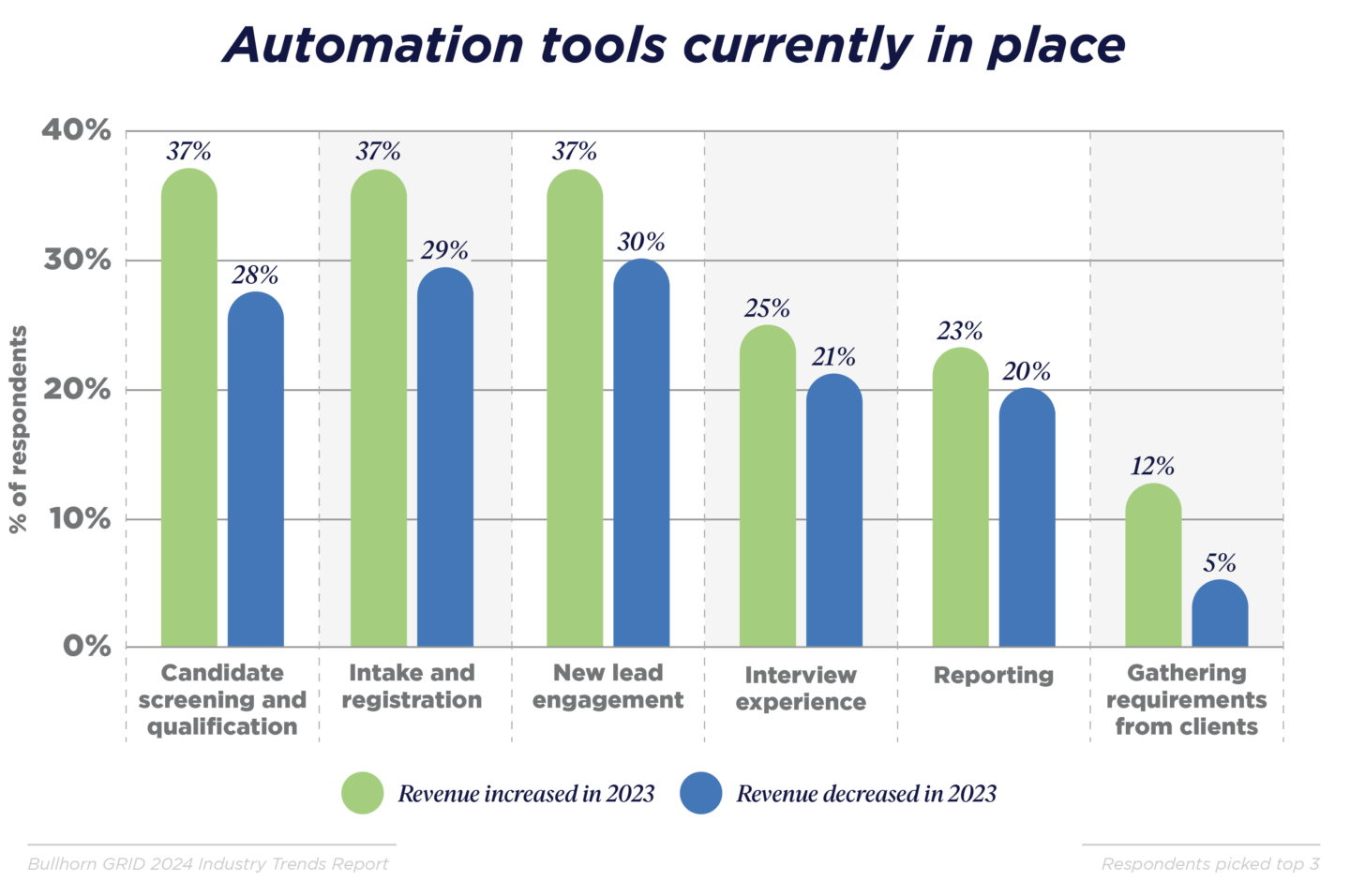
How are high-performers deploying automation?
They are more likely to have automated key tasks. They are 2.4 times as likely to have automated gathering client requirements and 32% more likely to rely on automation to handle candidate screening. And Bullhorn data shows that firms that automate their processes see 39% more submissions per head and fill 22% more jobs.
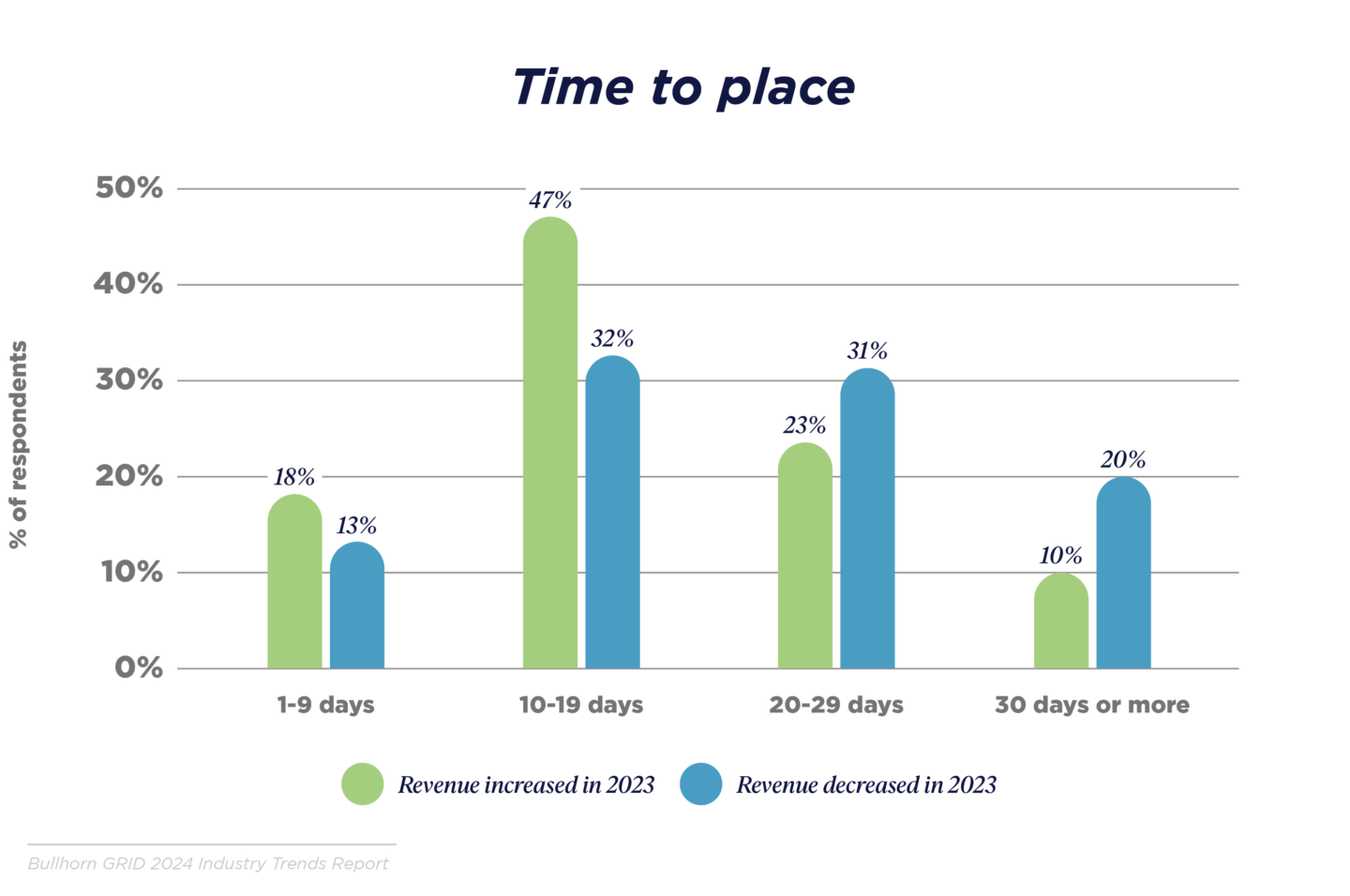
10-19 days is the sweet spot for time to place
Firms that saw revenue growth in 2023 tended to be linked to placing candidates in 10-19 days. 59% of the highest performers placed candidates in 19 days or less. Firms should consider investing in automation tools since Bullhorn data show that firms that automate their processes see a 26% reduction in time to place.
Setting up multiple interviews is a crucial way to impact time to place, and across the Bullhorn customer base, the number of candidates submitted for multiple interviews fell by 14% from 2022 to 2023.

What does this mean for firms in 2024?
For at least the beginning of 2024, clients will still be exhibiting caution when it comes to hiring. That means slower hiring cycles and a focus on truly mission-critical, high-value projects. Staffing firms will want to stay focused on the fundamentals: improving placement times and redeployment rates by leveraging technology to speed up and improve sourcing and candidate engagement.
Firms that continue to invest in their technology and talent pools will be well positioned for 2024, and even better positioned when the economy bounces back.

Top performers improve conversion rates by providing a better talent experience
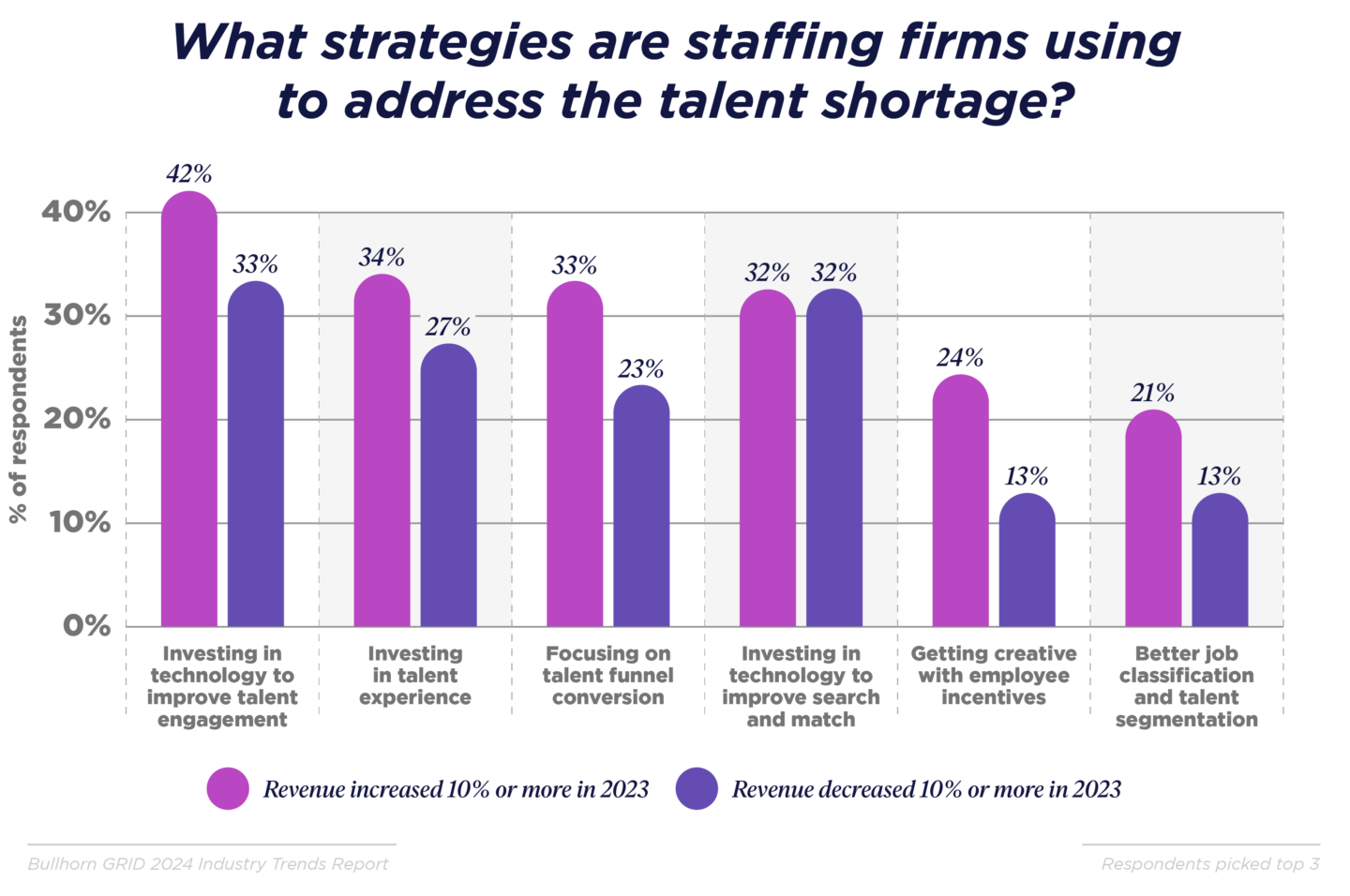
The talent shortage is not going away anytime soon, regardless of the macroeconomic climate. Firms that really differentiate their talent experience through technology and apply proven best practices will be the most successful in spite of this challenge.
Top performers are doubling down on technology investments designed to improve the overall speed, accuracy, and experience for high-quality candidates.
In particular, top performers are nearly two-thirds more likely to be enhancing their job classification and talent segmentation and are 85% more likely to be thinking creatively about employee incentives. And, thanks to their focus on efficient operations, they are more than 40% more likely to be improving their conversion rates.
What aren’t they doing? Sacrificing margin to chase more job requisitions. Instead, top performers are looking to create a talent engagement program that competes on value rather than simply price.
What does this mean for firms in 2024?
Investing in talent-focused technology and automation will be more important than ever in 2024 — the data above make it clear that top-performing firms are doing just that. What all these investments have in common is using automation to deepen and tailor talent engagement without additional staff or human effort. In particular, by automating outreach, job matching and all the tasks related to onboarding and intake.
In 2024, as the economy continues to be challenging, this kind of differentiation will showcase firms’ expertise and make them stand out with clients.

Top performers are already using AI to complete – or at least start – rote tasks
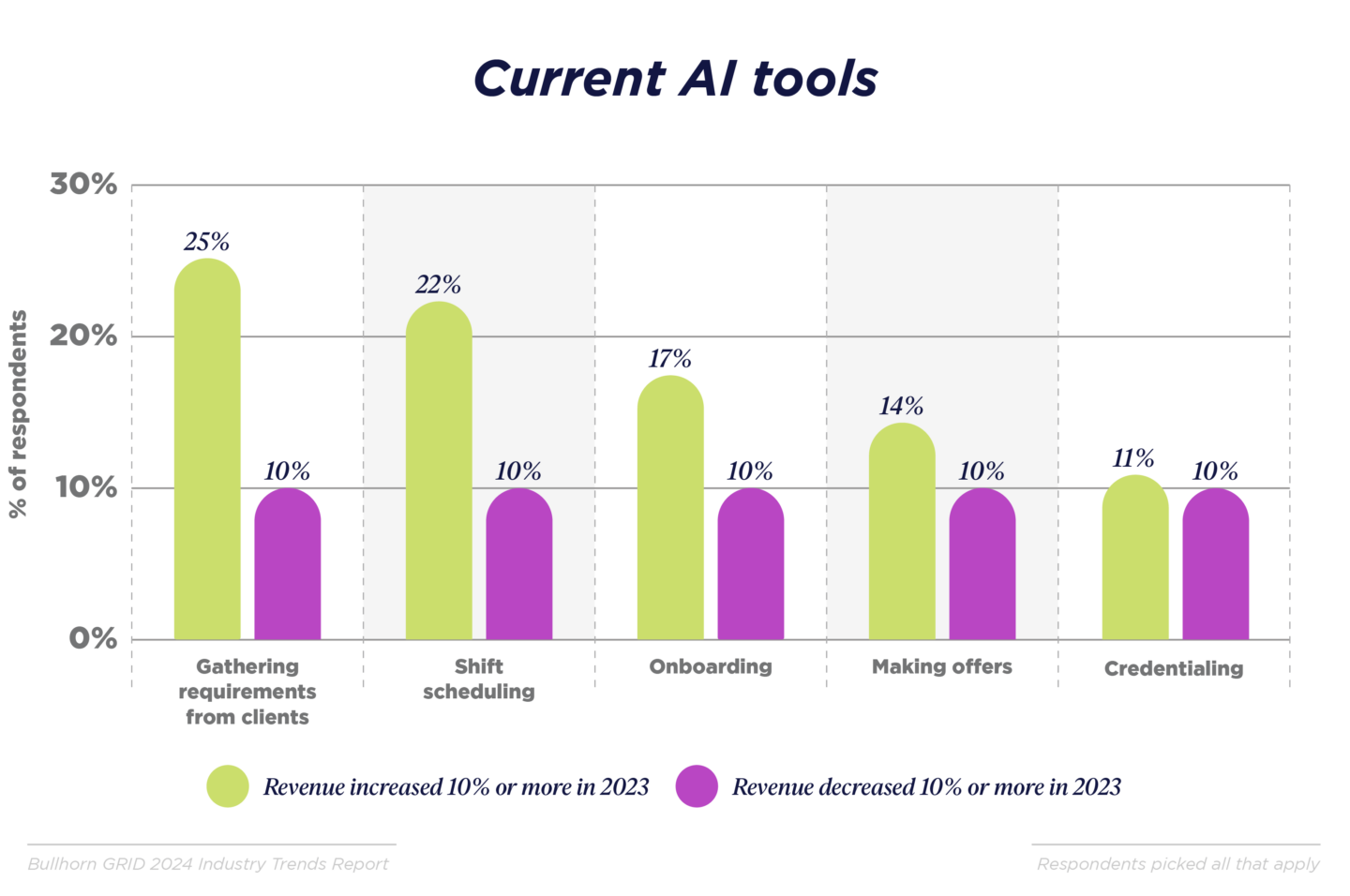
Top performers are early adopters of AI
Although the majority of staffing firms are still just beginning to explore the possibilities of AI, top-performing firms are at or near 20% adoption of key AI tools, even at this early date. They are more than twice as likely to report having AI driven tool in place for shift scheduling and credentialing, and 2.5 times as likely to be using it for gathering client requirements. These time-consuming but rote tasks are perfect candidates for AI, as long as there is human oversight of the process.
AI adoption correlates with revenue growth
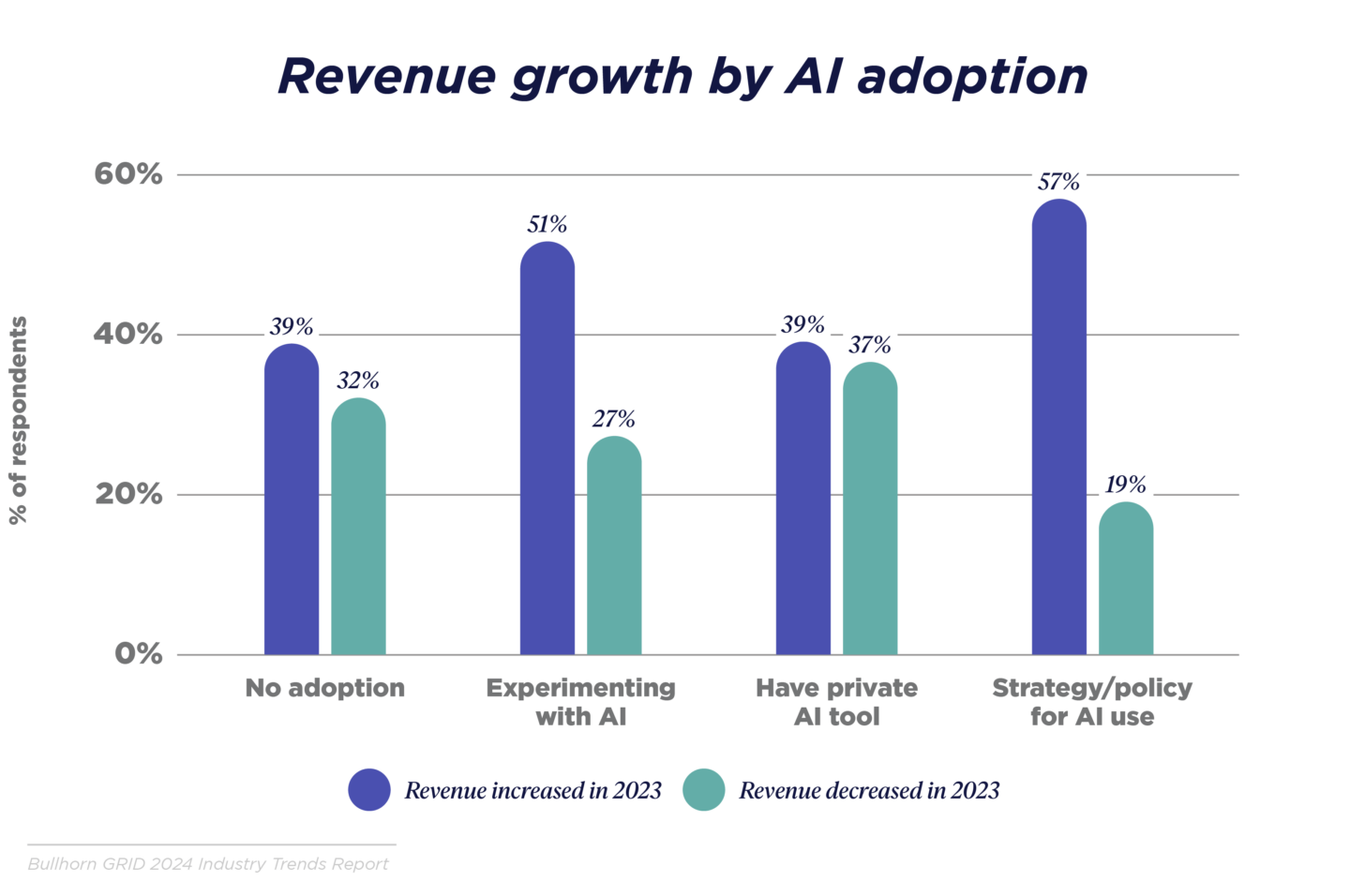
Firms with an AI strategy were the most likely to report revenue growth in 2023 (57%), followed by those who are experimenting with generative AI (51%). Most likely, this is an indication of the firms’ overall willingness to adopt technology rather than direct revenue generation from AI. But, in speaking with staffing firms, most predict that AI will be a regular part of every business by 2025.
What does this mean for firms in 2024?
Winners in this market are investing heavily in automating and applying AI to rote tasks that can easily be handled completely or in part by technology, like onboarding paperwork and gathering job requirements. That way, human beings can step in only when there is an exception or to perform a final review, freeing them up to focus on strengthening client relationships, pursuing new business opportunities, and offering higher-margin services like consulting. Lower-performing firms are missing opportunities to automate repetitive tasks, to leverage AI to improve their talent and client engagement, and aren’t automating new lead engagement to the same degree.
Firms who get out in front on this trend and are early adopters of new technologies will enjoy a significant competitive advantage moving forward and remain winners.

Top-performing firms won new business in spite of the economy
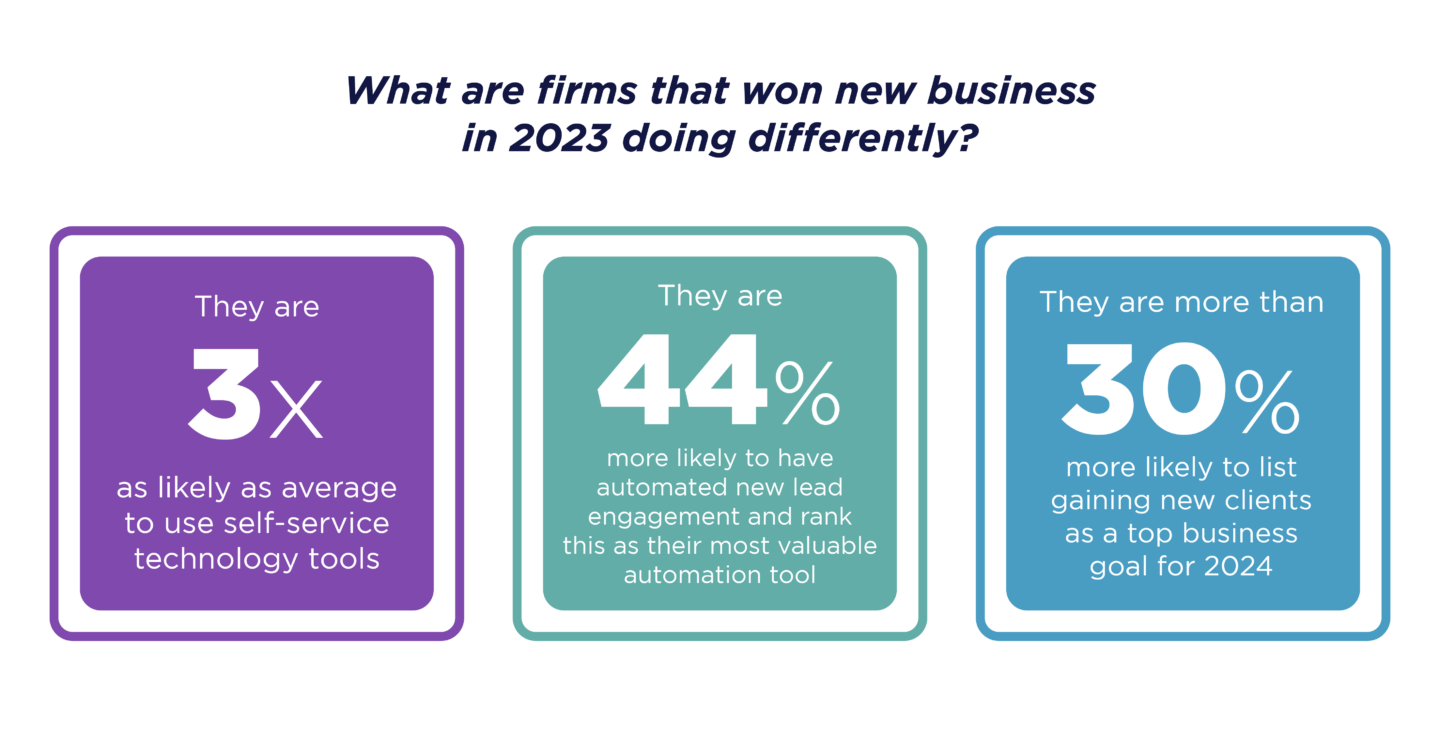
It’s not surprising that firms that saw >10% revenue increases in 2023 were more likely to rate their success at winning new business as excellent. What are they doing differently?
What does this mean for firms in 2024?
With the economy still uncertain, firms will need to closely examine what wins them business — and what is losing it. The data clearly indicate that digital transformation and implementation of sales-support technology drive sales wins. The tough economy in 2023 really separated the wheat from the chaff and the data make it clear that high-performing firms are using technology to give themselves a competitive advantage.
A focus on new and existing clients tops the list, but talent and technology both remain important
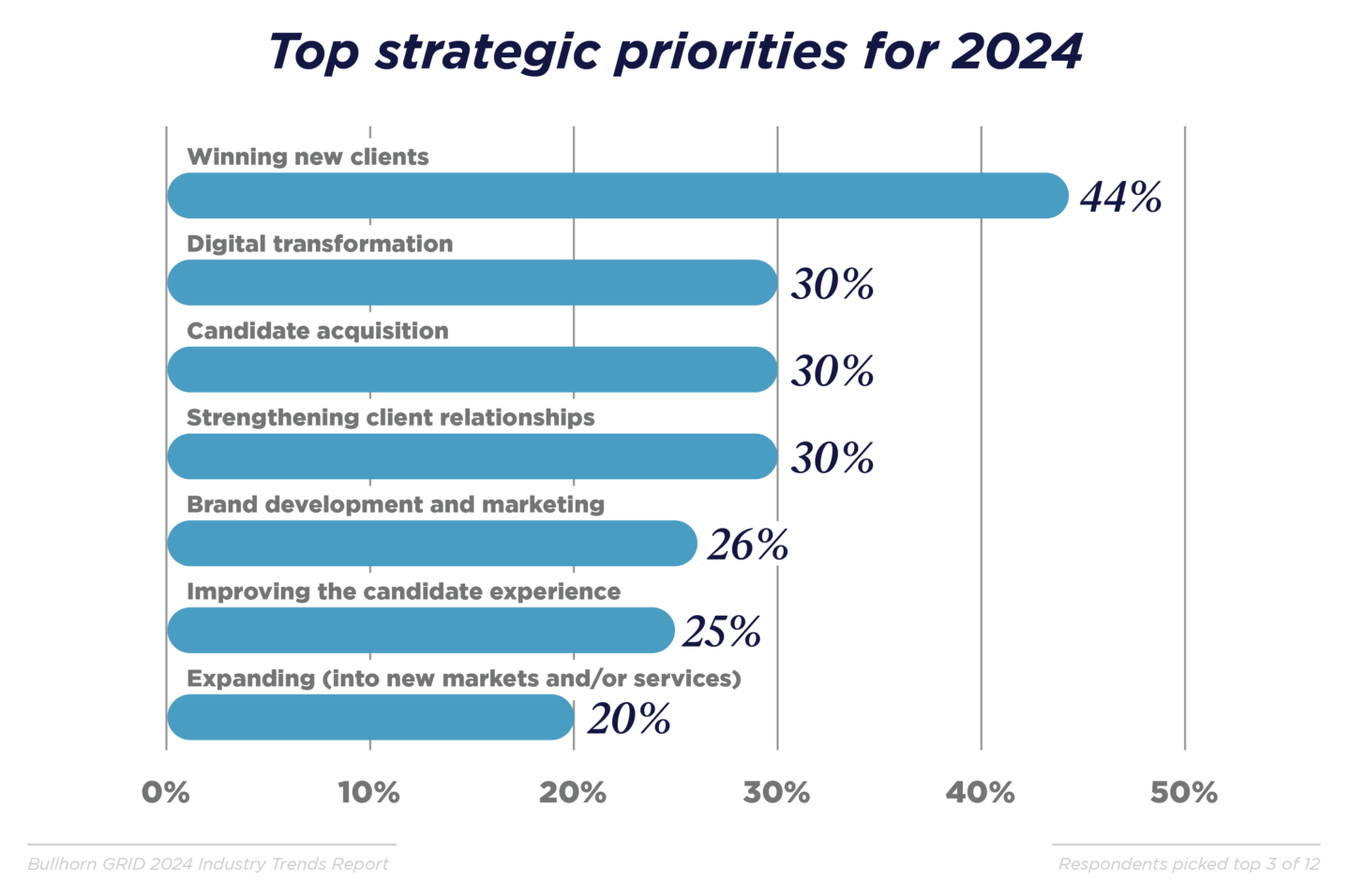
As in 2023, winning new clients is the top priority for staffing firms. Overall, 59% of firms were focused on client relationships, either winning new clients or strengthening existing relationships. Tied for second are digital transformation and candidate acquisition, which go hand in hand as firms seek to use technology to improve candidate experience and engagement. And all firms continue to rely on technology to achieve these key priorities.
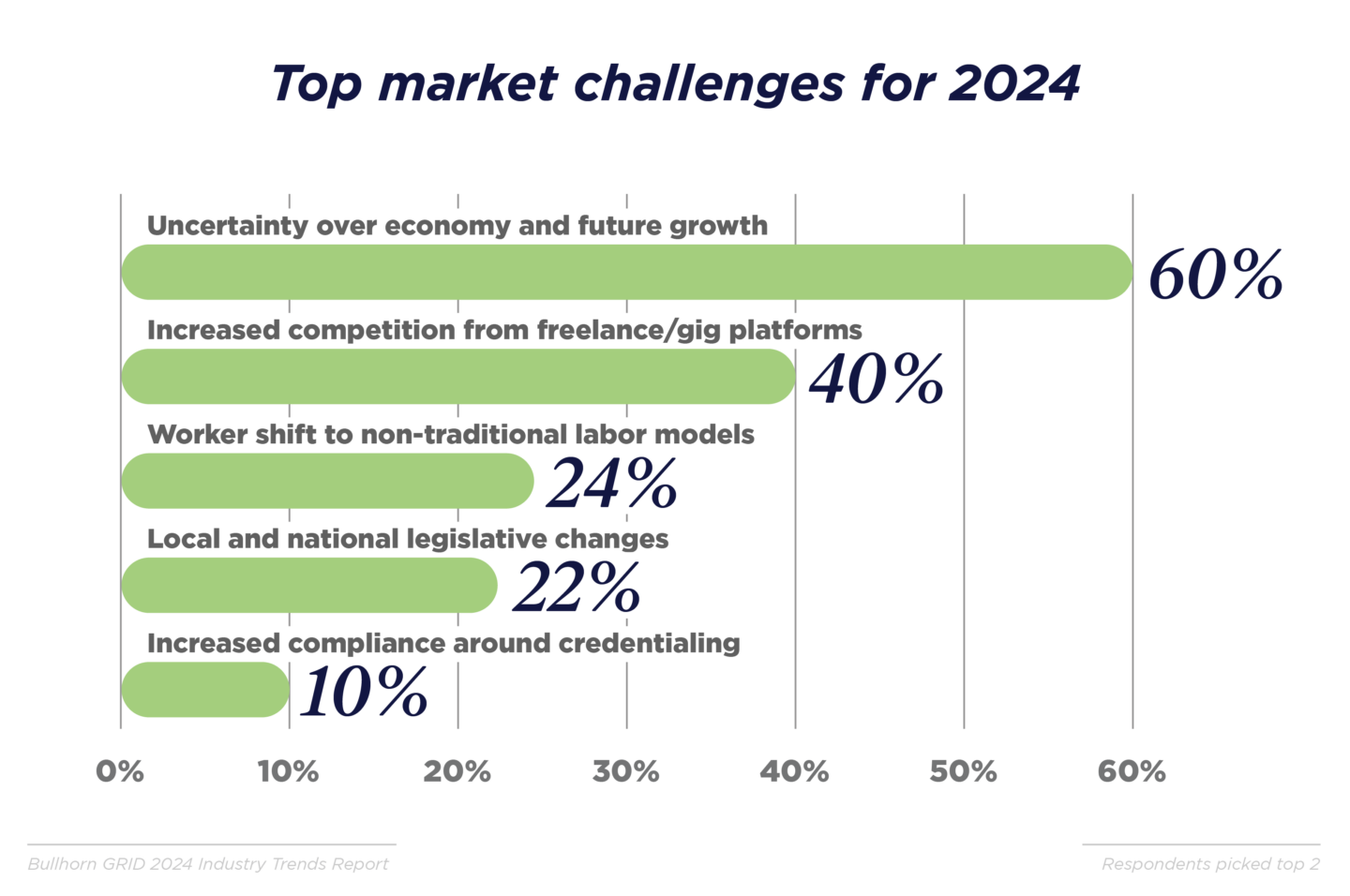
It isn’t surprising that the biggest market concern for all firms is the overall economic forecast. However, there is also a lot of concern over the rise of gig platforms and changing worker preferences — a big change from 2023 when this was a negligible concern. Firms are trying hard to keep ahead of these market changes and continue to demonstrate their value to clients and candidates.
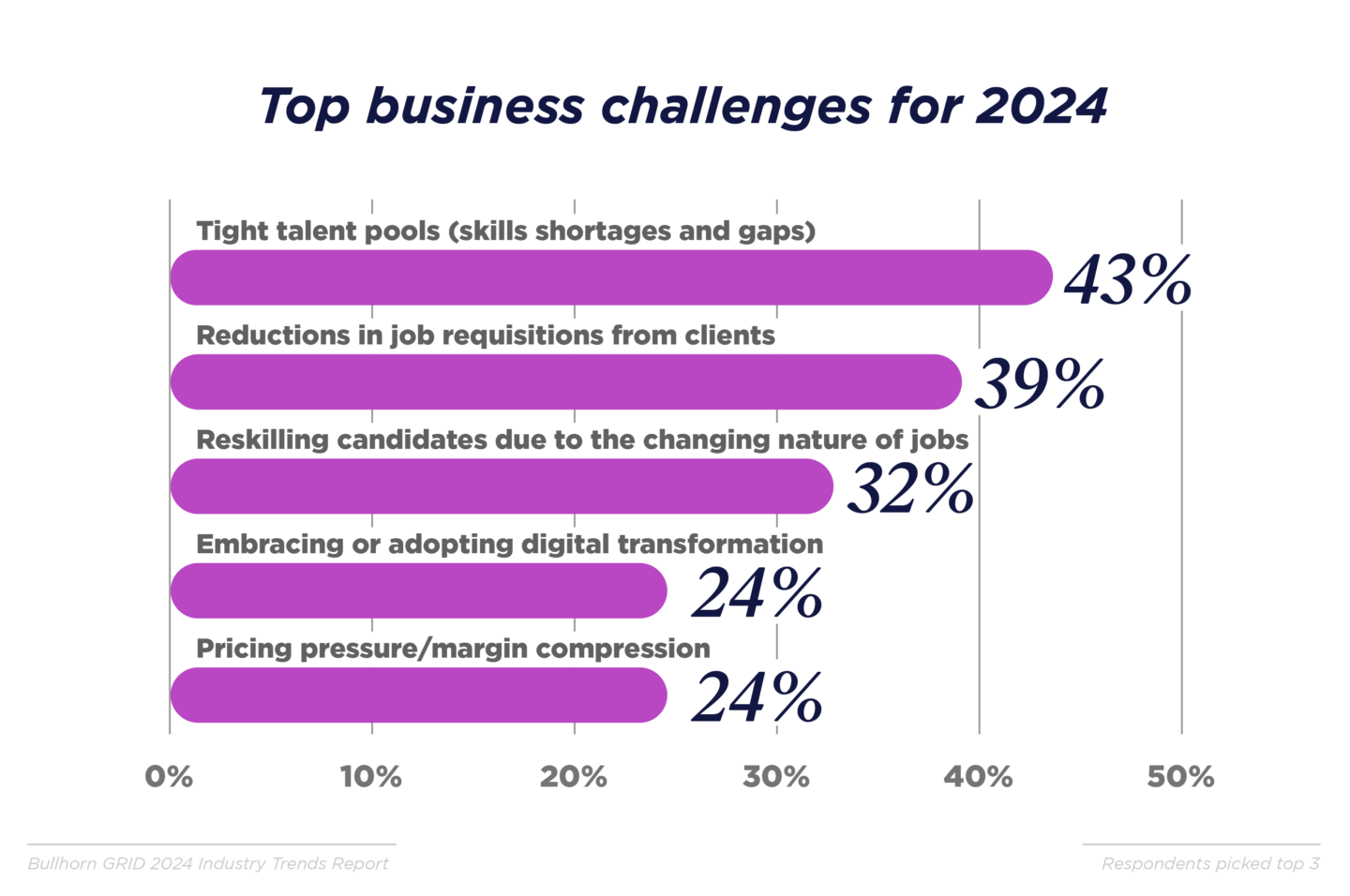
Tight talent pools remain a pain point
In spite of the weaker economy, the talent shortage shows no signs of abating, particularly in high-skill, specialized fields. Concerns about reskilling candidates is likely related to the increase in these kinds of jobs based on evolving technology.
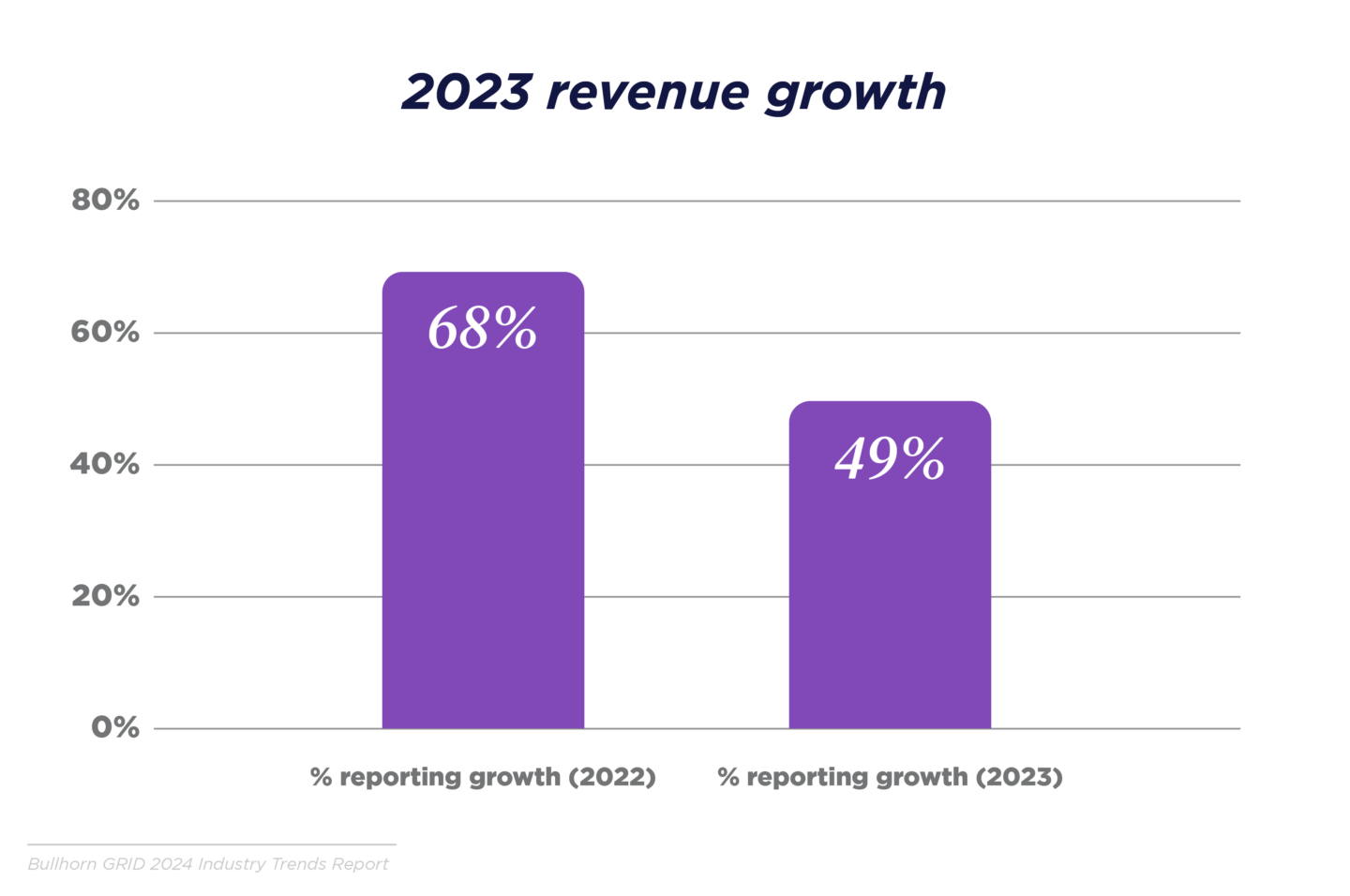
Revenue growth declined for first time in three years
2023 was a difficult year economically for most industries, including staffing, particularly MSPs. About half of firms saw some growth, mostly under 10% — but over one-quarter saw a decline. The slowing economy led to a reduction in job requisitions and slower conversion cycles, but without any improvement in the tight labor market.
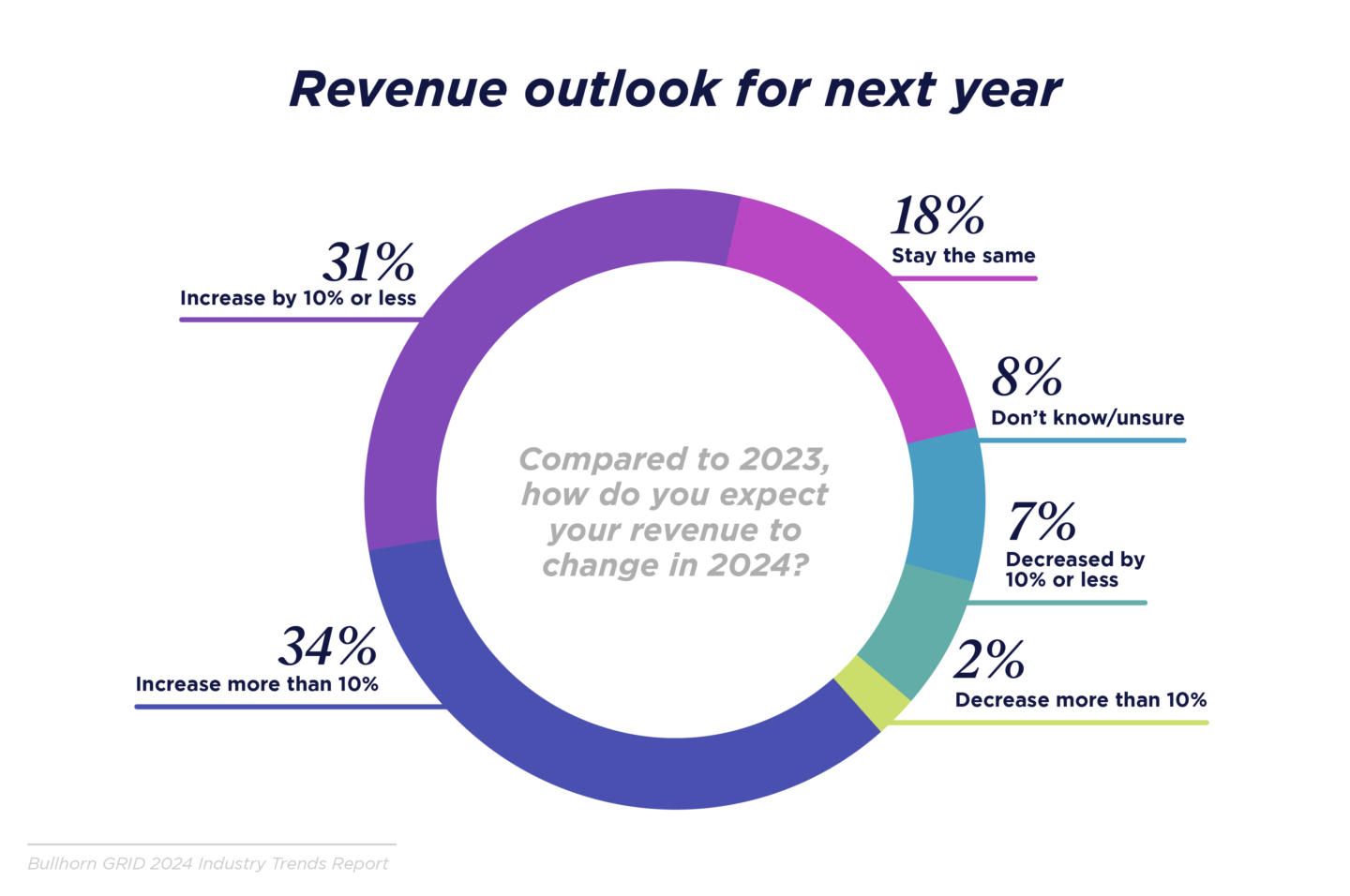
Economic recovery anticipated
Most firms are bullish on 2024, with nearly two-thirds predicting a revenue increase, aligning with hopes that the global economy has a soft landing and actually improves in the latter half of 2024. The positive revenue outlook was consistent across most industries and agency types. However, over 70% of IT and engineering firms expect revenue growth in 2024, whereas only 57% of light industrial firms say the same. DACH and the UK and Ireland are particularly optimistic in predicting an economic recovery that benefits the staffing industry.