GRID 2026 Industry Trends Report
Introduction
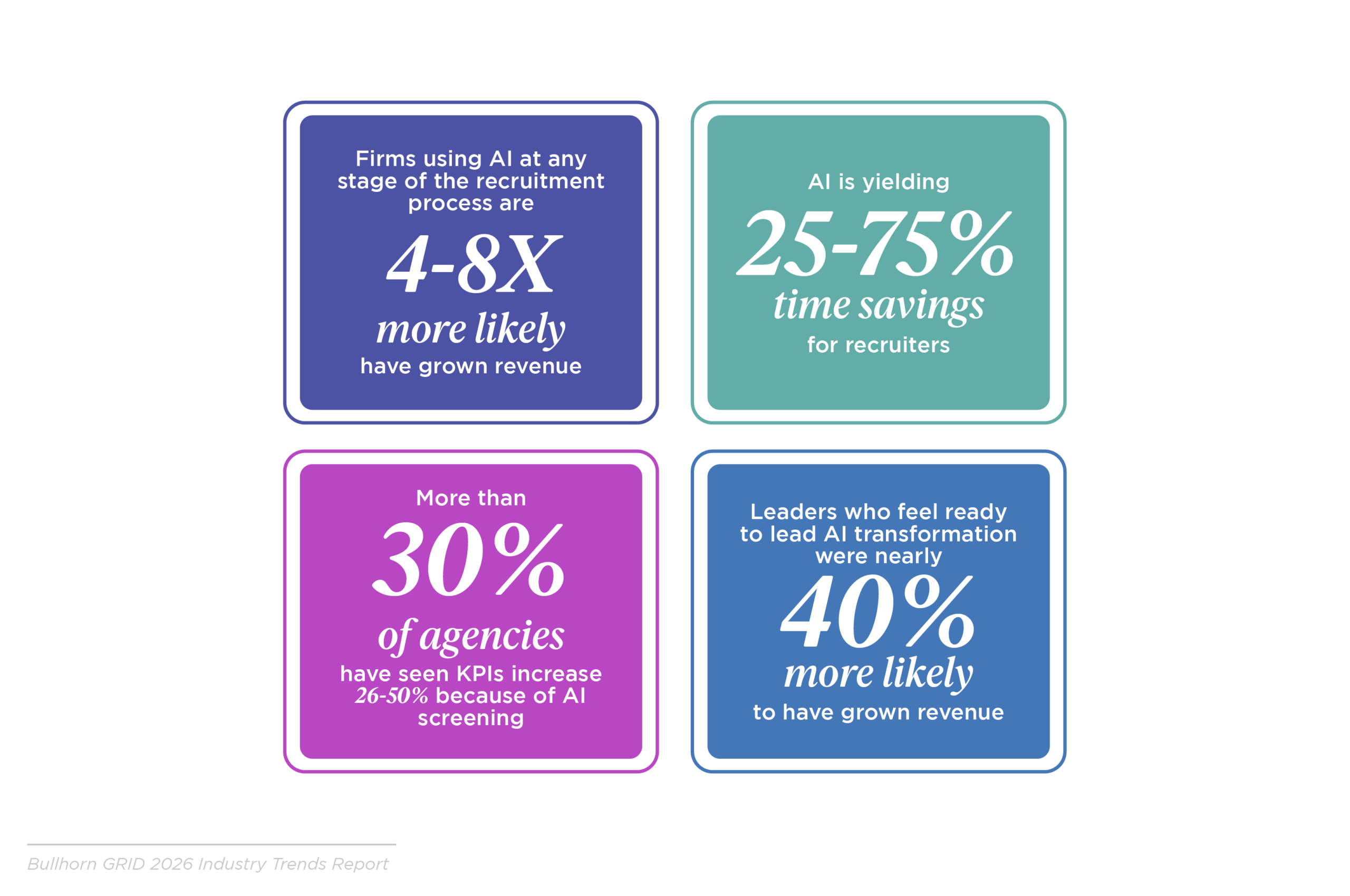
Macroeconomic conditions were unpredictable and labour markets remained sluggish in 2025, but many agencies were able to find success in this challenging market. One way was with AI, which revolutionised the recruitment industry in 2025. Agencies using AI at any stage of the recruitment process were four to eight times more likely to have grown revenue than lost revenue last year. And 56% have seen KPIs increase more than 25% because of AI screening alone.
For our 16th annual GRID Industry Trends Report, Bullhorn surveyed nearly 300 recruitment industry professionals in the UK&I region to understand the most effective strategies in the field today. We also interviewed a half-dozen industry executives to hear their take on the trends revealed in the survey. Read on to find out how these insights can inform your strategic decisions in 2026.
 Click on any chart to enlarge

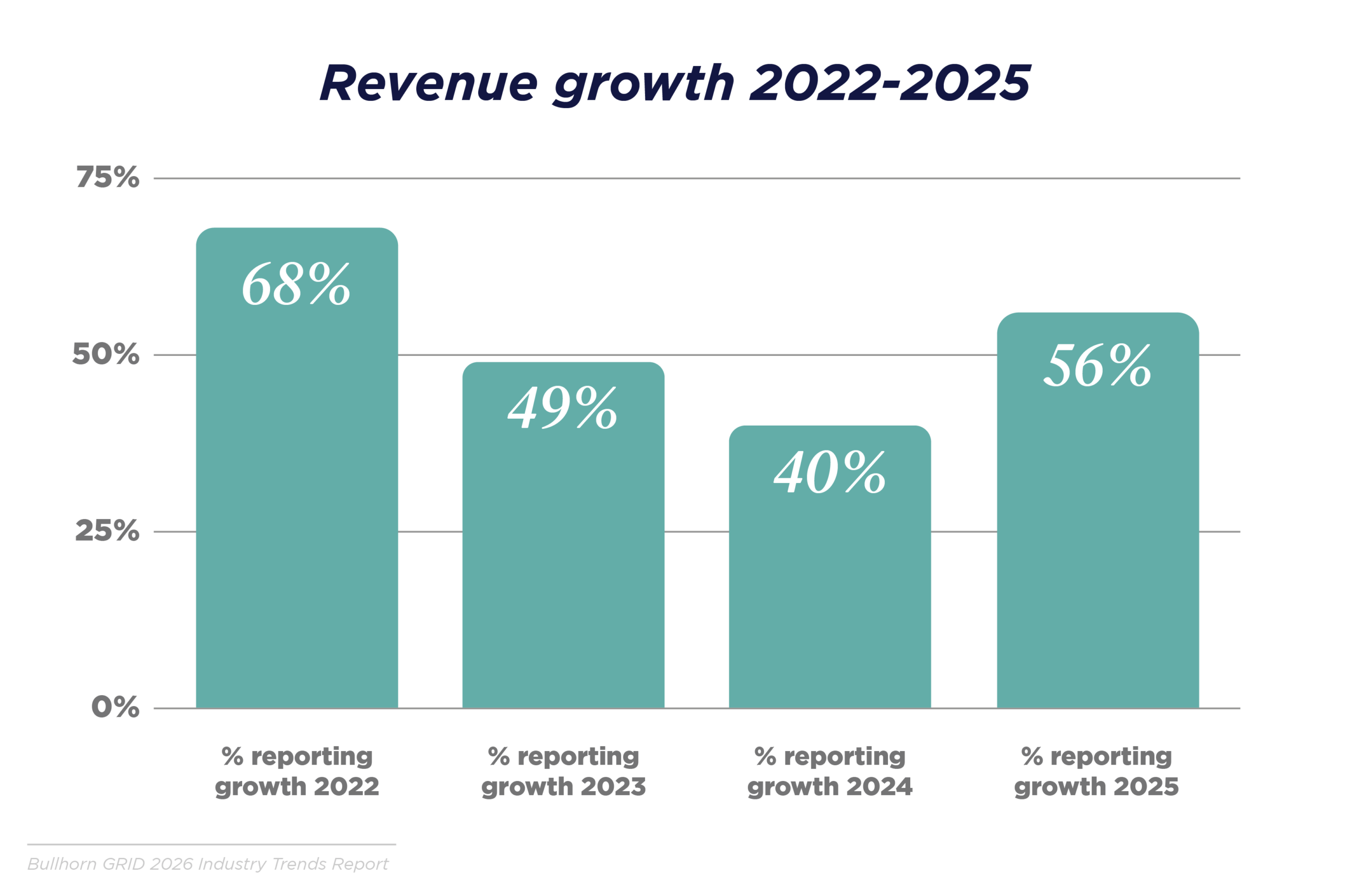
More agencies reported revenue growth than in either of the last two years
In 2025, financial performance was surprisingly positive across the recruitment industry. 56% reported revenue growth globally, compared to 40% last year. This is higher than either of the last two years. And 14% of UKI agencies actually saw revenue increase by more than 25% year over year.
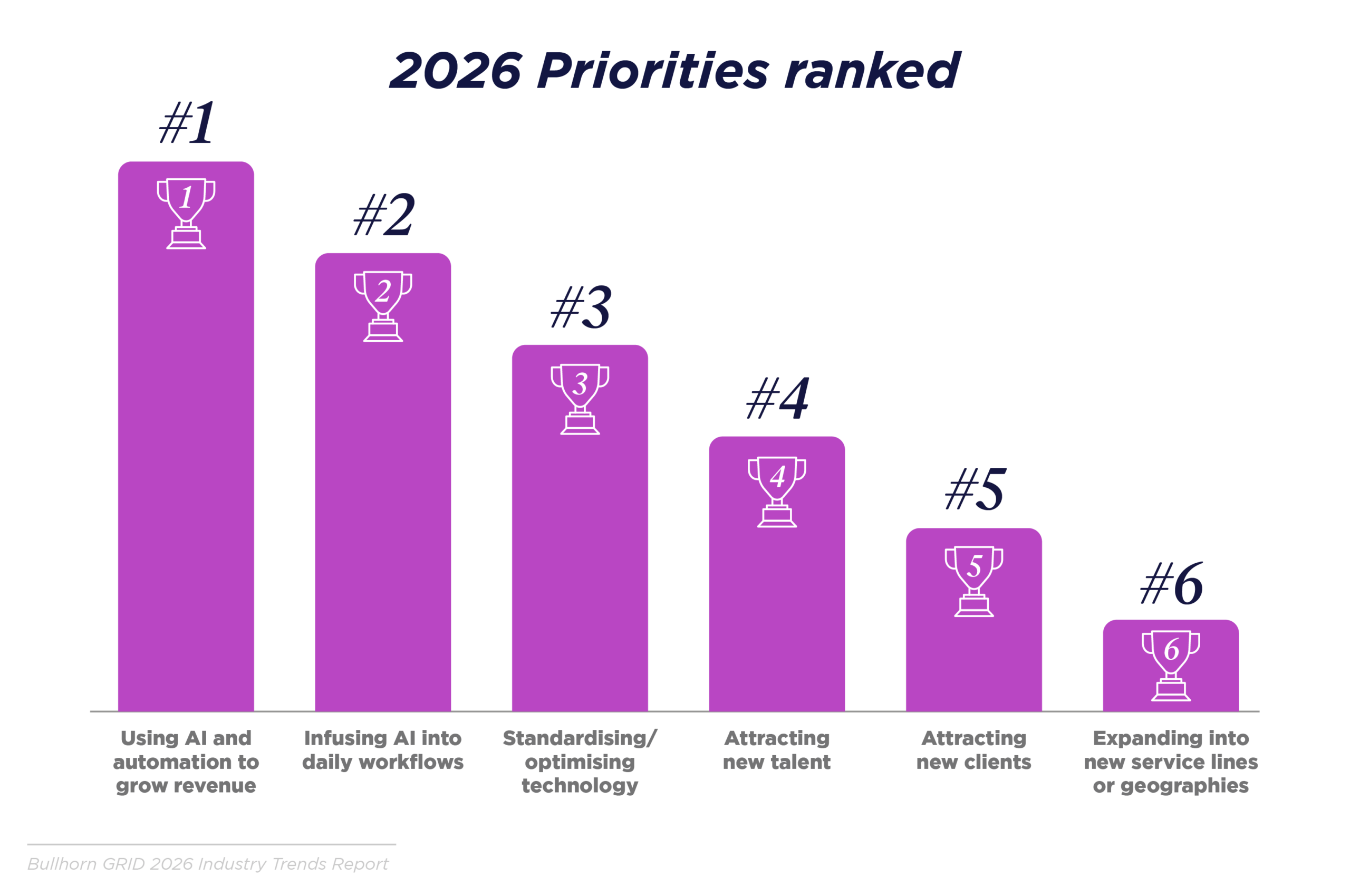
AI is the top priority for 2026
For a third year, agencies identify the paradox of tight talent pools and falling job volumes as their top challenges for 2026, which aligns with them saying that hiring freezes and budget constraints are the biggest obstacles to winning new business. Against that backdrop, it is no surprise that the top priorities for recruitment leaders all relate to using AI to improve financial and operational performance.
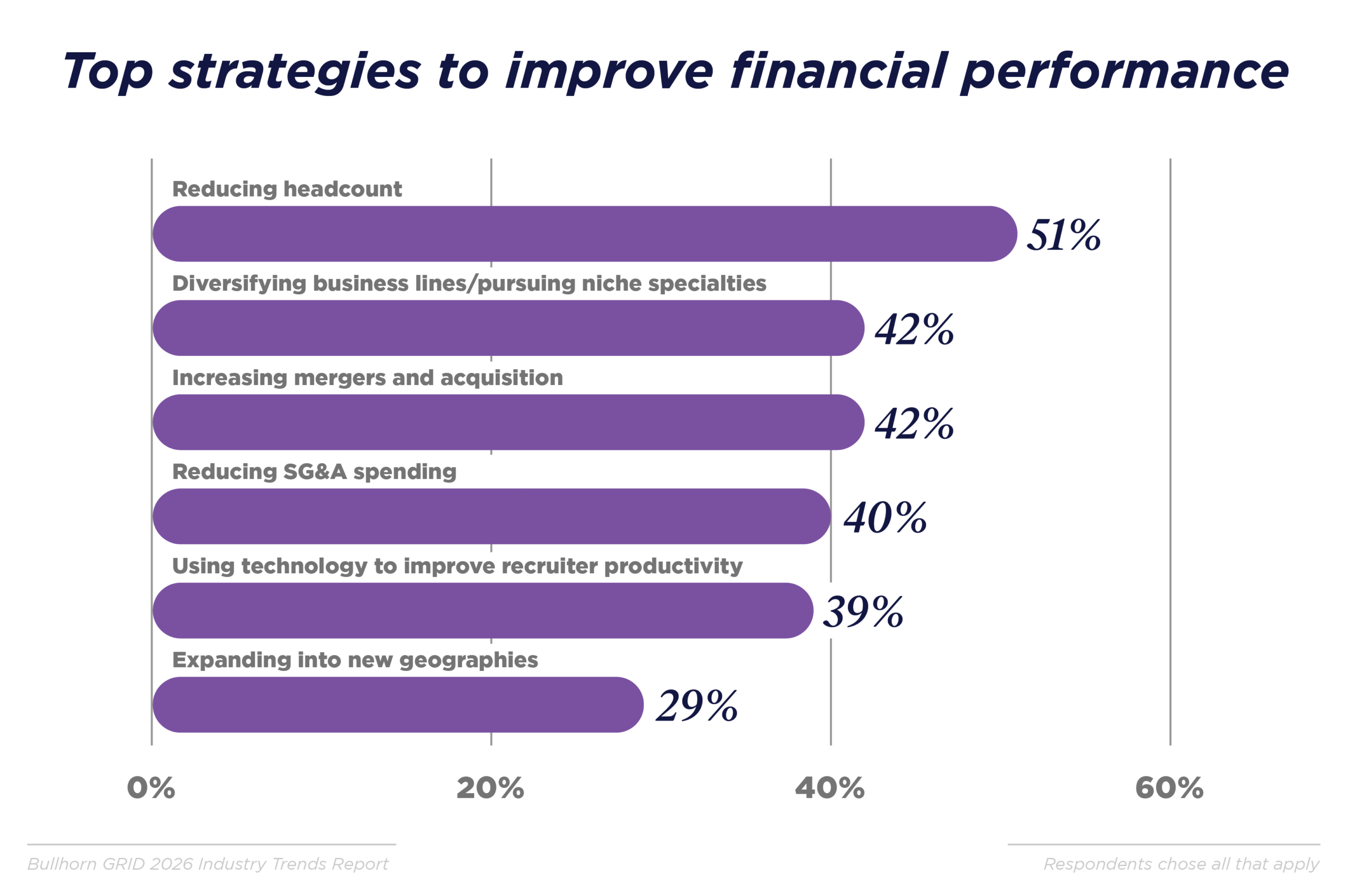
Leaders expect more in 2026
Leaders’ top strategy to preserve financial performance in 2026 is to reduce SG&A costs, followed by diversifying into niche specialties. And the leaders we spoke with shared that really focusing on where they can compete and what new services they can provide is part of how they are doing more with less, which significantly raises the bar for productivity and strategic focus.
AI use is strongly tied to revenue growth
Agencies that increased revenue in 2025 had much higher AI adoption rates than those that lost money. And the industry as a whole has come a long way in terms of AI. With almost everyone now using AI to some degree, competition between agencies is increasing; competition from other agencies is now the second biggest obstacle to winning new business and a growing concern in this year’s data. The most successful agencies are implementing AI throughout the workflow and leveraging it in ways that make them faster than the competition and retain their unique differentiation.
AI won’t take your job, it will help you get better at it, but what will take your job is another recruiter at a competitor that’s using AI and automation really well…


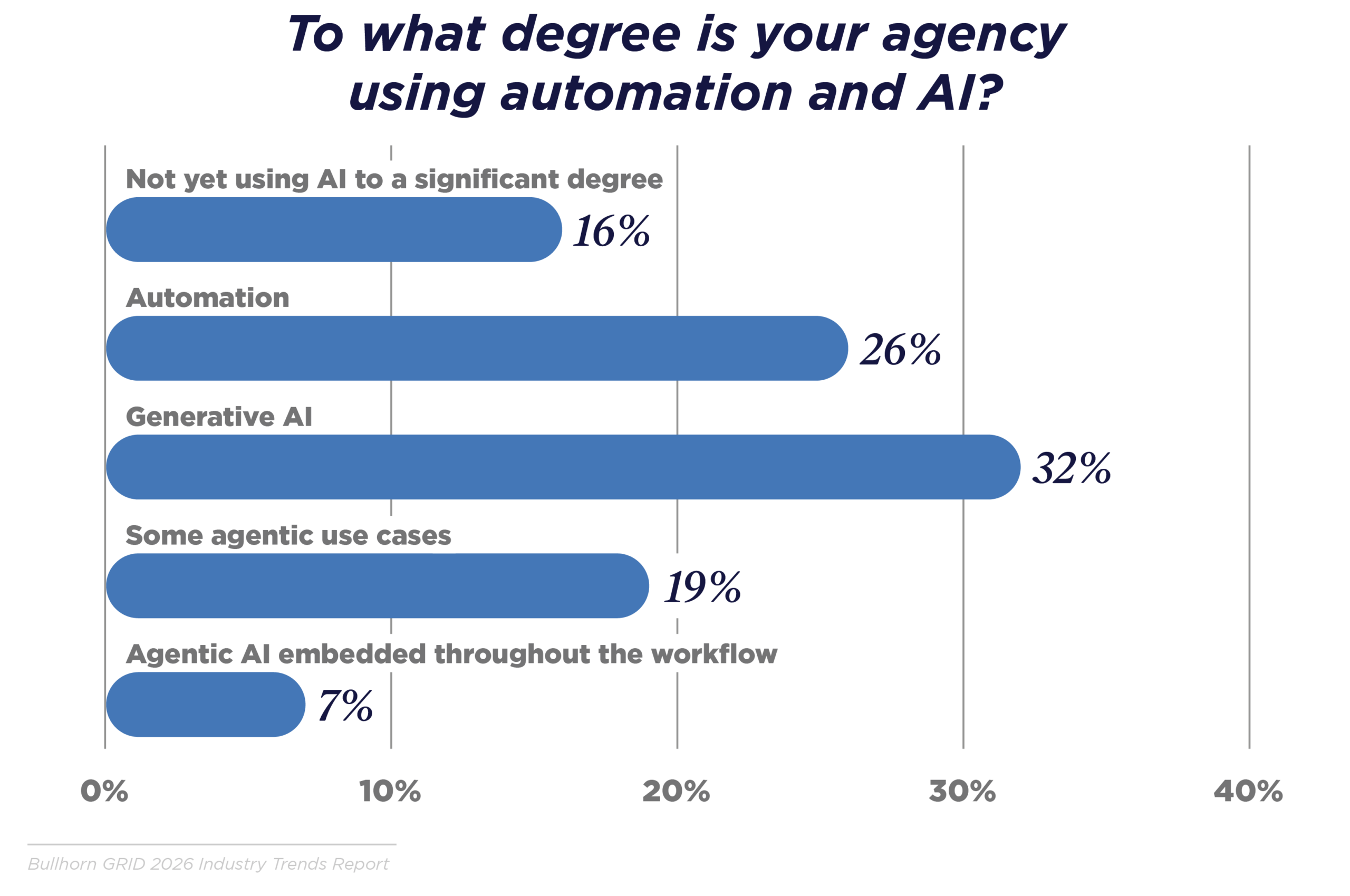
AI adoption has increased significantly
Last year the plurality of agencies (64%) were only experimenting with basic generative AI tools. This year, only 32% are still in the generative AI category and 26% have moved to some level of agentic AI tools.
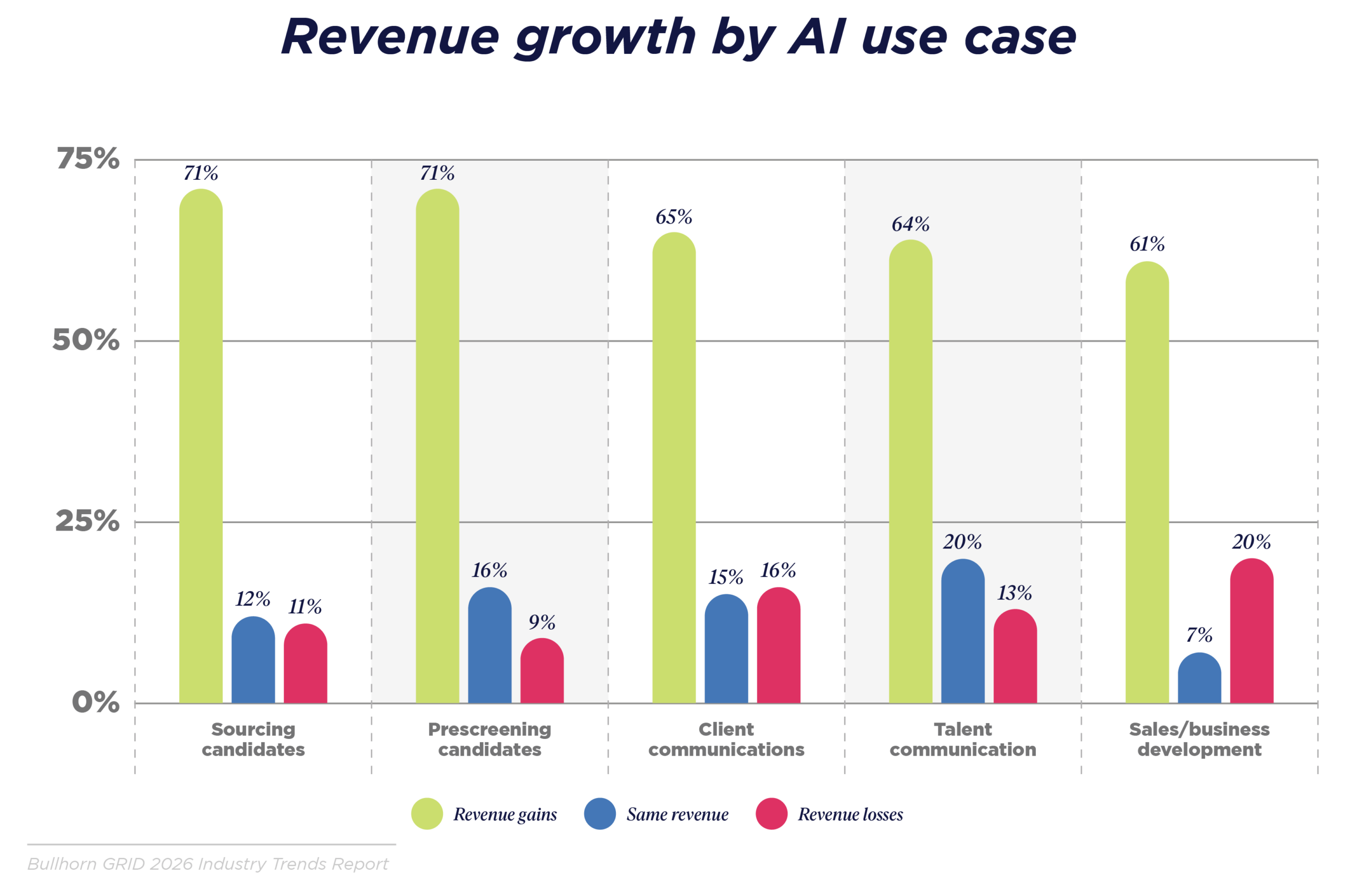
Top-performing agencies are more likely to be using AI
Agencies with the best revenue performance in 2025 were the most likely to be using automation and AI. And agencies that saw revenue decline by more than 10% were the most likely to say they aren’t yet using AI. Agencies using AI at any stage of the recruitment process are 4-8 times more likely to have grown revenue. Last year, agencies using AI at any stage were only 25-40% more likely to have increased revenue, so the performance gap is growing between agencies that are taking full advantage of AI solutions and those that are not.
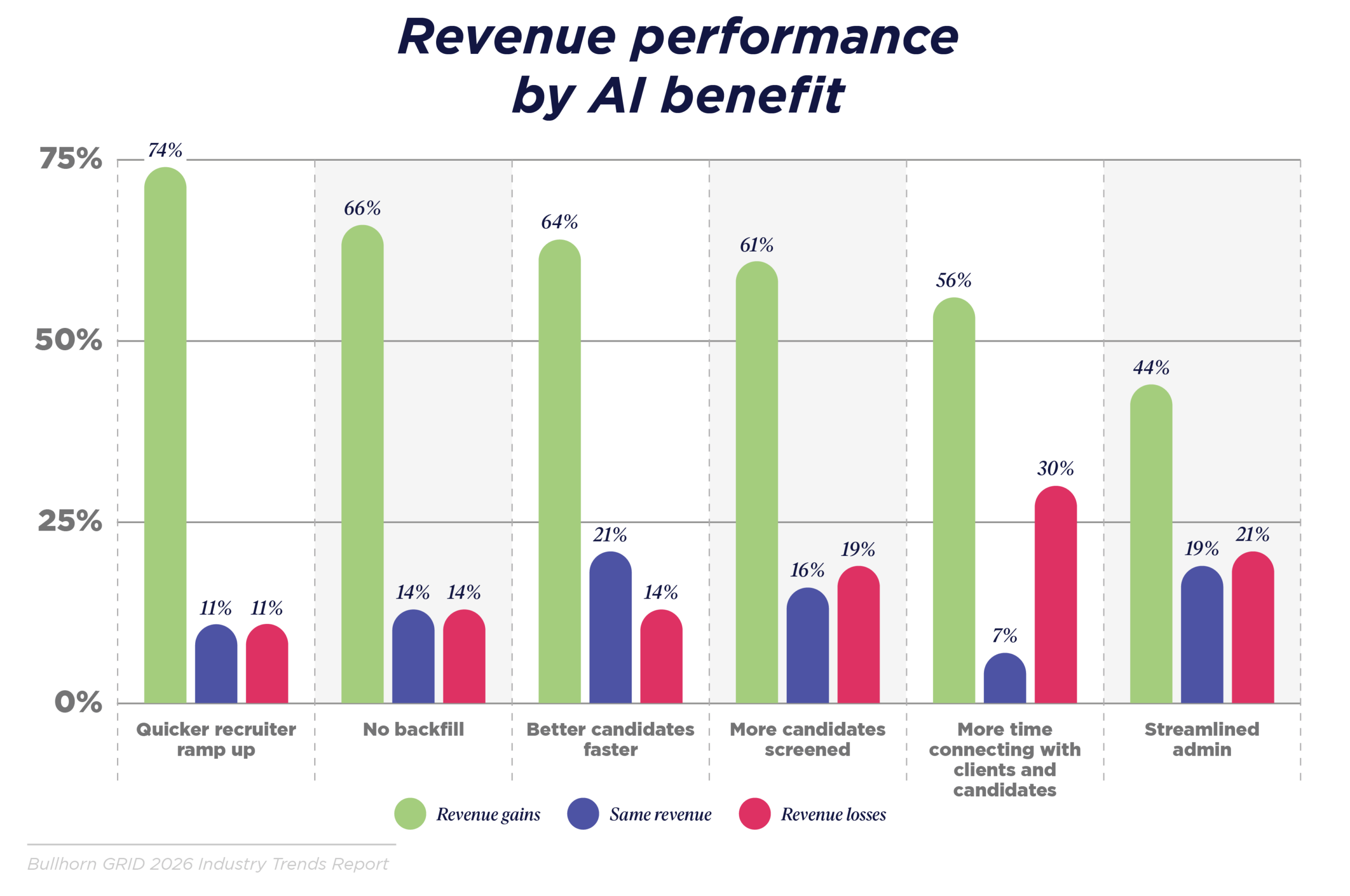
Agencies leveraging AI in meaningful ways are up to 6 times as likely to grow revenue
It is not enough to simply have adopted AI; it matters that agencies are using it in meaningful ways that yield tangible benefits. Agencies that are seeing the impact of AI on candidate screening and quicker recruiter ramp-up are reaping the financial benefits, making them significantly more likely to have increased revenue in 2025.
And AI is yielding significant operational benefits when deployed strategically
Recruitment leaders rank the reduction in SG&A and the ability to scale without adding headcount as the top ways that AI is adding value to their organisations. This aligns with what was shared in our conversations with recruitment leaders: to truly see the benefits of AI, agencies need to really focus on ROI and closely tracking the impact on KPIs. Basic generative AI and fragmented point solutions are not going to get the job done.
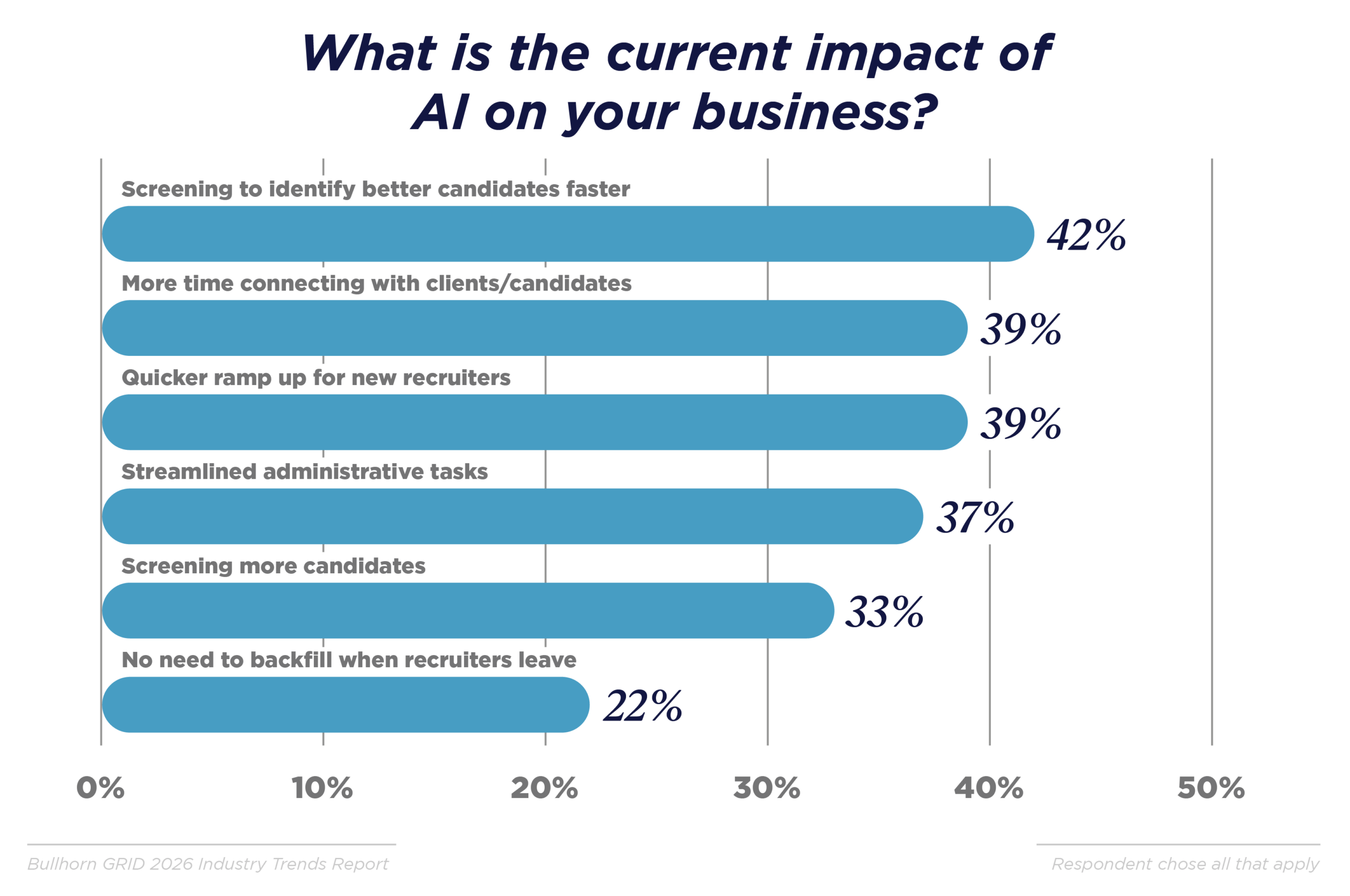
Identifying better candidates faster is the number 1 benefit of AI
42% of leaders and 31% of recruiters say AI is already helping them identify better candidates faster, and this is the biggest benefit they are seeing from AI to date. The second biggest impact is more time to connect with clients and candidates. This came up time and again in our conversations: that the true benefit of AI is in freeing up recruiters to do the relational work that truly differentiates agencies. In fact, recruiters ranked this as the most important way that AI has improved their productivity.
I'm trying to make supercharged consultants, not replace them, so I'm consciously trying to build in time to have very human-level conversations.


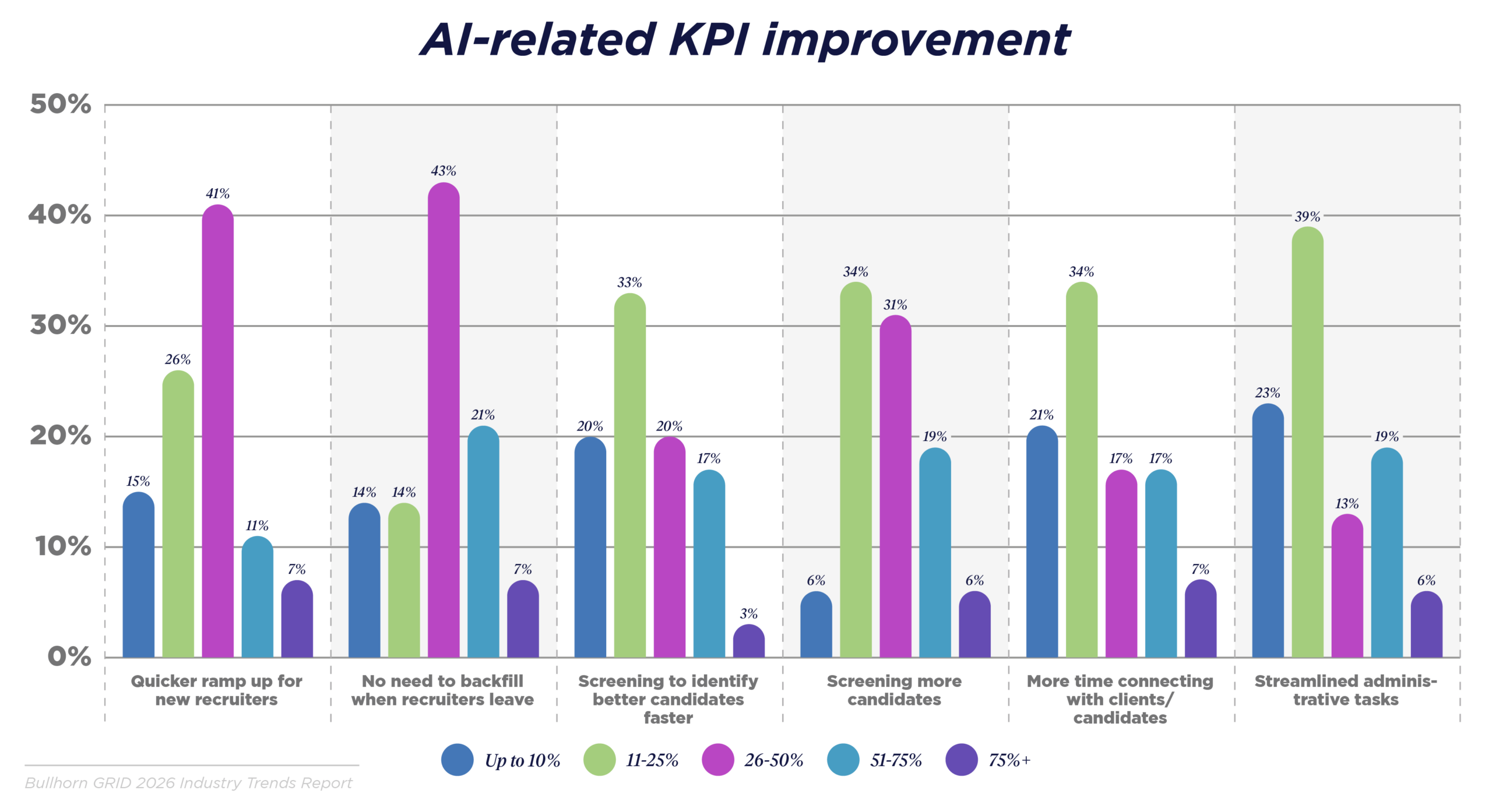
Most KPI’s are up 11-50% as a result of AI
Leaders overwhelmingly say that the financial impact of AI tools has been positive. But they are also closely tracking the effect on key operational metrics. The majority have seen KPIs improve by 11-25%, and many are seeing a 50% improvement. This aligns with the finding that agencies using AI also have better placement times across the board. These improvements are setting a new benchmark for performance and efficiency, with leaders expecting far more from their teams.
60% of people we are placing are from active candidates, which in some way we will have used AI to find or engage.
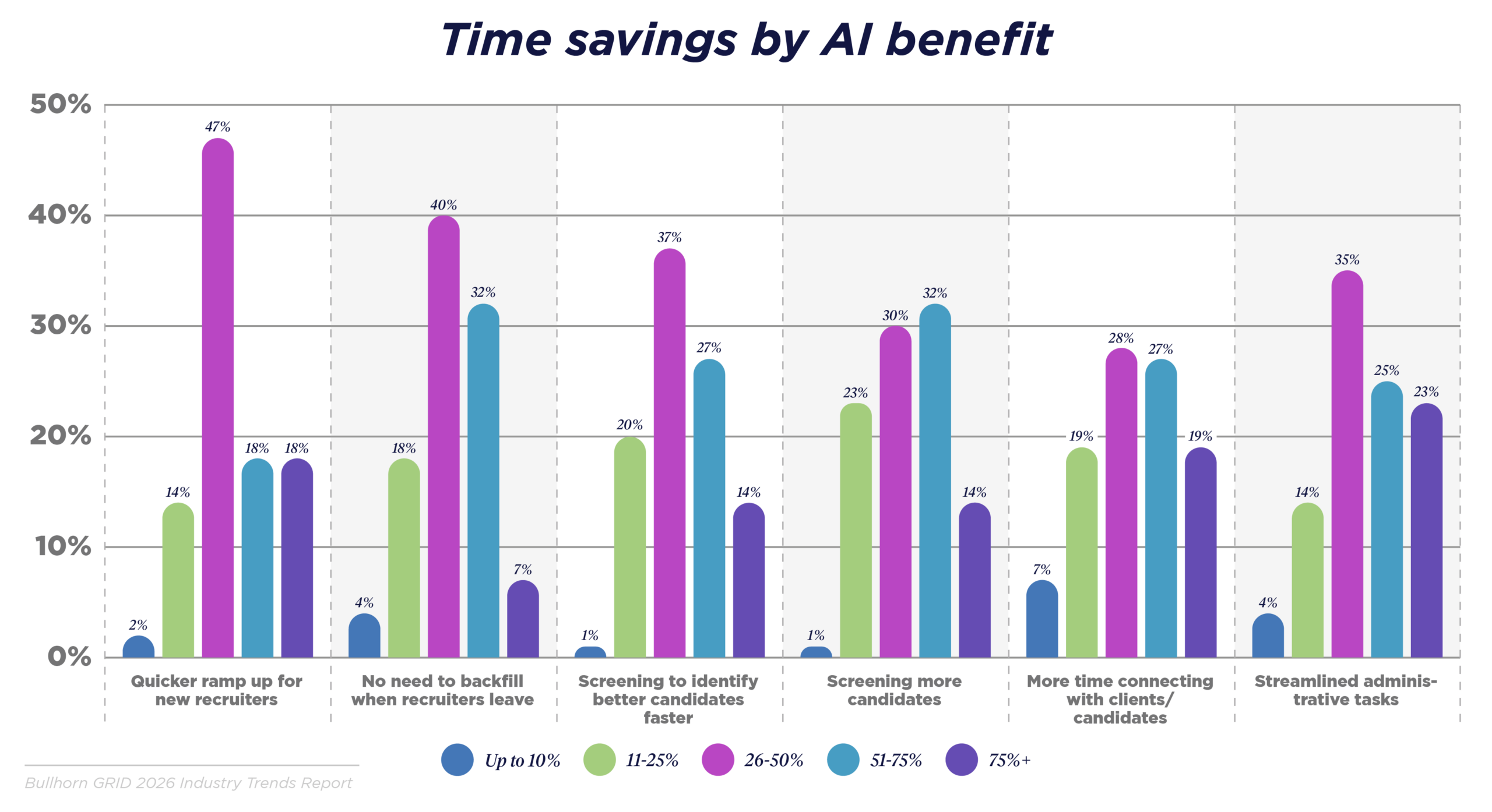
AI is rewriting the rules for searching and screening
Recruiters report that searching for candidates takes up the most time in their day, followed by screening applicants. But AI is already having a huge impact on these time-consuming tasks. Most recruiters say AI is reducing the time they spend on searching for and screening candidates by 26-75%, freeing them up to work more jobs and do more relational work.
Each week, they're effectively getting a whole day's worth of work back.
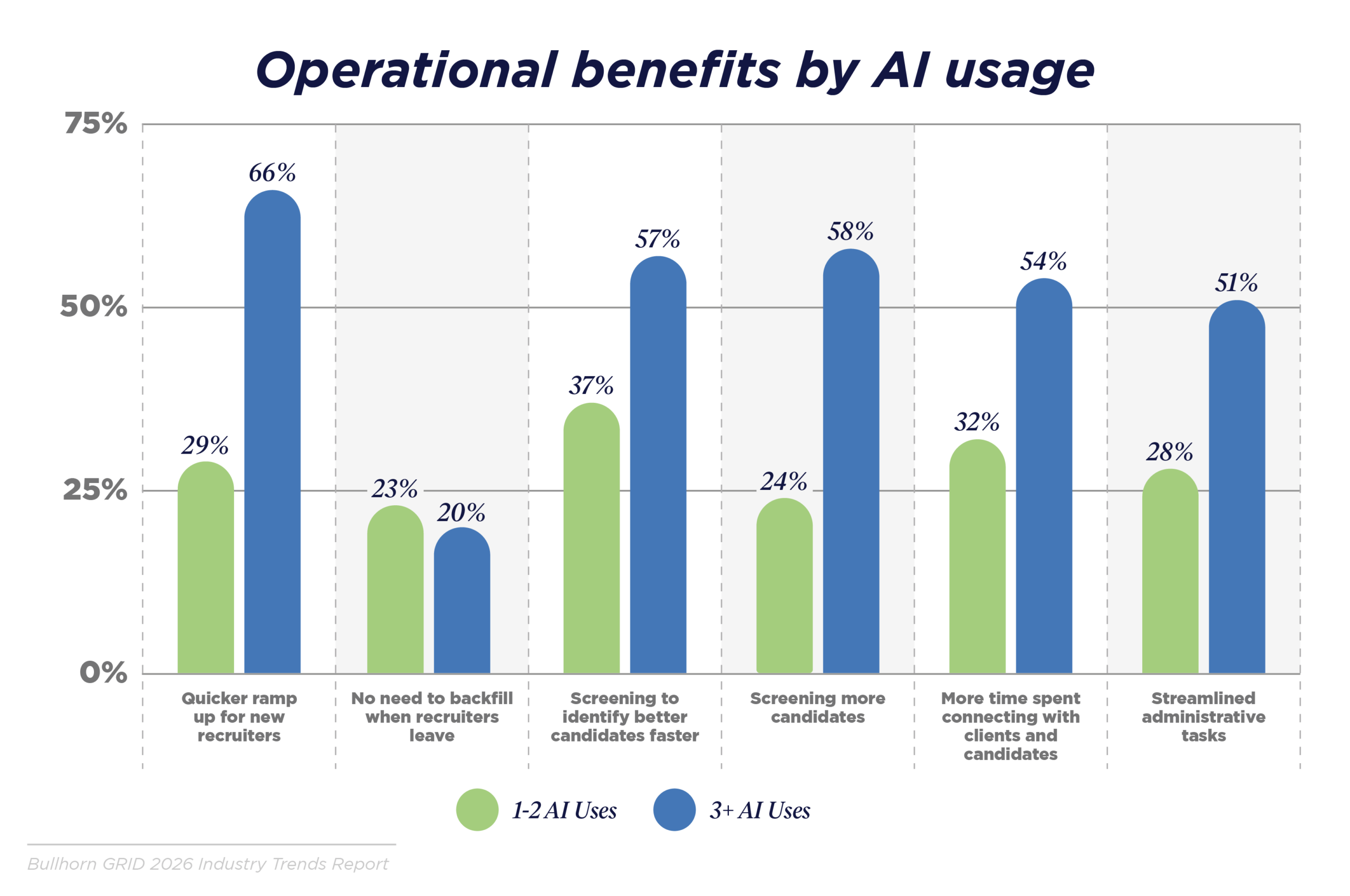
The benefits of AI increase when deployed across the platform
The impact of AI is amplified when it is deployed across the whole lifecycle, and the recruitment leaders we spoke with said, particularly when it is embedded across the platform. Agencies that are using AI for multiple use cases are seeing heightened operational improvements, sometimes more than doubling the impact. And this translates into financial performance as well. 70% of agencies that grew revenue are using AI tools embedded in their ATS.
What we're trying to do is redesign everything to be AI-native, instead of just trying to bolt AI on, I don’t think that’s the effective way.


There is still a long way to go on adoption of automation and AI
In spite of the clear financial and operational benefits, many agencies still have not fully embraced automation and AI across their platforms. Only 7% of agencies report having AI embedded throughout their workflow. 2026 will likely be the year that sees AI in recruiting move from early adoption to full integration.
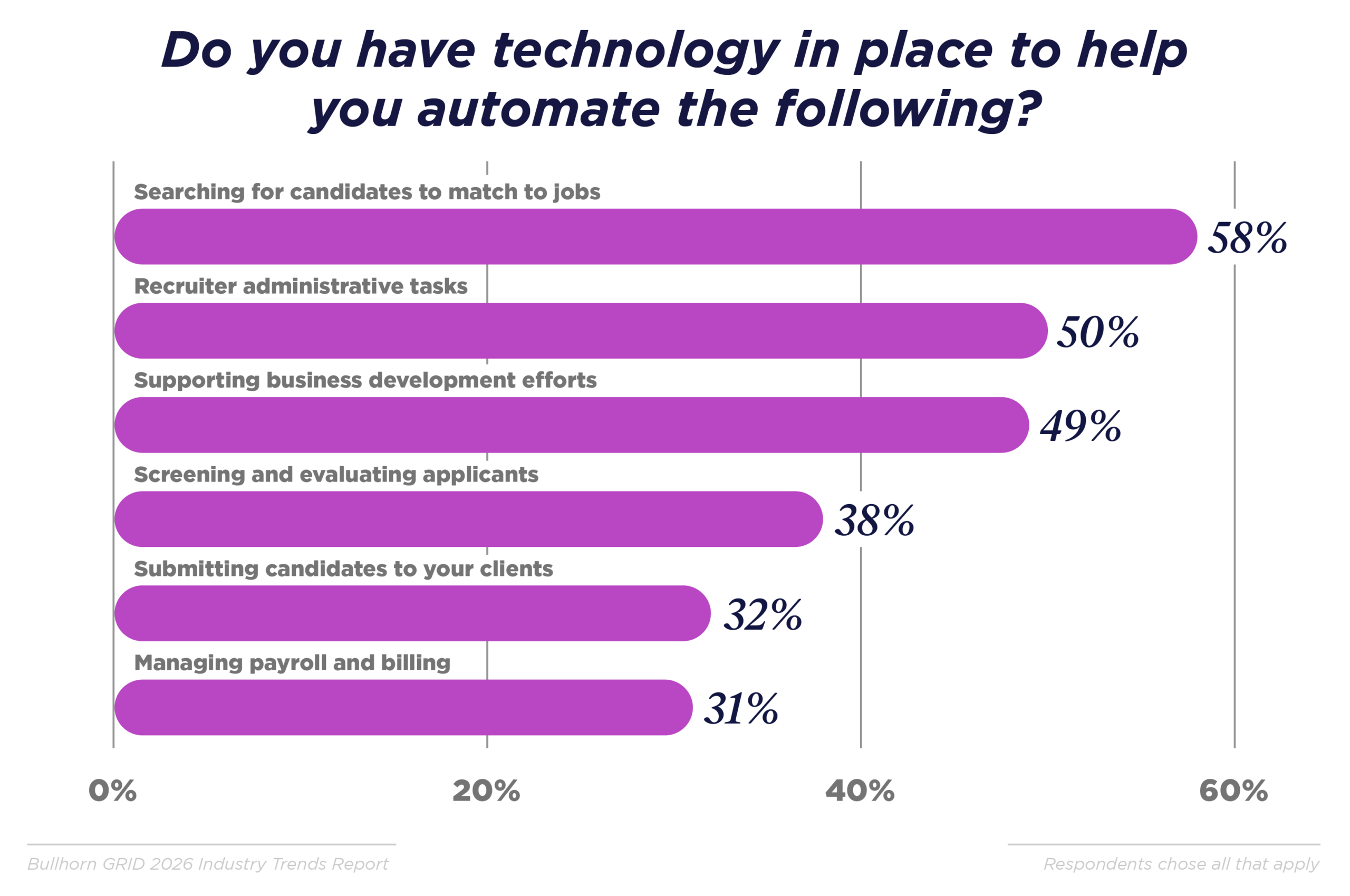
Barely half of agencies say they have fully automated candidate search
60% of agencies report that they have automation in place for search, and that percentage is even lower for middle office functions like payroll and billing. This landscape is likely to change drastically in the next year, especially since recruiters say overwhelmingly that search is the function they most want to automate, likely because it is where they spend most of their time.
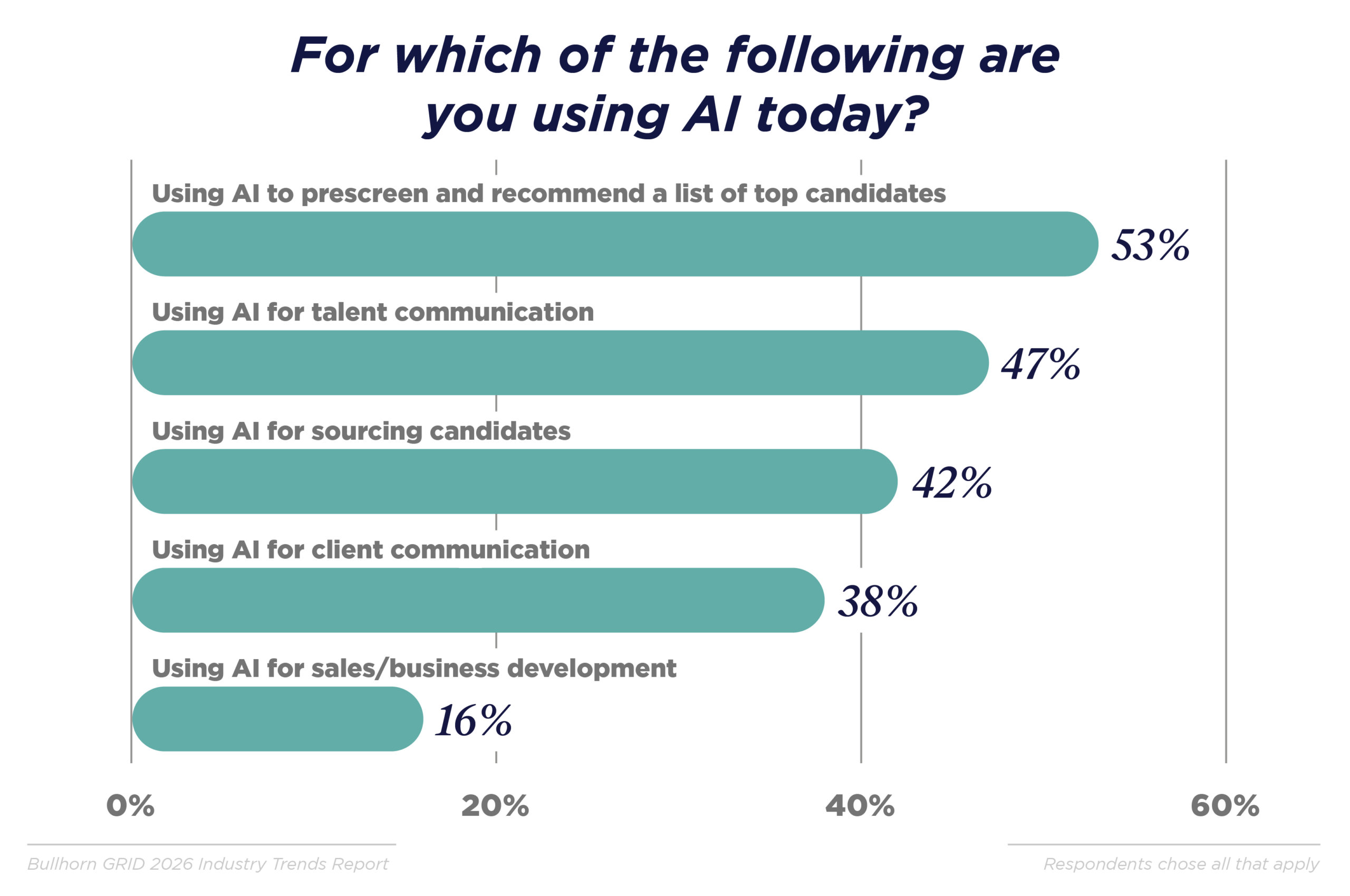
Most agencies are not yet fully leveraging AI
Half or fewer agencies are using AI for any individual recruitment function. And only 7% of agencies reported having agentic AI embedded throughout the workflow. That leaves a lot of room for growth and even greater revenue and KPI impact in coming years.
Successful AI adoption requires data quality, the right leadership, and a clear implementation strategy
Most leaders (73%) feel ready to lead their agencies through AI transformation, but when we dig deeper into the remaining obstacles that stand in the way of full adoption, there are some common themes. Data quality and security are challenges that many agencies have not quite been able to overcome. And 28% say they lack a clear implementation plan. These concerns are consistent for both leaders and recruiters alike. Leaders also report that they are working hard to help recruiters see and feel the benefits of AI in their work. One agency shared that they have created an intentionally diverse group of “AI ambassadors” to make sure the AI wins are relatable across all areas of the organisation.
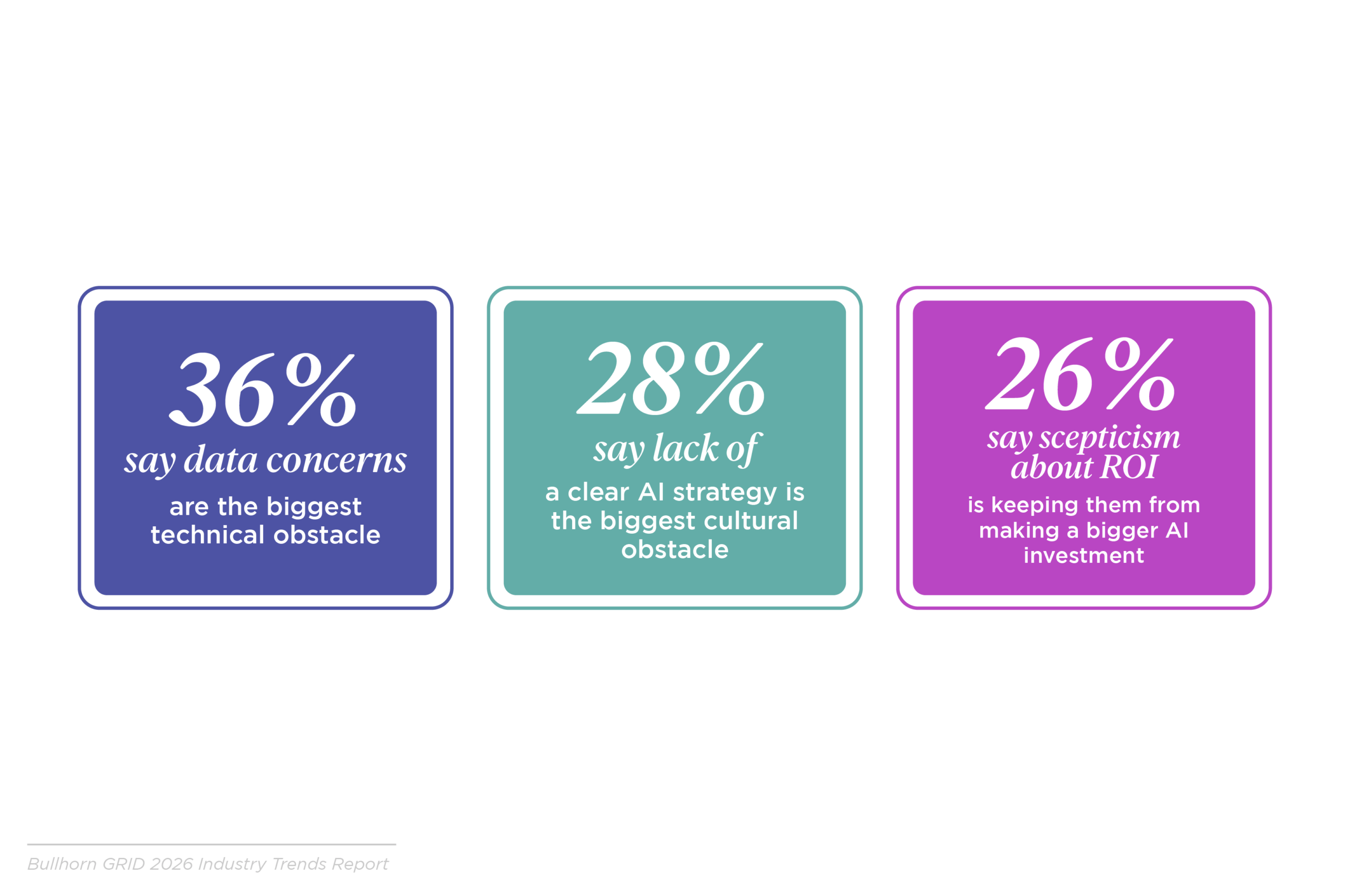
Data concerns and strategy are the biggest obstacles to AI adoption
Data and security concerns are top of mind for recruitment leaders with respect to AI. And these concerns stand in the way of full adoption of the technology. Agencies need to work with partners that can help them address these foundational concerns to get the most out of AI.
When you have employees keen to use AI, you have to quickly provide secure approved alternatives, as well as have policies and controls. You don't want people uploading confidential documents into open instances of AI chatbots like chatGPT and putting them out there, because they are quickly adopting these same tools in their life outside of work


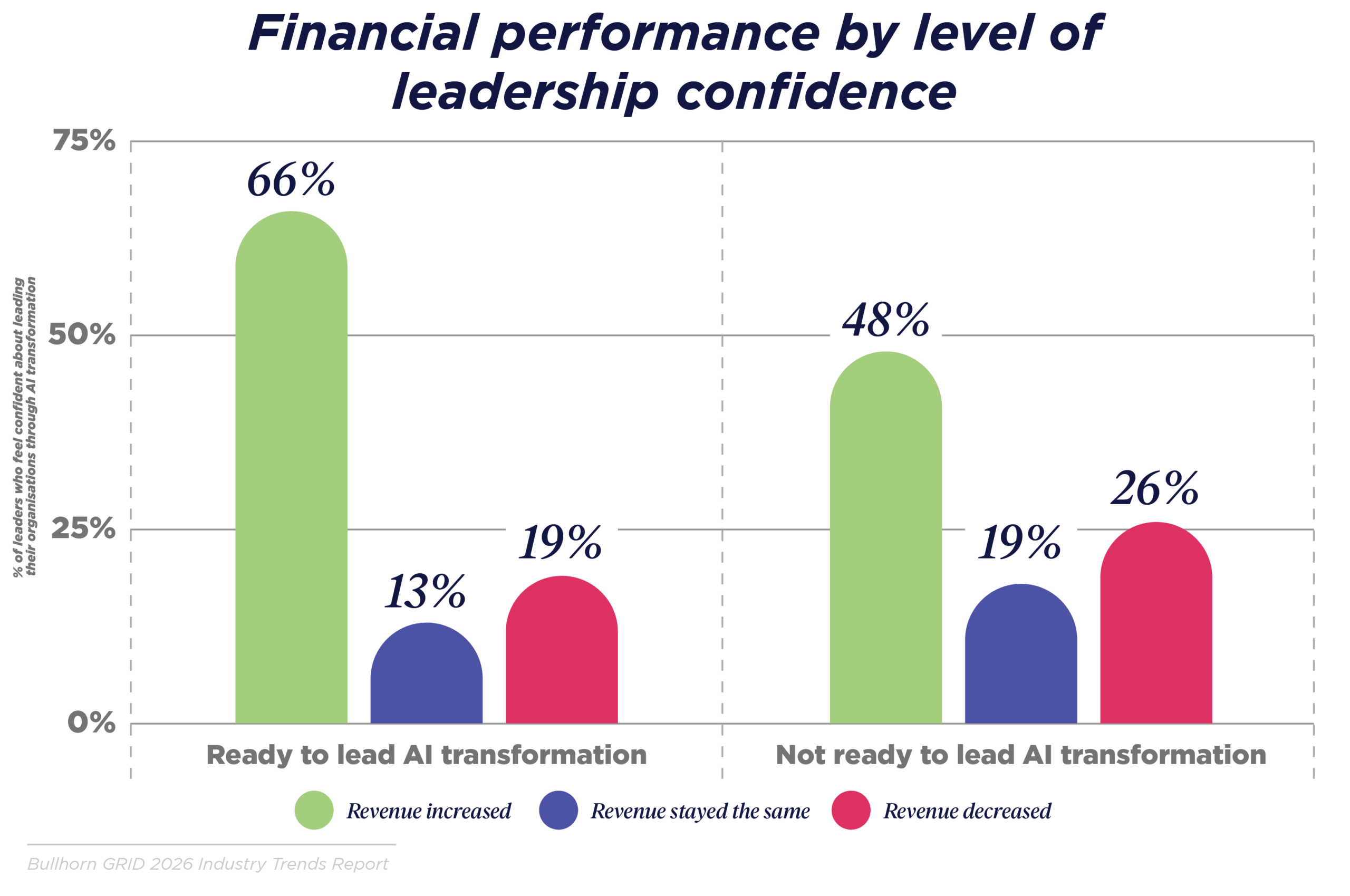
Leadership from the top is crucial to real AI adoption
Leadership confidence tracks with performance. 81% of leaders at the highest growth agencies feel prepared to lead their organisations through AI transformation. Whereas only 54% of those with the weakest revenue performance felt prepared.
...from our executives and cascading to our leadership teams, there is not just a mandate to use the tools in our day-to-day jobs, but actually they're walking the walk.
What do the top-performing agencies have in common?
This report has identified a number of factors that impact financial and operational performance, but it is worth pulling together a portrait of what the top-performers–those that achieved 25+% revenue growth in 2025–have in common. These firms are rewriting the rules for productivity and efficiency.
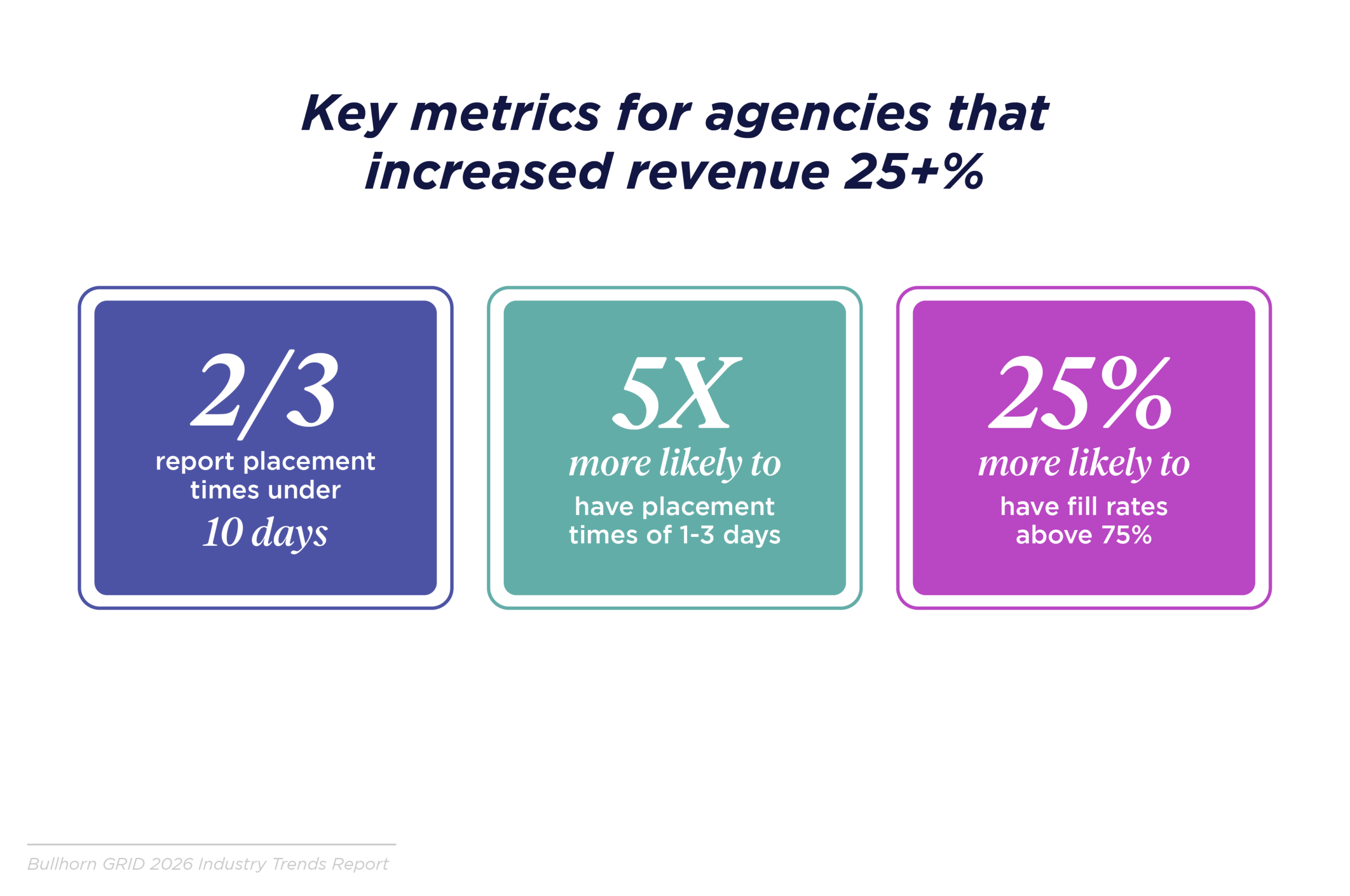
Expectations for time to place are increasing
2/3 of the top performers report an average time to place under 10 days. They are 5 times more likely to have average placement times of 3 days or less, more than any other revenue category. This is a velocity shift from last year, when the correlation with growth cut-off came at under 20 days. This year, ⅓ (33%) of agencies that lost revenue in 2025 had placement times of 10-19 days. And these top performers are demonstrating real efficiency and productivity when it comes to placements per month and candidate acceptance rates.
Performance per [employee] is up probably about 70% over the last 3 years, 24% year-on-year.
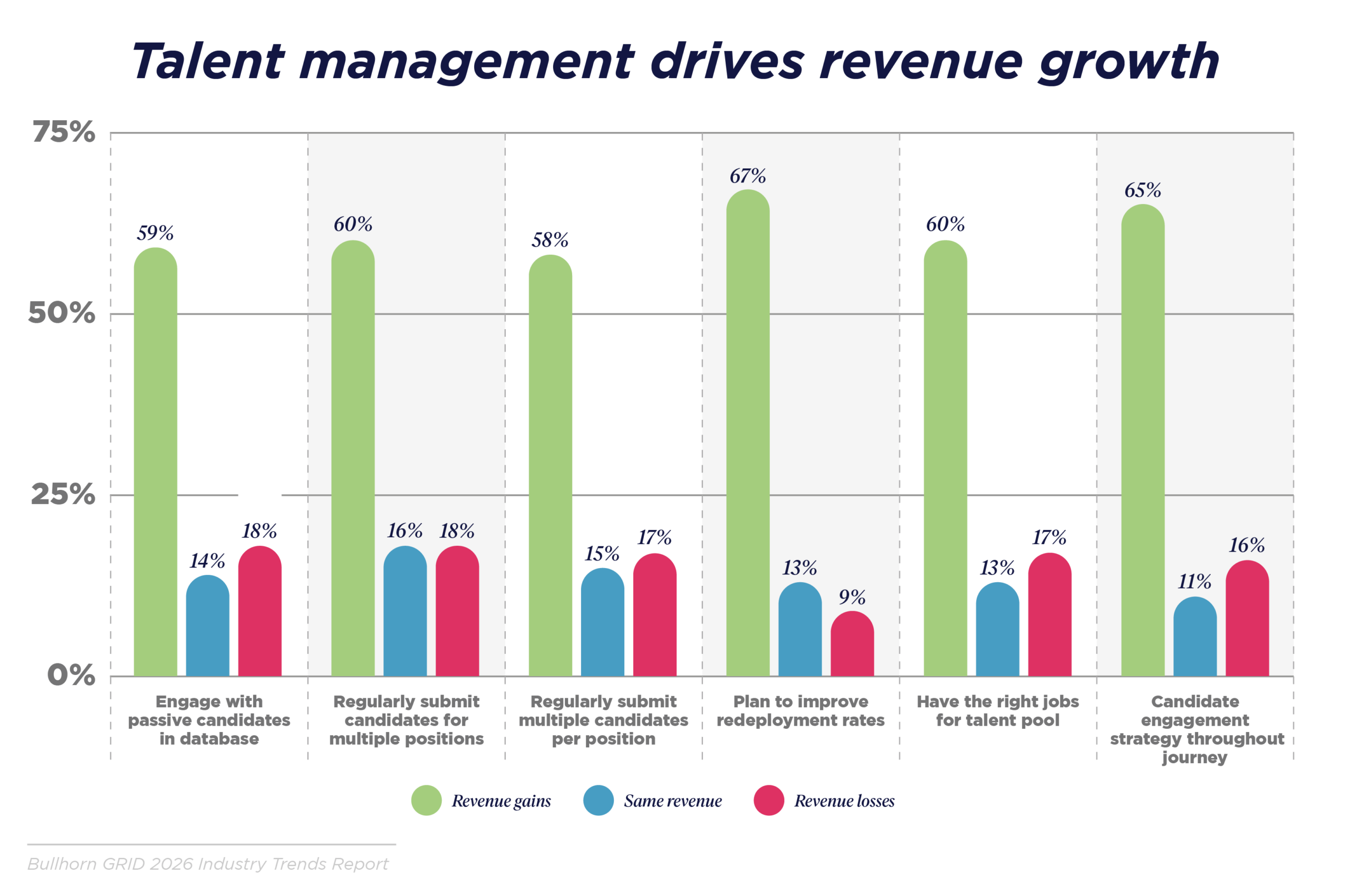
Talent management drives revenue growth
Making efficient use of databases and carefully managing candidate submissions and redeployment clearly correlates to revenue growth. And these strategies have significant operational impact as well. 52% of agencies that submit multiple candidates to a position report time to place under 20 days.
What do recruiters need to meet these new standards for productivity? AI that super-charges, not replaces, the human
This year’s conversations with recruitment leaders made it clear that a big concern is making sure that AI facilitates human connections with clients and candidates, rather than reducing recruitment to a series of prompts and preset interactions. The focus is on using AI to smooth out friction for both recruiters and candidates, without sacrificing differentiation. Leaders indicated they are working hard to allay recruiters’ fears around over-reliance on technology.
The biggest objection I get with AI and automation from the individual recruiter is they lose their personality in their interactions with candidates.
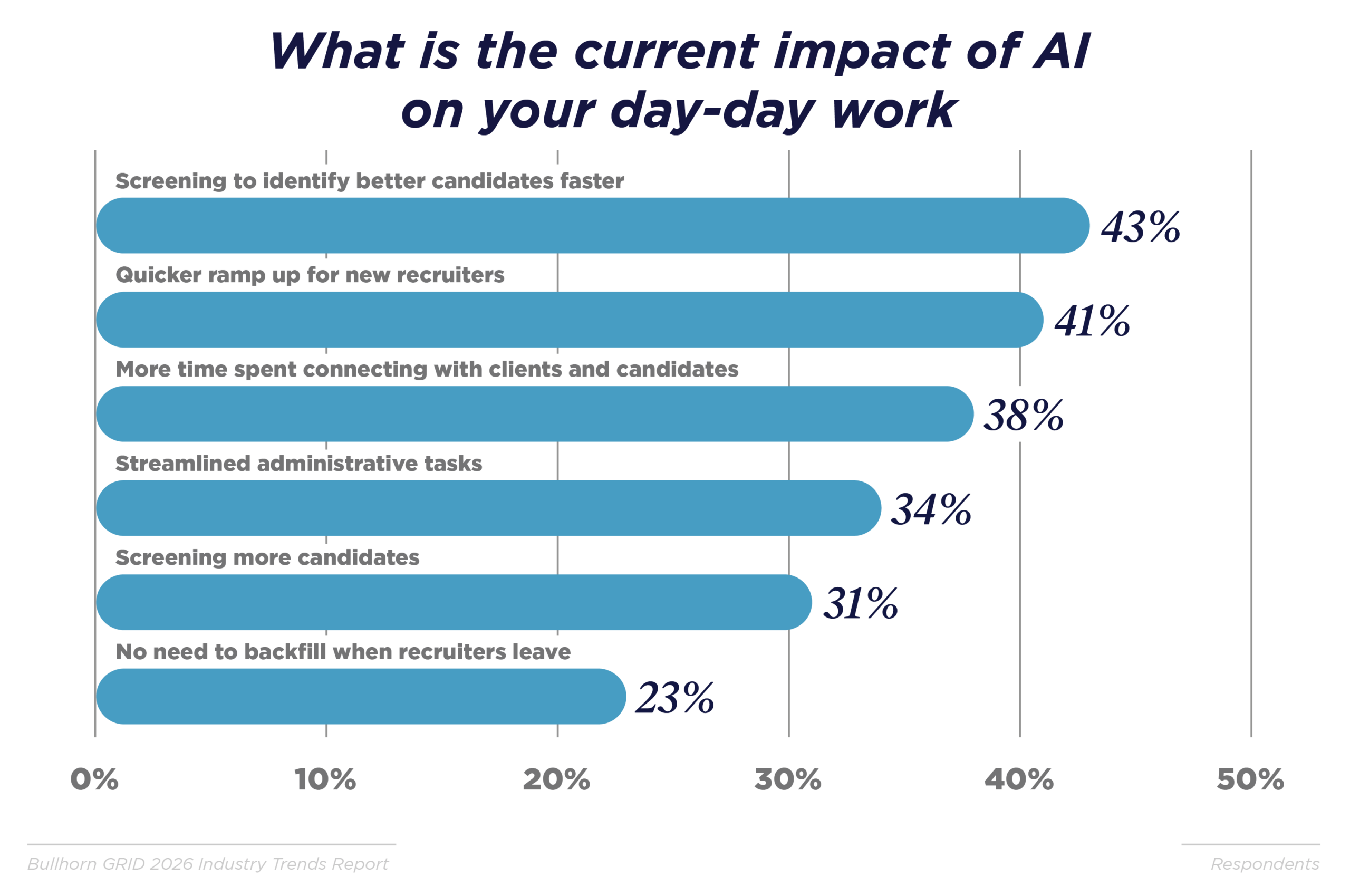
AI has biggest impact on search and screening
Recruiters say searching for candidates is by far the most time-consuming part of their day and the most challenging part of the recruitment lifecycle. The good news is that 43% of recruiters say AI is helping them identify better candidates faster, and 31% say they are screening more candidates overall. AI sourcing also tops the list of what recruiters value most about AI.
38% note that AI is helping them find more time to connect with clients and candidates, keeping that human connection that is so crucial for a recruiter’s job satisfaction.
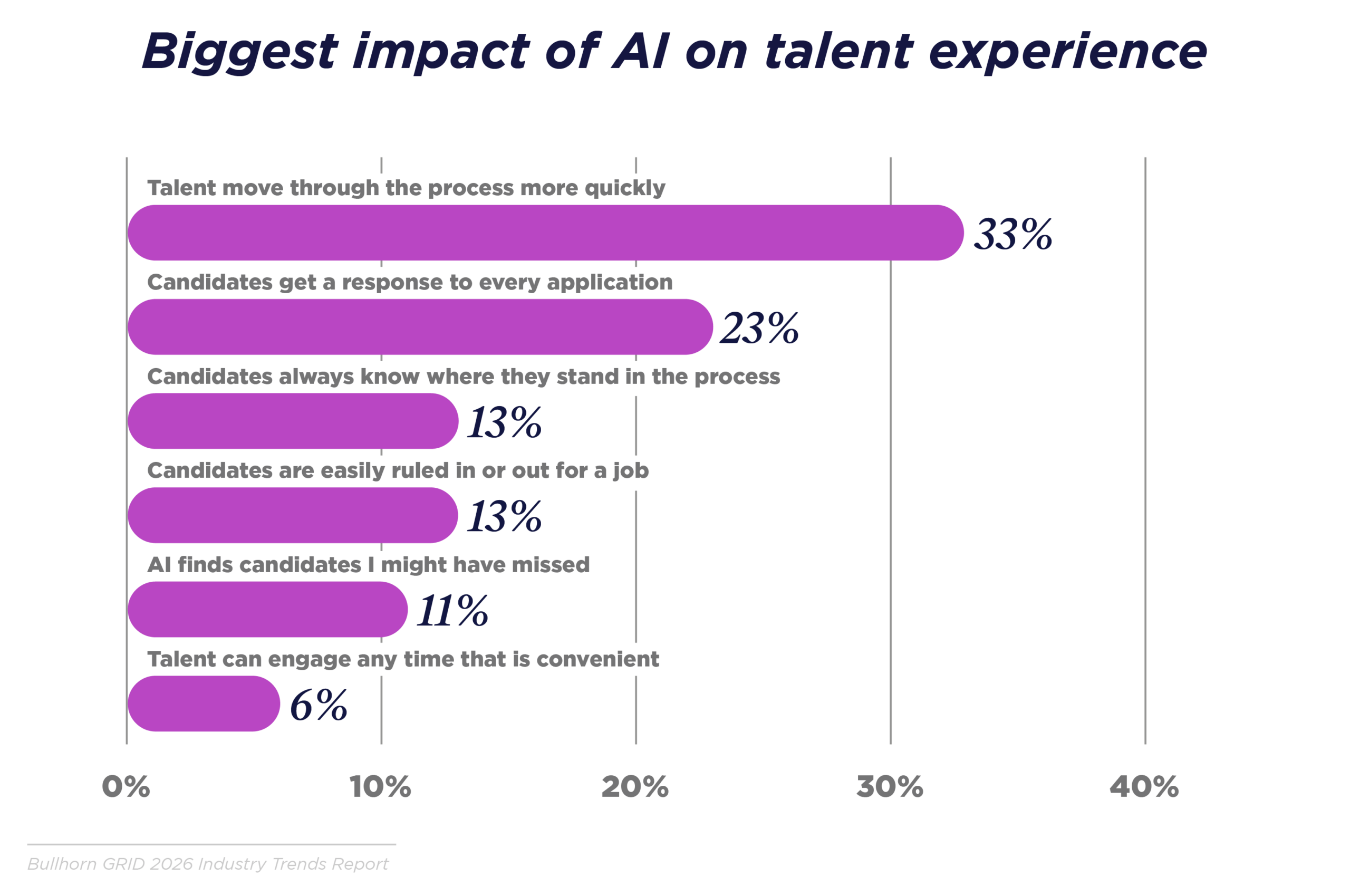
Speed and responsiveness are the key benefits for talent
As we saw in the GRID 2025 Talent Trends Report, speed and responsiveness are critical for talent engagement. Recruiters believe the biggest impact of AI on the talent experience is moving them through the process more quickly. This aligns nicely with the finding that faster placement, even faster than last year, correlates with revenue growth. The second biggest benefit is that candidates get a response every time they apply — and this is exactly what candidates said they most valued about AI.
The application process now goes from black hole to hope. The candidate doesn't care that it's a robot or automation. They're getting a response back on something they spent their own quality time to do.


Overall business strategy and economic outlook
49% of agencies expect the economy to improve in 2026 (compared to 62% last year), so optimism has dampened, and almost as many expect it to stay the same (41%). Anecdotally, and from qualitative interviews, the expectation is largely for stabilisation to modest improvement, not a radical snap back. However, everyone we spoke with was optimistic about their own place in the recruitment ecosystem because they were focused on creating their own tailwinds regardless of prevailing market conditions. The bold leaders we interviewed shared that they expect to gain market share, even if the total market shrinks, by being more agile and more efficient than competitors and using AI to enhance their “special sauce” rather than dilute it.
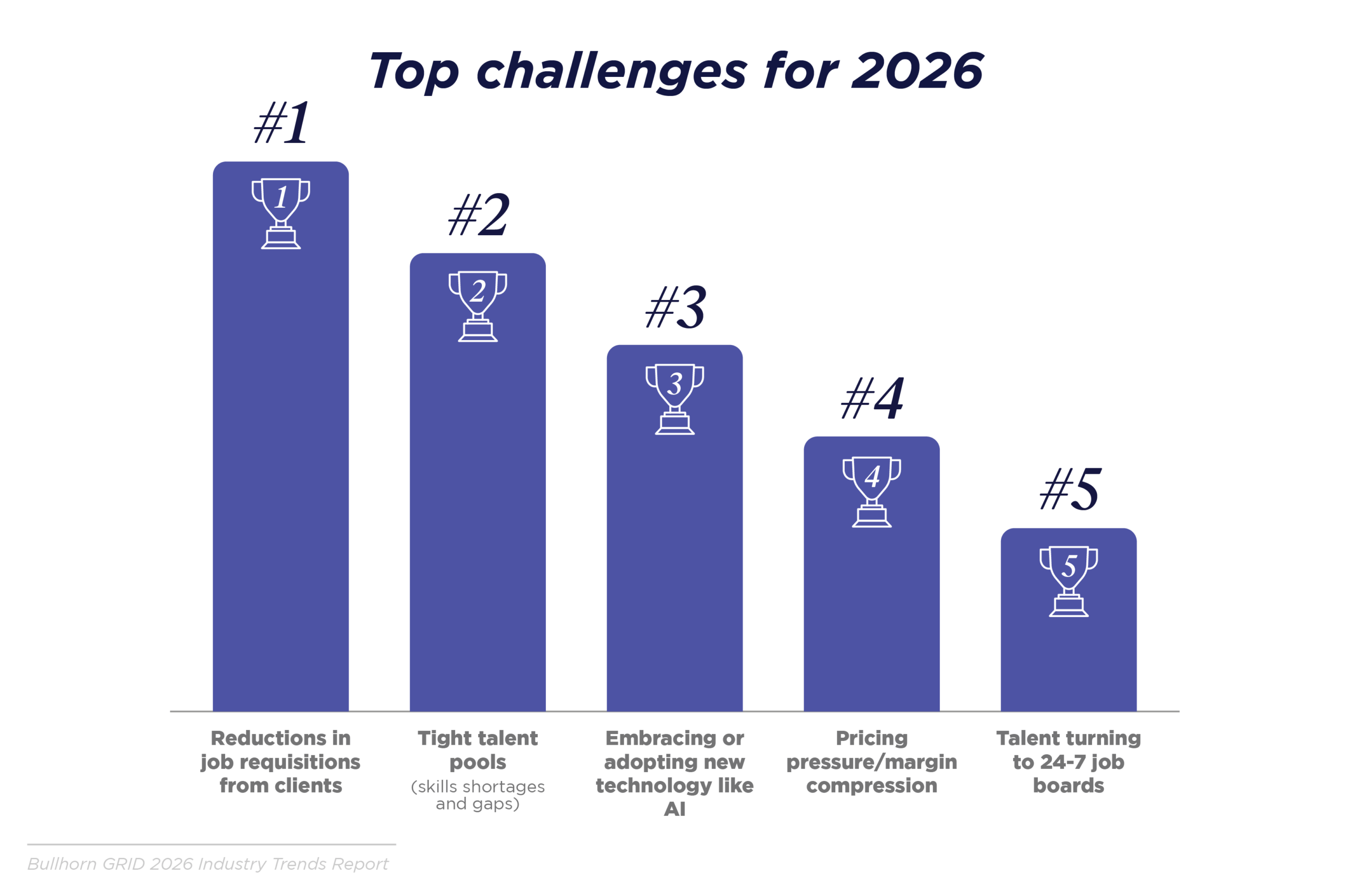
Fewer jobs and tight talent pools remain the key industry challenge
Talent pools are still tight and job volumes are still down, continuing the trend of the last few years. And 2-3 out of 5 candidates who receive offers are still turning them down. The top reason is that they received a better offer elsewhere.
How are bold agencies creating their own tailwinds:
- Super-focus and niche specialisation: Instead of chasing every opportunity, the strategy is intense focus. One agency shared that they are narrowing their target market to specific, high-growth, under-penetrated niches within large sectors (e.g., substations in energy), and favouring skilled trades that are showing resilient demand. Others shared that they are really examining where they are winning and losing and aren’t afraid to get out of areas where they are not succeeding.
- Leaders are thinking holistically about the skills mismatch issue, not at a candidate level but at a workforce level. Agencies are already sensing this, with candidate training and reskilling being the number one new business line they are looking to expand into this year, and expansion into this domain correlates with revenue growth. One leader shared that they are focused on creating a program to help clients reskill existing employees. 38% of the top-performing agencies are expanding candidate reskilling.
- Leaders shared that they are expanding into new services, particularly advisory services. These offerings are part of a shift towards “non-traditional, non-end-to-end recruitment,” with a focus on advisory and consulting to help clients cope with the changing market. 34% of top-performing agencies are expanding their consulting services this year.
I think there's interesting opportunities in other parts of what we do. So there's interesting opportunities in outplacement, in coaching, in internal hiring, helping clients leverage their skills investments, and reskilling and upskilling around AI, not just with people who will be using AI skills as a core part of their role, but with executives and leaders.
Conclusion
AI has already reshaped the nature and the pace of the recruitment industry. The most successful agencies are investing not just in AI tools, but are thinking strategically about change management and adjusting their KPIs.
Key takeaways:
- AI is already yielding enormous financial and productivity gains across the recruitment industry
- Data quality, strategic leadership, and the right tech are the hurdles for full AI transformation
- Bold leaders are committed to overcoming these challenges in 2026 and are all in on AI
- Recruiters are onboard and, with expectations rising for delivery speed, they already know they cannot go back; the rules have already changed
- The economy may improve marginally in 2026, but visionary leaders are creating their own tailwinds