















 Bullhorn’s marketplace of 100+ pre-integrated technology partners gives recruitment agencies the tools they need to build a unique, future-proof solution.






How should recruitment brace itself for growth?

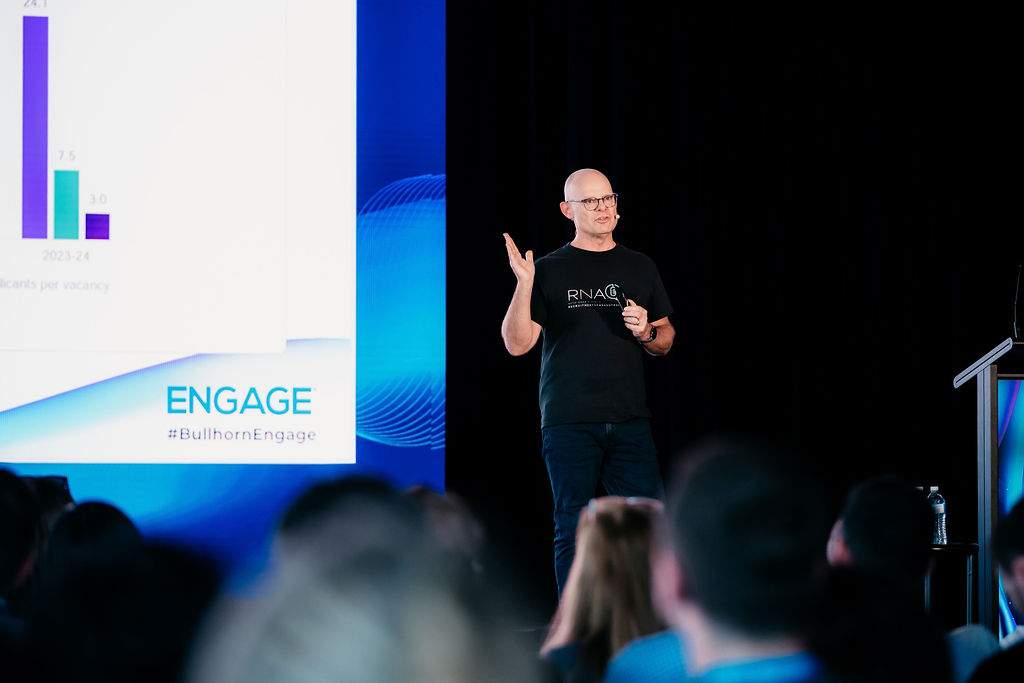
After a turbulent 2024 year, the recruitment industry is shifting its gaze forward. Only 37% of businesses reported revenue growth, per Bullhorn’s GRID survey, but change is still on the horizon. During a session at Engage Sydney 2025, industry leaders Matthew Dickason of Hays and Sue Healy of Talent Quarter shared candid insights on how they’re forging ahead after a challenging year.
When the market moves, move with it
Few sectors have experienced the dramatic swings of the past few years quite like healthcare. Healy described explosive growth between 2020 and 2023, with her business scaling fivefold in just two to three years. But by mid-2023, the tide began to turn—state budgets tightened, contracts were slashed, and the era of high margins began to fade. “We’re having to rethink our business model, delivery approach, and cost structure,” Healy explained.
That pressure was felt across the board. Dickason noted that buyer hesitation led to significantly longer sales cycles. While candidates were plentiful, many weren’t the right fit. After a wave of job changes during the pandemic, professionals were more cautious and risk-averse. “You had this frozen marketplace,” he explained, compounded by economic uncertainty, inflation, and evolving labor laws.
But perhaps the biggest challenge was internal. As Healy pointed out, many managers had never weathered a downturn like this before. Lacking the muscle memory from past lulls, teams were forced to learn and adapt on the fly. “A lot of organisations weren’t match fit,” Dickason added. “You didn’t have to do a lot of business development. Suddenly, you had to become much more of a sales organisation.”
Because you’re worth it
In a cost-conscious climate, it’s critical companies prioritise showing exactly what their services are worth.
“Ultimately recruitment is inherently a human endeavor,” said Dickason. Efficiency is important, but shouldn’t come at the cost of personal touch. “We need to empower our consultants to provide insights and advice to our customers so that they value us to a greater extent.”
Healy shared a similar view. “Our focus is on loyalty—building loyalty in our workforce, building loyalty in our customer base. So our acquisition costs less.” That loyalty comes from delivering consistent, high-quality experiences: simplifying workflows, reducing friction, and investing in people. “The more we can keep our workforce and keep that knowledge,” she said, “allows us the money to be able to reinvest in keeping those people with us.”
Tech that works with you
But how can we leverage technology without compromising the human side of recruitment? AI can be a powerful asset, but only when used with intention and care.
Healy shared a compelling example: Talent Quarter’s robotic assistant, Miranda. By automatically scraping emails and loading job orders, Miranda dramatically cuts time-to-market. “By the time we got [jobs] in, they would have gone and we wouldn’t have filled them,” she recalled. Now, Miranda takes over that task, freeing consultants to focus on the more human side of the work.
It’s clear that AI enables companies to perform more efficiently at scale. Dickason envisions a future where interacting with CRM systems feels more intuitive and natural, leading to richer data and deeper insights. “It gives us a much better data set that we can interrogate and provide better customer service out of the back of it,” he explained.
Yet, automation still raises concern. As Healy cautioned, “The risk is the dumbing down of our society.” The solution could lie in training, particularly in the art of prompt engineering. Teaching consultants to work skillfully with AI will ensure it enhances human expertise rather than replaces it.
Indeed, studies show that AI improves performance, but not if people accept its outputs uncritically. “AI is not going to give you the perfect thing the first time,” Dickason stressed. “You’ve got to know how to engage with it.”
Make data work harder
Think of AI as the engine and data as the driver. Sue stressed the need to track what’s working: “Focusing on your digital outputs and the reporting… is really critical.” Dickason put it another way: “Data is the oil in the machine—but it’s the gold in reality.”
Smart use of data helps recruitment agencies do more than spot trends; it uncovers gaps and drives more precise, effective service.
Why people still matter most
Even amidst rapid technological change, people remain the most important investment. “Our people are great at what they do,” said Healy, “but they’ll need to work differently—and more collaboratively.” That takes time, resources, and a willingness to experiment, even if it means getting things wrong. “We’ve got to be brave as businesses.”
For Dickason, leadership is key to making change last. “Our job is to embed a change mindset across the organisation,” he said, making transformation feel safe and expected. At Hays, that starts with line managers. “We try to create change leaders throughout the business.”
Today’s most effective consultants share two essential traits: curiosity and resilience. “It’s the resilience to keep on being curious and finding opportunity,” said Dickason. Curiosity sparks meaningful conversations and creativity, while resilience ensures the follow-through it takes to deliver results.
As the role evolves, so do the skills it demands. Healy highlighted the growing need for “a respect for tech and data,” emphasising that today’s consultants must act as strategic partners, not just order-takers.
People have always been the heart of recruitment. And while technology is transforming the tools, the fundamentals remain: connection, trust, and insight. The agencies that succeed next will be those who bring the human and the technical together, seamlessly, and with purpose.
Or, in Dickason’s words: “Change just becomes normal.” And when it does, progress follows