
























Five fears candidates have about AI (and how to help your talent overcome them)
AI is transforming the recruitment landscape faster than any other innovation in recent memory. From matching candidates to open roles in seconds to handling initial screens overnight, AI is reshaping how recruiters work and a candidate’s experience throughout the hiring process. And for many job seekers, that change can bring on some unease.
According to Bullhorn’s GRID 2025 Talent Trends Report, which surveyed nearly 2,800 candidates, 77% of respondents who have experienced AI in the job-search process said the experience was positive. Still, a handful of persistent fears remain—rooted in uncertainty, misunderstanding, or lack of transparency. For recruitment agencies, addressing these concerns is essential to building trust, improving engagement, and creating experiences that turn candidates into long-term advocates.
Let’s explore the five most common fears candidates have about AI, as cited in the GRID Talent Trends Report, and how you can help alleviate them.
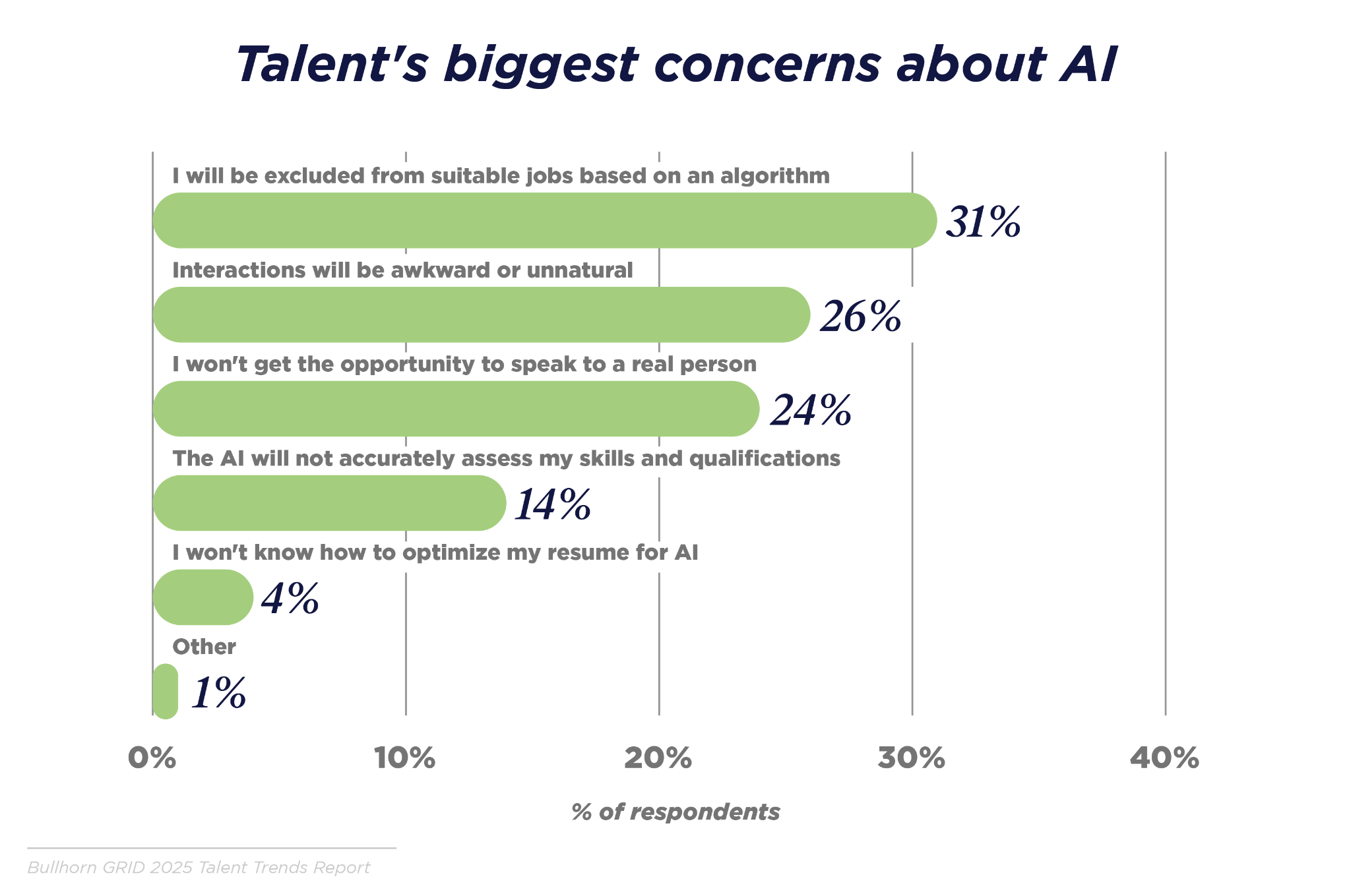
1. “I’ll be excluded from suitable jobs based on an algorithm.”
This is the most common fear candidates express about AI. Many worry that an algorithm might misread their experience or exclude them from roles that would be a perfect fit. It’s a valid concern. After all, AI only performs as well as the data and design behind it.
But modern AI recruiting tools are far more sophisticated than basic keyword filters of the past. When powered by recruitment-specific data and continuously refined through machine learning based on real hiring outcomes, these systems get smarter and more accurate over time. They can recognise transferable skills, interpret context, and align candidates with roles beyond a simple title match.
This is where recruitment agencies, powered by AI, excel over job boards. With AI recruiting tools surfacing the best matches for recruiters, agencies can achieve the speed and responsiveness of job boards while retaining the human element that only a recruiter can provide. A recruiter builds a connection with their candidates and, armed with that personal knowledge, connects the right talent to the right jobs.
2. “Interactions will be awkward or unnatural.”
The idea of talking to an AI screening agent can feel strange, especially for candidates new to the technology. But when designed thoughtfully, AI-powered interviews can actually enhance the candidate experience.
Recruiters play a crucial role in setting expectations. Just as you would prepare a candidate for a client interview, help them understand what an AI conversation entails: how it works, what it’s evaluating, and what happens next. That simple preparation removes uncertainty and builds trust.
And the GRID 2025 Talent Trends Report backs this up: 88% of candidates who have experienced an AI interview said it was equal to or better than a live interview with a person. As one recruitment industry COO shared, “I thought candidates would find the AI screening agent impersonal, but we haven’t seen that at all.”
3. “I won’t get the opportunity to speak to a real person.”
A major misconception about AI in recruitment is that it removes the human touch. In reality, AI helps recruiters focus more on people by removing repetitive tasks. As one recruitment COO put it, “Being able to see that chatbot interaction immediately and get it distributed out to a recruiter has made turnaround time so much faster. We’ve gotten a lot of positive feedback [from candidates] on responsiveness.”
Recruitment agencies can reinforce trust by mapping out the human touchpoints in the process and communicating them clearly to candidates. Share exactly when they’ll hear from a recruiter, and explain how AI helps get them there faster.
Technology’s role should always be to enhance human interaction by giving recruiters more time to connect meaningfully, not less. That guiding principle should underpin every AI strategy.
4. “AI won’t accurately assess my skills and qualifications.”
Candidates worry that AI won’t “get” their experience or might overlook unique strengths that don’t fit a traditional pattern. That fear is understandable, especially when candidates don’t have visibility into how AI tools make decisions.
The truth is, that’s a risk only when agencies use generic or poorly trained systems. Recruitment-specific AI, built on deep datasets of real hiring outcomes, looks beyond keywords and understands the nuances that make someone a great fit. These systems learn from successful placements, continuously refining what “qualified” looks like in the context of real-world performance.
The key to easing this fear is transparency. Let candidates know that your AI tools are designed to support fairness and accuracy by aligning assessments with real-world performance data. When recruiters explain how the technology works, why it’s used, and when a human steps in to make the final decision, it builds confidence and reduces anxiety.
5. “I won’t know how to optimise my resume for AI.”
AI is shifting from keyword matching to contextual understanding, so the best optimisation is actually authenticity. When building resumes, encourage your candidates to focus on clarity and outcomes: what they achieved, how they made an impact, and the skills they used along the way.
When recruiters can assure candidates that the technology is working with them, it fosters trust in both the recruiter and the process. And while AI helps recruiters discover strong candidates faster, human judgment will always have the final say.
Finding the balance between AI and the human touch
Over the next few years, one of recruitment’s biggest challenges—and opportunities—will be finding the right balance between automation and authenticity. The pace of AI adoption can feel overwhelming for both recruiters and candidates. But the agencies that embrace transparency, communicate openly with candidates, and integrate AI in service of human connection will stand out as industry leaders.
Our GRID 2025 Talent Trends Report shows that when candidates experience AI during the hiring process, their loyalty to recruiters actually increases, especially when that experience is positive and well-explained.
AI is here to stay, but its success depends on how it makes candidates feel. Candidates don’t want to feel like they’re talking to a machine; they want to feel seen, heard, and understood throughout the hiring process. When used thoughtfully, it can empower candidates with quicker responses, clearer communication, and better opportunities—without losing the human connection that defines great recruitment.
Want to learn more about how recruiters are leveraging AI to improve candidate experiences? Explore Bullhorn’s latest GRID 2025 Talent Trends Report for data-driven insights that can help your team move faster, work smarter, and connect more meaningfully with talent.