
























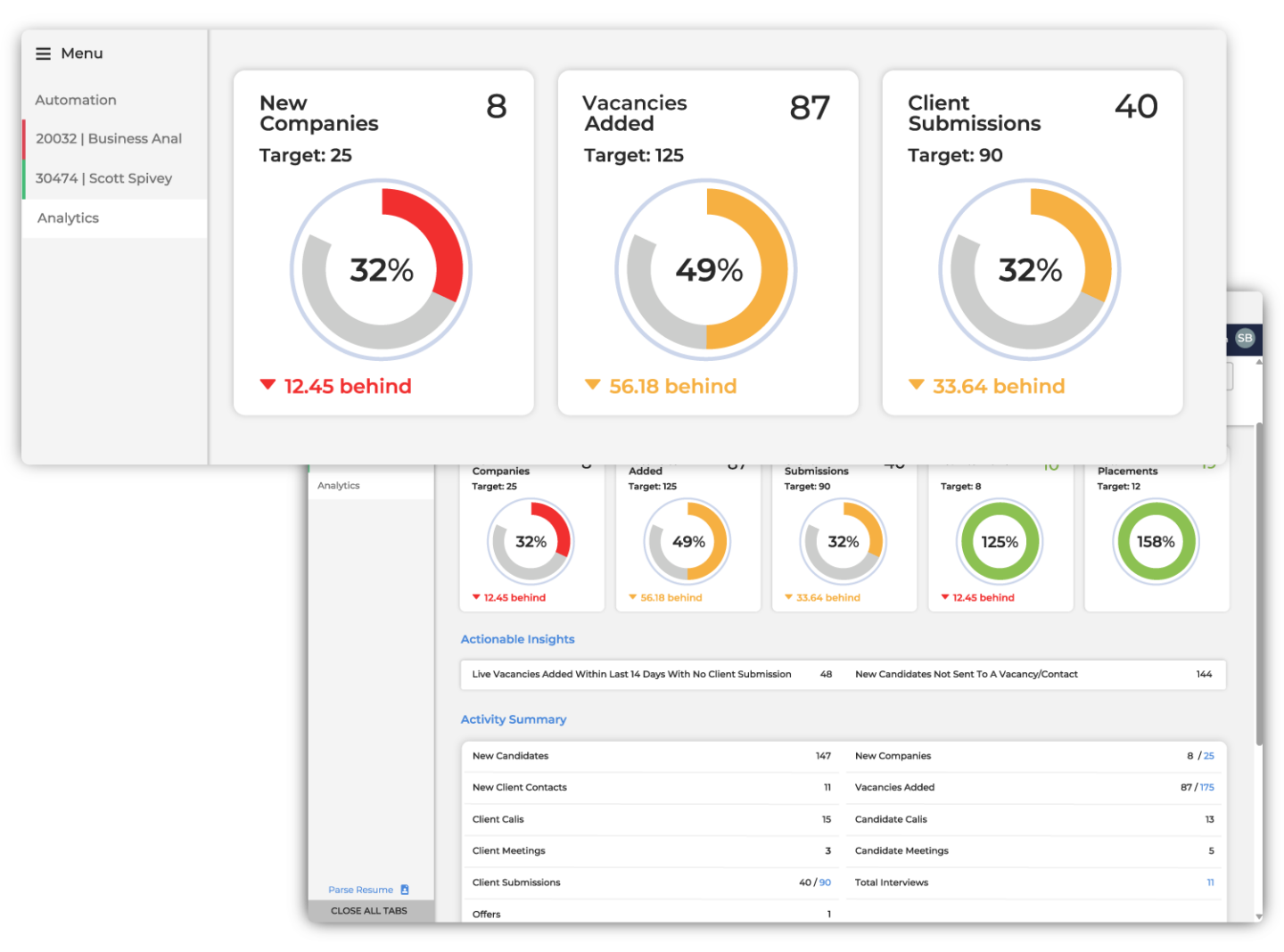



Bullhorn’s analytics tracks the daily activity metrics that drive placements for small recruitment agencies: calls, emails, and submissions per recruiter. It also provides calculated revenue summaries for both contract/temp and perm/direct hire placements, plus data quality insights to keep your database accurate. Admins can set targets for individual users and groups to keep the team focused.
How small agencies use recruitment analytics every day
Start your day focused.
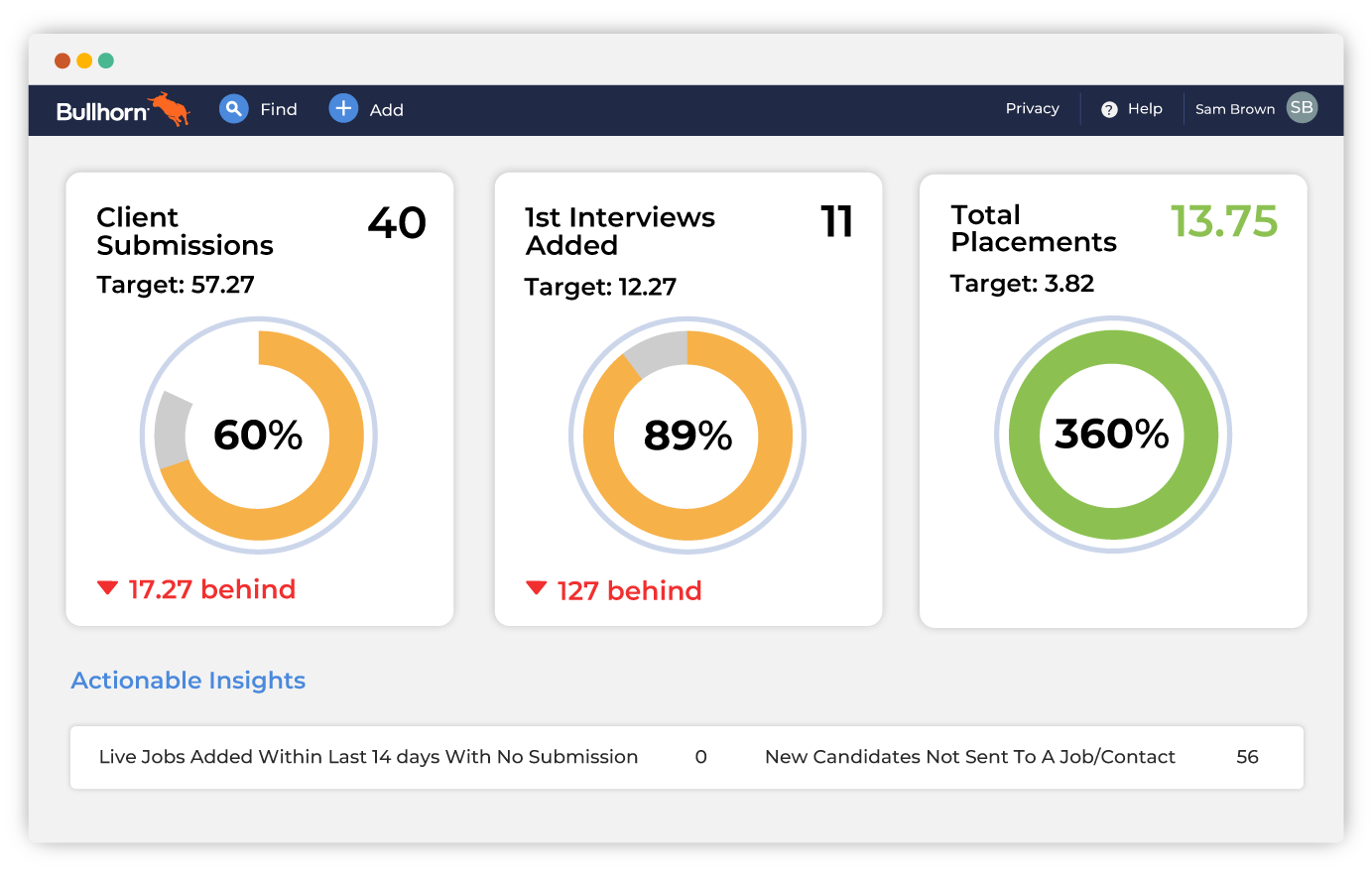
Your personal dashboard highlights exactly where to spend your time. Use detailed clickthrough to jump from your metrics straight to the records that need action. No morning stand-up or status updates required.

Master your core activity metrics.
Gain instant visibility into the metrics that define your recruitment funnel: Calls, Submissions, CVs Sent, Interviews, and Placements. Track in real-time to identify exactly where more focus is required.
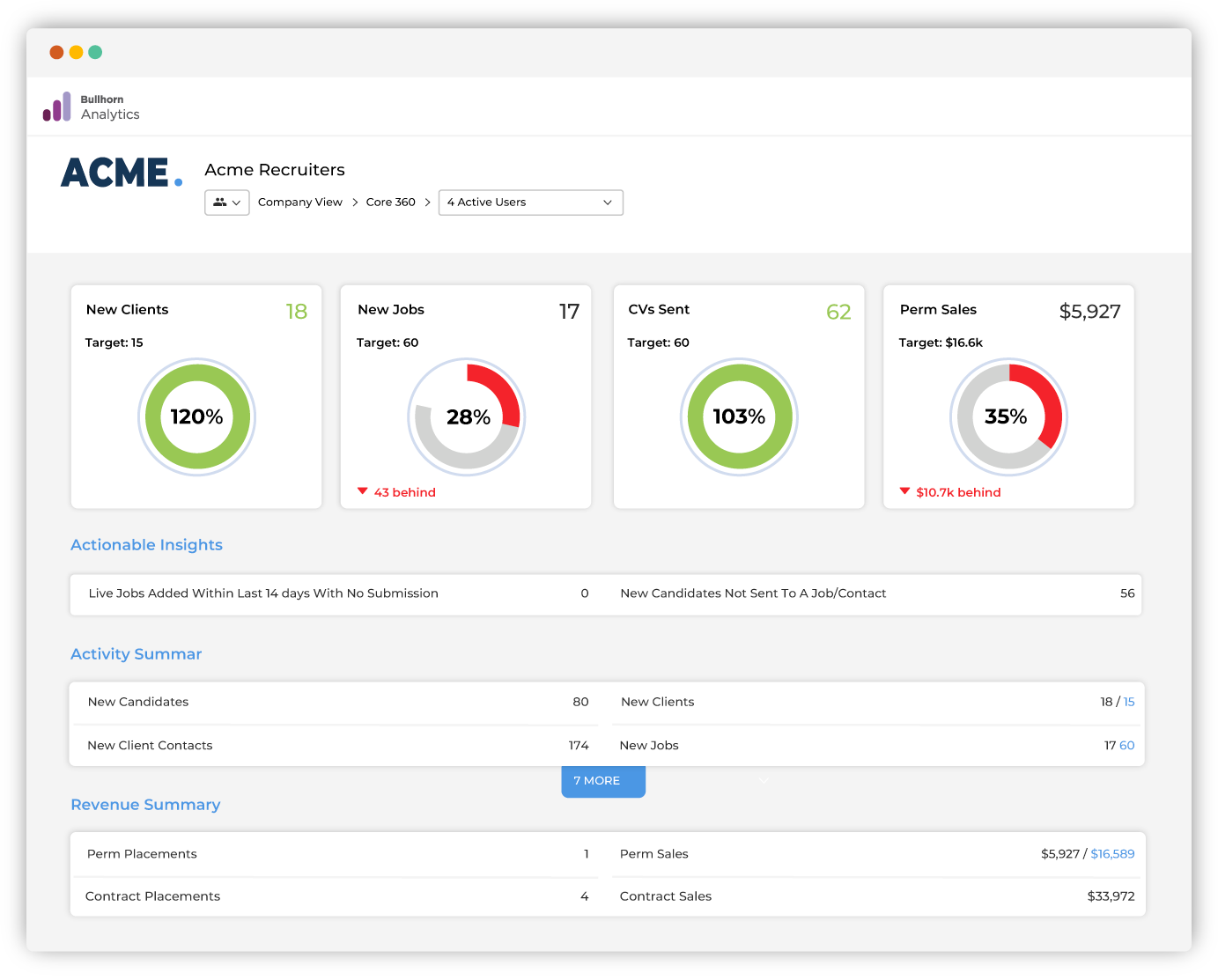
Monitor revenue basics.
View estimated billing for both contract and permanent placements in real-time. Gain visibility into potential financial performance based on your recruitment data. Understand your agency’s trajectory and celebrate wins without the need for manual spreadsheets.
Anyone in the staffing industry would agree that having real-time visibility of engagement and activity at desk level, and seeing how that translates to your strategic objectives and forecasts is dream list stuff
Ron Washburn
EVP, Soliant Health
See what your agency is actually doing
Every recruiter gets a personal dashboard. Activity, revenue, data quality. Book a demo and see it yourself.
Frequently asked questions
Yes. Bullhorn includes both real-time visibility and deep-dive performance tracking. Every recruiter has access to a personal analytics dashboard for immediate daily activity, revenue summaries, and data quality. For more formal analysis, you can access a library of out-of-the-box Standard Reports, including Recruiting, Sales, and User Activity. These pre-configured reports allow you to monitor long-term performance and track key metrics without the need for manual data entry or custom report building.
Bullhorn draws from data already in your ATS and CRM, so small agencies do not need a separate BI tool like Tableau or Power BI. Every recruiter gets a personal dashboard with activity metrics, revenue summaries, and data quality insights. Your team gets access within days, and small agencies are typically fully operational within weeks, not months.
Bullhorn gives every recruiter a personal overview page with key daily metrics, actionable items, and detailed clickthrough to underlying records. It includes calculated activity metrics (calls, emails, submissions), revenue summaries for contract/temp and perm/direct hire placements, and data quality tools that flag missing or incorrect information.
Bullhorn’s analytics is designed to work out of the box for small recruitment agencies, with no configuration or technical setup required. Every recruiter sees a personal dashboard the moment they log in, with daily metrics and actionable items surfaced automatically. Your team gets access within days, and small agencies are typically fully operational within weeks, not months.
Bullhorn identifies missing or incorrect data in your database and gives your team tools to fix it directly from the dashboard. Click through from a flagged record to the source and update it in seconds. Better data drives better placements, and Bullhorn keeps your database accurate without a dedicated ops team or a separate cleanup project.
Small recruitment agencies that manage by gut feel are more likely to hit a revenue ceiling because they cannot see which activities actually drive placements. Bullhorn’s analytics replaces intuition with evidence, giving agency owners real-time visibility into recruiter activity, revenue, and data health. 4,500+ small agencies use Bullhorn to run their business on data, not guesswork.
Bullhorn’s analytics is included in the Bullhorn platform, not sold as a separate add-on. Small agencies get access to personal dashboards, activity metrics, revenue summaries, data quality tools, and target setting as part of their subscription. Visit Bullhorn’s small agency pricing page for full details on packages and what is included.
Bullhorn’s recruitment analytics for small agencies includes a personal dashboard for every recruiter, calculated activity metrics (calls, emails, submissions), revenue summaries for contract/temp and perm/direct hire placements, data quality tools that flag missing or incorrect records, detailed clickthrough to underlying data, and target setting for individuals and groups. All of this is included in the platform and draws from data already in your ATS and CRM.