
























How small recruitment agencies build a tech stack that actually works
Small recruitment agencies face a version of every technology challenge that enterprise agencies face, with fewer people, tighter budgets, and no dedicated IT team to sort it out. That pressure has intensified in 2026 as AI tools have multiplied and the expectation to modernise has grown louder.
But the agencies getting this right aren’t the ones with the longest list of tools. They’re the ones who’ve built a focused, connected stack around a single principle: Bullhorn is the system of record, and everything else exists to feed it. Bullhorn serves more than 10,000 recruitment agencies globally, and the partners building on that platform have learned exactly what separates a stack that scales from one that creates new admin.
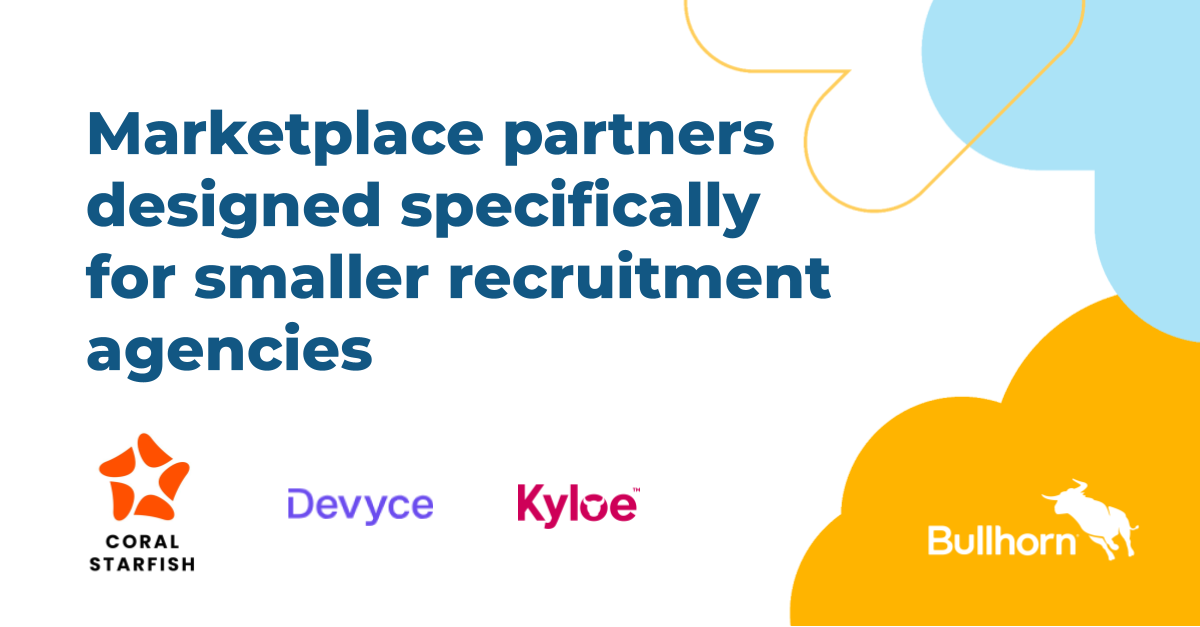
We spoke to three of those partners, Kyloe, Devyce, and Coral Starfish, about how small recruitment agencies can approach technology without getting overwhelmed. Here’s what they told us.
Key takeaways:
- Bullhorn is the foundation. Every tool in your stack should strengthen it, not sit alongside it as a separate silo.
- The best small recruitment agencies stacks are built around how recruiters actually work, not around feature lists.
- At small recruitment agencies scale, time-to-value matters more than technical sophistication. Tools need to deliver impact fast.
Start with workflow, not features
The most common mistake small recruitment agencies make when building a tech stack is buying technology based on what it can do, rather than what their team actually needs.
Martin Wishart of Kyloe puts it plainly:
“Start with the problem, not the product. It’s easy to get distracted by shiny new tools, but the best technology decision you’ll make is the one that solves a specific, painful problem your team is dealing with right now.”
Martin Wishart, Global Product Sales Manager, Kyloe Partners
That means asking practical questions before evaluating any tool. Where are your consultants losing the most time? Where is valuable information falling through the cracks? What’s slowing down placements?
Devyce recommends mapping recruiter workflows before making any purchase decision. Their advice: assess each product on three questions. Will consultants actually use it? Does it connect properly with Bullhorn? Does it remove work, or just add another system to manage?
Coral Starfish makes the same point from a design perspective.
“Technology should fit behaviour, not fight it. Many businesses buy technology based on features. We recommend looking at where recruiters actually spend their day and identifying friction points.”
Elliot Lack, Founder, Coral Starfish
For resource-constrained small recruitment agencies, this approach protects against one of the most expensive mistakes in the market: buying a capable tool that consultants don’t use.
Keep Bullhorn as your single source of truth
Every partner we spoke to said the same thing: the value of any tool depends on whether it flows data back into Bullhorn reliably. When it doesn’t, you get incomplete records, duplicate entries, and a CRM that gradually becomes less useful for everyone who depends on it.
Coral Starfish was built specifically to solve this problem at the sourcing layer. Recruiters spend significant time on LinkedIn and other platforms, but without the right tools that activity never reaches the ATS.
“Coral Starfish puts Bullhorn directly into recruiter workflows, allowing users to find, create, and update records directly from LinkedIn and other sourcing platforms, without leaving the profile.”
Elliot Lack, Founder, Coral Starfish
The consequences of data gaps compound over time. Candidate salaries, availability, preferences, and agreed next steps may be missing or outdated. Managers make decisions on incomplete information. Automations fire on dirty data. Reporting loses reliability.
Devyce addresses this problem at the communications layer. Orbis Group, a 50-person technology recruitment business operating across the UK and US, was losing data at scale: inconsistent call logging, gaps in CRM records, and limited reporting visibility. After implementing Devyce’s AI note-taker and Bullhorn auto-sync, the business now averages around 2,400 calls a month and saves approximately four minutes per call, returning around 160 hours per month to the team.
Kyloe approaches the same challenge across the full recruiter workflow. Their product suite covers document automation, data quality, call capture, and candidate onboarding, and it’s built entirely inside Bullhorn.
“Every Kyloe product lives inside Bullhorn. There’s no separate application to open, no data being duplicated elsewhere, no new system for your team to learn.”
Martin Wishart, Global Product Sales Manager, Kyloe Partners
Admin overload is a revenue problem
Time lost to manual tasks isn’t just an inconvenience. It has a direct cost in placements missed, consultants burned out, and data that no longer reflects reality.
TR2 Recruitment, a fast-growing agency that adopted Kyloe AwesomeDocs, reduced the time to produce a submission pack from 30 minutes to 5. Across thousands of placements a year, that translates to days recovered, not hours.
“We’ve grown really quickly, but we wouldn’t have been able to scale the business this quickly without having Kyloe AwesomeDocs in our armoury.”
Jonny Edwards, Recruitment Specialist, TR2 Recruitment
Kyloe also found that one customer cut the time spent on candidate profiles from 2 hours to 15 minutes, saving 60 hours a month on that single task alone.
Devyce estimates that each AI-generated note and automatic Bullhorn sync saves around four
minutes per call. For a recruiter making 20 calls a day, that adds up to more than an hour
returned every day, time that can be spent speaking to candidates and clients, arranging
interviews, and moving placements forward, rather than typing up notes after every call.
The cost of not acting compounds too. Agencies that don’t automate these processes aren’t just slower. They’re more exposed to compliance risk from inconsistent document handling, more likely to lose placements to competitors who can turn around contracts faster, and more likely to lose consultants who want to work in a more efficient environment.
Small recruitment agency-ready means fast to adopt, easy to manage
Enterprise tools are built for enterprise problems: large IT teams, long rollout timelines, complex change programmes. Most small recruitment agencies don’t have any of those.
All three partners design explicitly for this constraint. Coral Starfish offers a free trial and monthly rolling pricing, so agencies can see value before committing to anything. Customers typically see results within their first week or two. The product adapts to existing workflows rather than requiring teams to redesign their processes around new software.
Devyce customers can begin seeing benefits from day one. Before numbers are transferred, users take part in a training session with their account manager covering the softphone, Bullhorn integration, and click-to-dial functionality. For larger teams, Devyce provides in-person onboarding at UK offices, including desk-to-desk support on launch day.
Kyloe’s approach is similar. Their products use data already in Bullhorn, with interfaces designed for recruiters rather than developers. Ongoing support is part of the proposition too, not just the setup process. As one customer put it:
“Kyloe helped us clean the data, understand how to keep the data clean, taught us how to use the platform, helped create automations, and gave overall amazing support throughout the project.”
For small recruitment agencies with no dedicated IT resource, this kind of support isn’t a nice-to-have. It’s what determines whether a tool actually gets used.
Building the stack: where to start
If you’re building a Bullhorn tech stack from scratch, or trying to bring more structure to an existing one, the partners we spoke to suggest a prioritised approach rather than trying to solve everything at once.
Kyloe recommends starting with data quality. Clean, complete data is the foundation for everything else: automations, AI tools, reporting. From there, they suggest adding document automation for immediate, measurable ROI, then call intelligence capture to keep Bullhorn records accurate and up to date. For agencies running temp or contract desks, candidate onboarding tools should come early too. Compliance risk and slow onboarding are costly from day one.
Devyce places communications close to the top of the priority order, directly after the CRM. Calls are still how recruiters build relationships and surface information, and adding a communications layer early prevents poor data habits from forming as the business grows.
Coral Starfish completes the picture at the sourcing layer. Once the core stack is working, a tool that connects LinkedIn activity directly to Bullhorn records closes one of the most persistent data gaps in a recruiter’s day.
The consistent advice across all three partners: don’t build the whole stack at once. Start with the problem costing your team the most time or creating the most risk, implement one tool well, and expand from there. A lean stack that consultants actually use will always outperform a comprehensive one they don’t.
The agencies winning in 2026 aren’t the ones with the most technology. They’re the ones who’ve made a disciplined decision to keep Bullhorn at the centre, choose tools that embed into recruiter workflows, and scale their output without scaling their headcount.
The right Bullhorn partner can help you get there. Explore the Bullhorn Marketplace to find tools that fit your stack.