














 Bullhorn’s marketplace of 100+ pre-integrated technology partners gives recruitment agencies the tools they need to build a unique, future-proof solution.






The 7 best healthcare recruitment software platforms of 2026
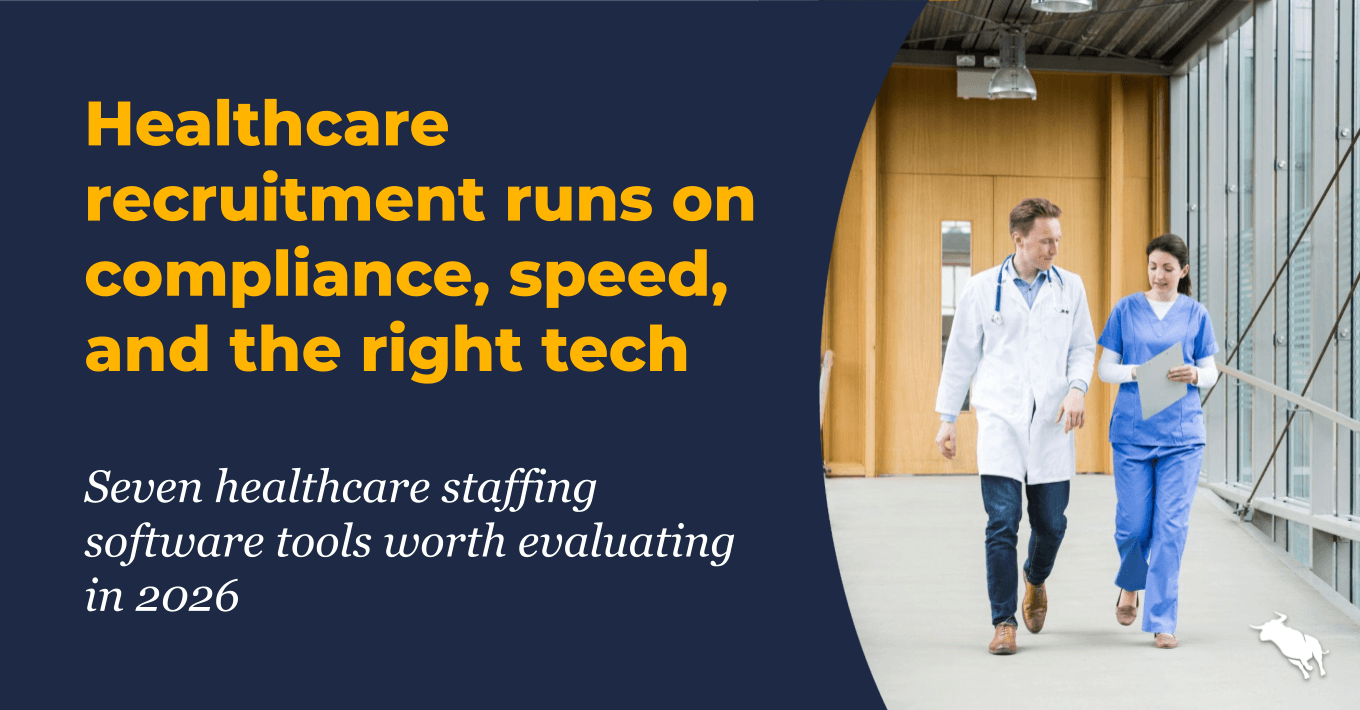
Healthcare recruitment operates under pressures that general recruitment software wasn’t designed to handle. Credentialing requirements change by state and speciality. Compliance failures carry real patient safety consequences. Shift-based scheduling demands real-time coordination across facilities, and the talent shortage in nursing, allied health, and locum tenens shows no sign of easing.
At the same time, the technology available to healthcare recruitment agencies has moved forward significantly. According to the GRID 2025 Industry Trends Report: Healthcare Spotlight, healthcare recruitment agencies predicted AI could save each recruiter 19 hours per week, and firms using AI are 96% more likely to grow revenue. The GRID 2026 Industry Trends Report reinforces the pattern: top-performing firms are four times more likely to be using AI, and the gap between adopters and non-adopters is widening fast.
This post covers the platforms that matter most for healthcare recruitment agencies in 2026, from the core system that runs your operation to the specialised tools that handle credentialing verification, clinical sourcing, scheduling, and compliance.
Here’s what we’ll cover:
- What healthcare recruitment software is and why it’s essential in 2026
- The features that matter most for healthcare recruitment agencies
- How we evaluated the platforms in this list
- Seven healthcare recruitment software platforms
- How to match the right platform to your agency size and speciality
- Emerging trends shaping healthcare recruitment technology
What is recruitment software for healthcare?
Healthcare recruitment software is a platform designed to manage the full recruitment lifecycle for medical professionals, from sourcing and credentialing through placement, scheduling, and compliance. It combines the functionality of a traditional ATS and CRM with healthcare-specific capabilities like license tracking, credential expiration management, shift scheduling, and integration with vendor management systems (VMS).
What separates healthcare recruitment software from general recruitment platforms is the depth of compliance and operational complexity it needs to handle. A missed credential expiration or a scheduling gap at a hospital isn’t just an inconvenience. It’s a risk to patient care and your agency’s reputation. The right platform manages that complexity so your recruiters can focus on placing talent, not chasing paperwork.
For a broader view of how recruitment software fits together, see Bullhorn’s guide to the best recruitment software.
Why is healthcare recruitment software essential in 2026?
The healthcare recruitment market faces a unique combination of pressures that make the right technology more critical than in any other vertical.
The talent shortage is structural, not cyclical. Nursing and allied health shortages are projected to persist through the end of the decade. SIA forecasts modest growth for healthcare recruitment in 2026, but demand for contingent workers remains strong, particularly in travel nursing, locum tenens, and specialised allied roles. Agencies that can source, credential, and place faster have a real advantage.
Compliance complexity keeps increasing. Credentialing requirements, license verifications, OIG/SAM exclusion checks, and Joint Commission standards all require continuous monitoring. Manual tracking isn’t just slow. It’s a liability. The firms that automate credentialing and compliance workflows are the ones that avoid costly lapses and maintain their contracts with health systems.
AI is changing what’s possible. AI-powered candidate matching, automated screening interviews, and predictive scheduling are moving from pilot programs to production. The GRID Healthcare Spotlight found that firms automating candidate search are 44% more likely to place in under 20 days, and automating screening increases that likelihood by 56%.
On-demand recruitment models are gaining traction. Healthcare professionals increasingly expect mobile-first, self-service experiences: picking up shifts, submitting credentials, and managing their availability from their phones. Agencies that can’t offer that experience lose talent to platforms that can.
For more on what this shift means for recruiters, read Bullhorn’s take on the role of recruiters in the age of AI.
Essential features to look for in healthcare recruitment software
Credentialing and compliance management
This is a non-negotiable. Your platform needs to track every credential, license, certification, and expiration date for every provider, and alert your team before anything lapses. Look for automated primary source verification, OIG/SAM exclusion monitoring, and configurable compliance workflows that adapt to different state and facility requirements. Bullhorn’s healthcare recruitment software handles credentialing tracking and expiration management natively, while specialised tools can add deeper verification layers on top.
AI-powered candidate matching and automation
Healthcare recruiting requires matching on far more than keywords. You need AI that understands specialities, certifications, shift preferences, facility history, and location. Bullhorn Amplify handles this within the platform, matching candidates to roles based on actual placement data. Recruitment automation then handles the follow-up: credential reminders, assignment communications, and redeployment outreach.
Scheduling and shift management
Healthcare recruitment is shift-based, and the scheduling requirements are complex: on-call rotations, speciality-based coverage, float pool management, and last-minute cancellations. Your platform needs real-time scheduling visibility, mobile access for providers, and ideally predictive tools that flag coverage gaps before they become emergencies.
Vendor management system (VMS) capabilities
Many health systems manage their contingent workforce through a VMS. Your recruitment software needs to integrate with those systems so submissions, timesheets, and compliance data flow without manual re-entry. The agencies that can respond to VMS requisitions fastest win the placement. Bullhorn’s marketplace includes VMS integration partners that connect your ATS directly to client systems.
How we evaluated the best healthcare recruitment software
We evaluated platforms based on five criteria: healthcare-specific functionality (credentialing, compliance, scheduling), AI and automation capabilities, integration depth (VMS, EHR, payroll), scalability across agency sizes and specialities, and track record with healthcare recruitment agencies. We prioritised platforms that solve problems general recruitment software can’t, and we focused on tools that complement rather than duplicate each other.
Top healthcare recruitment software platforms of 2026
1. Bullhorn recruitment software for healthcare: best for streamlined technology
Bullhorn is the all-in-one recruitment platform purpose-built for recruitment, with deep specialization in healthcare. It connects ATS, CRM, automation, AI, and analytics in a single system, with healthcare-specific workflows for credentialing, compliance tracking, and shift management.
Bullhorn Amplify brings AI directly into the recruiting workflow: sourcing and ranking candidates, screening through AI-powered interviews, drafting personalised outreach, and matching providers to roles based on speciality, certification, and placement history. Customers using Amplify are seeing 51% more submissions and a 22% increase in fill rates.
Recruitment automation handles credential expiration alerts, redeployment outreach, assignment communications, and compliance reminders, delivering 36% more placements per recruiter. The platform extends into middle office and onboarding for pay and bill, timesheets, and provider onboarding.
With 25+ years in recruitment, 10,000+ customers, and a marketplace of 300+ integration partners, Bullhorn is the foundation that every specialised tool in this list works better when connected to. For healthcare-specific insights, see healthcare workforce management software.
2. PitchMe (AI-powered candidate sourcing and database enrichment)
PitchMe uses AI-driven algorithms to automatically source, update, and shortlist candidates from both your existing database and a global talent pool of over 900 million profiles. It enriches candidate records with current work experience, skills data, and contact information, then matches them against open roles using skills-based criteria rather than keyword matching alone.
In healthcare recruitment, database quality is everything. Agencies with thousands of clinical professionals in their ATS often can’t find or reach them because profiles are outdated, credentials have lapsed, or contact details are missing. PitchMe works continuously to fill those gaps, keeping candidate records current so your matching and automation tools have accurate data to work with. Its AI also identifies new business opportunities by matching top talent in your database against open roles at prospective clients, turning your candidate pool into a business development asset. For healthcare agencies competing on speed to fill clinical roles, a clean and enriched database means your recruiters spend less time searching and more time placing.
3. Vetty (healthcare credentialing and screening)
Vetty integrates directly with Bullhorn’s credentialing API to automate healthcare-specific pre-hire screening, license verification, sanctions checks, and ongoing compliance monitoring. Its platform handles professional license verification with status tracking and expiration alerts, OIG and SAM exclusion screening, National Practitioner Data Bank checks, drug and health screenings, and role-specific credential packages, all with real-time status updates flowing back into Bullhorn. Mobile-first candidate flows reduce drop-off during onboarding, and automated workflows run checks in parallel to shorten turnaround times.
Agencies placing nurses, allied health professionals, or physicians need to verify not just criminal history, but active license status, disciplinary actions, malpractice history, and federal sanctions, often across multiple states and licensing boards. Vetty builds tailored screening packages by role and facility rather than applying a one-size-fits-all check. Its continuous monitoring tracks license status and compliance changes post-hire, with automated alerts that keep agencies ahead of expirations and audit requirements. For healthcare recruitment agencies where credentialing accuracy directly affects patient safety and contract compliance, that level of specificity is what separates a background check from a credentialing program.
4. Healthcare Staffing Hire (competency assessments)
Healthcare Staffing Hire (HSH) is an ANCC-accredited competency platform built specifically for healthcare recruitment. It delivers nursing and allied health assessments, skills checklists, and continuing education contact hours through a mobile-friendly portal that integrates directly with Bullhorn.
For healthcare recruitment agencies, competency testing is a compliance requirement that can slow down placements if it’s not handled efficiently. HSH removes that bottleneck. With over 400 exams and skills checklists, the largest library in healthcare recruitment, providers can complete their competency requirements from any device. Bullhorn manages the placement workflow. HSH ensures your providers meet the clinical competency standards that facilities require before they start an assignment.
5. Great Recruiters (provider sentiment and reputation)
Great Recruiters captures real-time provider sentiment by triggering automated feedback requests at key stages of the recruitment process, like post-interview or post-placement. That data feeds into a public-facing trust score for your agency, built on verified reviews from the healthcare professionals you’ve actually worked with.
In healthcare recruitment, provider experience directly affects retention and redeployment. The GRID 2025 Talent Trends Report found that 54% of candidates gave up on a recruiter because the process was too slow or communication was lacking. Great Recruiters turns your provider experience into measurable data you can act on, and into a business development asset that helps you win new health system contracts by proving your quality of service.
6. RefAssured (clinical reference verification)
RefAssured is a Joint Commission-compliant, SOC2-Type II certified reference checking platform built for healthcare and professional recruitment. It lives natively inside Bullhorn, with automated activity and file updates, and offers three modes: recruiter-led, candidate-led, and zero-click automation triggered by rules you define. Reference results feed directly into candidate profiles as verified performance insights.
Background checks confirm a provider’s identity and history. RefAssured adds something background checks can’t: verified feedback on how a provider actually performed in previous clinical placements. Recruiters use these insights to pre-screen talent and align candidates’ strengths with facility requirements, while account managers include reference results in candidate presentation packages. For healthcare agencies where Joint Commission compliance requires documented reference verification, RefAssured handles it automatically within the workflow your team already uses.
7. StaffingOS (mobile-first shift management and scheduling)
StaffingOS is a private-labeled recruitment platform built for agencies that place deskless, hourly, and contingent workers, with specific workflows for nursing and clinical recruitment. It combines a branded mobile app for talent, a recruiter console, and a client portal into a single system that handles shift broadcasting, real-time matching, automated scheduling, credentialing, and compliance tracking. Agencies can launch their own branded platform in under two months.
For healthcare recruitment agencies, the value is in speed and control. Per diem nursing shifts need to be filled fast, often with only a couple hours notice. StaffingOS automates the match between credentialed nurses and open shifts, pushes mobile alerts, and confirms placements in real time. It tracks credentials by role, facility, and state, automates expiration alerts, and generates audit-ready reports. For agencies managing travel contracts across multiple states and licensing boards, that centralised compliance visibility replaces the spreadsheet chaos that creates risk. Clients get self-serve access to request talent and track performance under your agency’s brand, not a third-party platform’s.
Comparing healthcare recruitment software by agency size and speciality
Best platforms for small healthcare recruitment agencies
If you’re running a small healthcare recruitment agency, you need a platform that handles credentialing, compliance, and candidate management without overwhelming a lean team. Bullhorn’s small agency software gives you ATS, CRM, credentialing tracking, and automation in one system. You get the same healthcare-specific workflows that larger firms rely on, with the flexibility to add capabilities like AI matching and middle office as your operation grows. The platform is built to scale with you, so you won’t face a painful migration in 12 months.
Best platforms for mid-sized and growing agencies
Mid-sized healthcare recruitment agencies typically need deeper automation, stronger analytics, and tighter VMS integration to compete for health system contracts. Bullhorn delivers here with Amplify for AI-powered matching and screening, recruitment automation for credential expiration alerts and redeployment outreach, and reporting and analytics for real-time pipeline visibility across specialities and facilities. As you grow, the platform scales naturally without requiring a system change.
Best platforms for enterprise MSPs and large recruitment agencies
There’s a reason 18 of the top 20 largest healthcare recruitment agencies use a Bullhorn solution. At enterprise scale, healthcare recruitment demands credentialing at volume, multi-facility coordination, VMS interoperability, and financial operations that smaller platforms can’t support. Bullhorn’s enterprise platform and Bullhorn Recruitment Cloud (built on Salesforce) provide the infrastructure: middle office for pay and bill with complex time-interpretation rules, onboarding for provider documentation at scale, VMS integration for growing your managed services business, and dedicated healthcare account management with 250+ support advisors who understand medical recruitment. Combined with Amplify for AI-powered placement and a marketplace of 300+ partners, Bullhorn gives enterprise MSPs the complete infrastructure to manage the most complex health system contracts.
Best platforms for specialised healthcare recruitment
Agencies specialising in travel nursing, allied health, or locum tenens face unique challenges: multi-state licensing, rapid credentialing turnaround, and high candidate expectations around communication and scheduling. Bullhorn’s automation handles redeployment outreach and credential expiration tracking, with credential expiration tracking and provider communication at every stage of the assignment. Amplify’s AI matches providers to roles based on speciality, certification, and facility history. And the mobile-friendly provider experience helps you attract and retain talent. Firms like Ingenovis Health have used Bullhorn to streamline credentialing and achieve NPS scores in the low 90s for their provider experience.
Emerging trends in healthcare recruitment software
AI and predictive analytics for workforce planning
Healthcare recruitment is moving from reactive placement to predictive workforce planning. AI tools that forecast demand based on patient volume patterns, seasonal trends, and facility-level data help agencies position talent before the request comes in. Bullhorn Insights provides market-level intelligence to inform your workforce planning strategy.
On-demand and gig-based recruitment models
Healthcare professionals increasingly want the flexibility to pick up shifts, manage their availability, and handle credentialing from their phones. Agencies that offer mobile-first, self-service experiences are winning talent from competitors that still rely on phone calls and email. Platforms with strong mobile capabilities and automation for shift notifications are becoming essential.
Enhanced compliance automation and audit readiness
As regulatory scrutiny increases and health systems demand more from their recruitment partners, compliance can’t be a manual process. Automated credentialing workflows, continuous exclusion monitoring, and audit-ready documentation are moving from nice-to-have to table stakes. Agencies that can demonstrate real-time compliance readiness win and retain contracts.
Interoperability and EHR integration
The next frontier for healthcare recruitment technology is deeper integration with electronic health records (EHR) and clinical systems. As health systems expect recruitment partners to feed data directly into their operational workflows, agencies with platforms that support interoperability will have a significant advantage over those that can’t.
Finding the right healthcare recruitment software for 2026
Healthcare recruitment demands more from your technology than any other vertical. The compliance is more complex, the scheduling is more dynamic, and the consequences of getting it wrong are more serious. But the right platform turns that complexity into a competitive advantage.
Bullhorn gives healthcare recruitment agencies the ATS and CRM, embedded AI, automation, and analytics they need in a single platform, with healthcare-specific workflows for credentialing, compliance, and shift management. Combined with a marketplace of 300+ partners and the specialised tools profiled in this post, it’s the foundation for building a healthcare recruitment operation that scales.