




















Don’t wait for perfect: Implementing AI in healthcare staffing
Among healthcare staffing leaders, the buzz isn’t about whether AI will disrupt the industry. The conversation is around how firms can keep up right now.
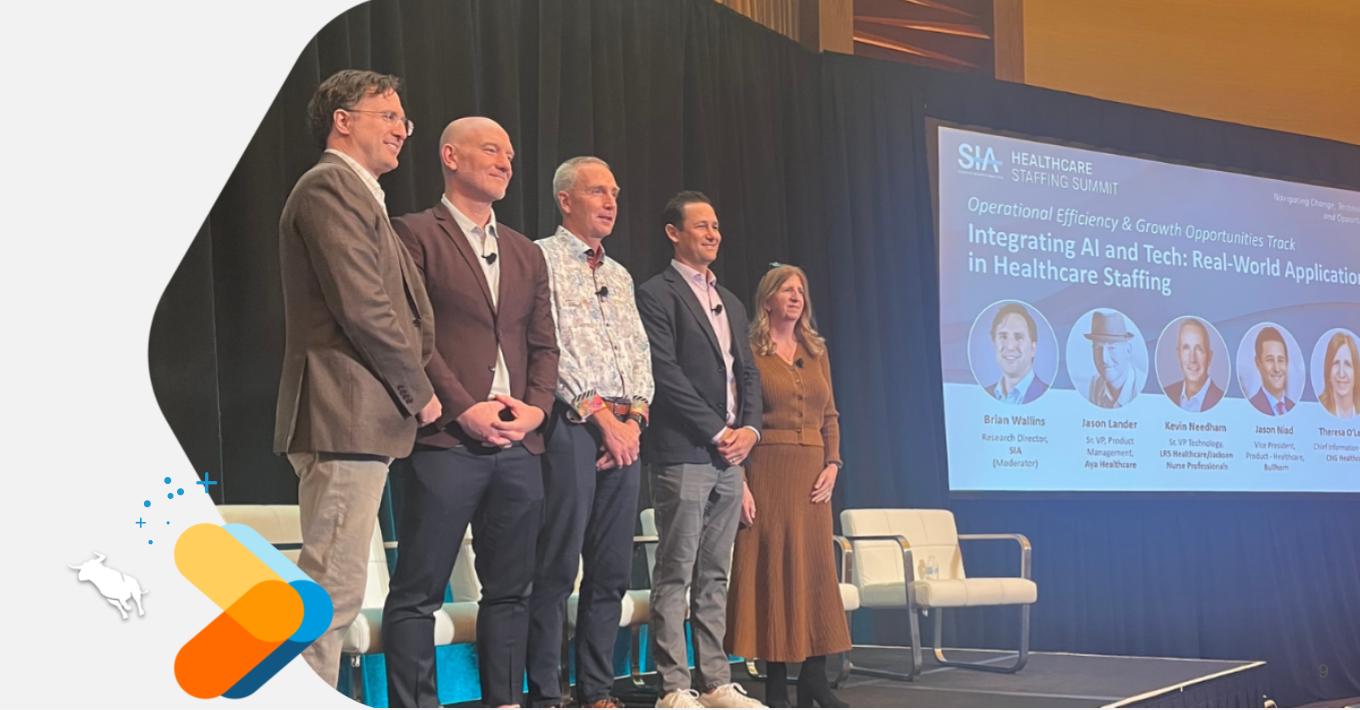
The conversations at the recent SIA Healthcare Staffing Summit were no exception. During the panel session on Integrating AI and Tech: Real-World Applications in Healthcare Staffing, healthcare staffing industry experts gathered to distinguish hype from reality. The panel featured Jason Niad, VP of Product, Healthcare at Bullhorn, alongside key technology leaders Jason Lander of Aya Healthcare, Kevin Needham of LRS Healthcare/Jackson Nurse Professionals, and Theresa O’Leary of CHG Healthcare.
The consensus was clear: the era of waiting on the sidelines to determine the ideal AI strategy is over. Firms that haven’t yet experimented with AI are already falling behind. Here are the essential takeaways from the session on navigating your AI journey.
The strategy: Start now and start small
One of the biggest hurdles preventing staffing firms from adopting AI is the fear that their data isn’t “ready.” There is a misconception that a pristine database is required before launching a single AI tool.
Jason Niad challenged this notion directly. “Great data is the key. It should not be a barrier to starting,” Niad said. “If you wait, you’re behind”.
The panel advised a pragmatic approach to implementation:
- Don’t wait for perfection. There are immediate use cases, such as data enrichment and resume creation, that don’t depend on perfect historical data.
- Take “small bets”. Kevin Needham of LRS emphasized making small, targeted bets. A project failing after a few weeks is not catastrophic; instead, it serves as a learning experience. This “fail fast” mentality is crucial.
- Start with “low” KPIs. To build organizational trust, Niad suggested starting with outcome-based KPIs that are “comically low”. The AI exceeding these targets builds confidence and excitement among the recruiting teams rather than creating anxiety about underperforming.
Real-world use cases: Beyond the hype
AI is no longer just a shiny object; it’s already driving efficiency across the entire staffing lifecycle and resulting in tangible wins. The panelists highlighted several areas where AI is making an immediate impact:
- Screening and engagement: The fear that candidates don’t like automation is fading. Niad noted that in many cases, candidates report having better conversations with screening agents than with newly hired recruiters.
- Data enrichment: AI can breathe new life into stale ATS data, pulling new insights and structuring unstructured information to make it actionable.
- Manager coaching: AI can recognize patterns and identify at-risk placements before they happen, allowing managers to intervene and coach the recruiter to save the placement.
- Transcription and Notes: Instead of relying on recruiters to take perfect notes, AI can transcribe calls and automatically populate CRM fields with structured data, such as licensure status and location preferences.
The recipe for success
Firms aren’t handing over entire jobs to AI, but they can allow AI to take over the most burdensome parts of a recruiter’s day-to-day work. Theresa O’Leary of CHG Healthcare likened the process to autonomous vehicles.
Drivers didn’t immediately switch to fully autonomous cars; instead, they gradually accepted features such as lane-keeping and steering-wheel vibrations. Staffing leaders should follow a similar incremental approach. Putting tools in people’s hands little by little allows them to get used to the technology and understand how it fits into their workflows.
To ensure a successful AI implementation, the panel agreed on these core pillars:
- Business-led, not tech-led: Technology projects fail when they lack a clear business problem. Success requires sales and operational leaders to buy in and drive the vision.
- Automate your hygiene: Relying on humans to clean up data often leads to inconsistency. Automation and AI can clean, structure, and migrate data more effectively. It is faster, more accurate, and frees up recruiters to focus on relationships.
- Strategy is key: A vision for where the organization is going is essential. This ensures teams aren’t just chasing “shiny objects” but are solving actual business problems.
The AI-enabled agency of the future
With AI accelerating at a rapid pace, no one can predict the future. That being said, the panelists speculated on what an AI-powered healthcare staffing firm might be able to accomplish now and in the near future.
O’Leary predicted that speed will be the defining factor for winning firms. By removing unnecessary complexity and automating processes, firms will become faster and more accurate, freeing up time to handle the unpredictable human elements of staffing.
Lander warned that success won’t come from merely inserting AI tools into existing workflows. He argued that true high performers will embrace “radical change,” building entirely new processes and skills rather than trying to retrofit old systems.
For Needham, the future is about creating personalized experiences at scale. He foresees a world where friction is eliminated for caregivers, for example, by uploading documents and having the system immediately recognize and process them without manual intervention.
Finally, Niad envisioned an “AI-first” world where every recruiter and account manager is supported by an AI agent to handle coordination. “It’s not a matter of replacing the recruiter at all,” Niad explained. “The recruiter is going to lead the relationship, and the AI is going to manage the coordination”.
Next steps
The landscape is moving fast. As O’Leary pointed out, speed is how you win in this space. However, moving fast doesn’t mean adding a dozen new tools to your tech stack.
Niad advised firms to look inward first. Before buying a new disparate solution that might silo data, staffing leaders should talk to their existing technology partners. “There’s no reason to go bring on a new technology… without talking to your existing vendors first,” Niad advised. “We’re in this with you.”
Are you ready to start your AI journey? Don’t wait to be left behind. Visit bullhorn.com/amplify today to learn how Bullhorn can help you start small, move fast, and unlock the power of AI in your workflow.