



















Demystifying the modern middle office: A Q&A with Eliassen Group
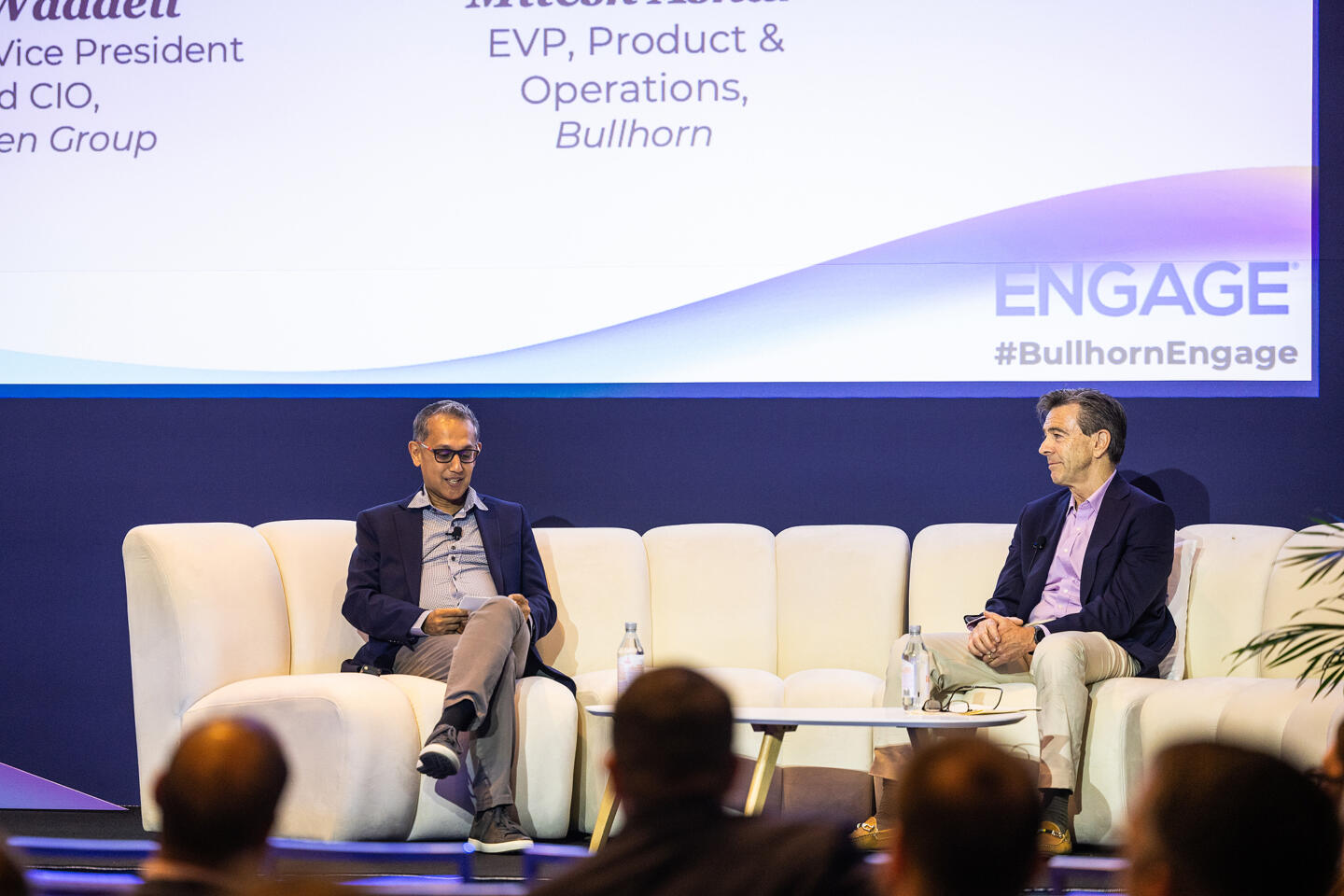
Over the past few years, Eliassen Group has undergone a major digital transformation, modernizing its tech stack to support its global growth and streamline operations. Mitesh Ashar, Chief Customer Officer at Bullhorn, sat down with Rob Waddell, EVP/CIO of Eliassen, who led the organization’s shift, to discuss Eliassen’s approach, the role Bullhorn Recruitment Cloud and Bullhorn Middle Office played, and the advice he’d offer other leaders considering a similar move. We’ve edited their conversation below for length and clarity.
Ashar: Eliassen has made some major shifts in recent years. Can you share a bit about this?
Waddell: Sure. So over the last 35 years, Eliassen has grown into a $500 million business. We’ve evolved significantly in our use of technology. After a strategic review in 2023, we set our sights on global growth and better cross-selling across our three business pillars: technology solutions (our technical consulting and staffing pillar); financial, risk and compliance advisory; and clinical solutions business. We saw clear cross-selling opportunities that we weren’t capitalizing on and realized we needed a more unified process across these groups. That led us to find the right system to support our goals.
We learned that Bullhorn could do something to tie the ATS to the middle office using Workato, and we landed on integrating Bullhorn’s Middle Office with Bullhorn Recruitment Cloud. And I’m pretty happy we did.
Ashar: Before you actually implemented the solution, what were some of your big challenges from a payroll and billing standpoint?
Waddell: Before implementation, we relied on a heavily customized Erecruit setup for payroll and billing. But there was a lot of custom automation in there, and it wasn’t really set up for long-term integration success. So as we started pushing into global expansion, the idea of shifting some of that automation to our partners instead of handling it all in-house just started to make more sense. We used NewAge Technology’s cloud-to-cloud services and integration services to integrate with downstream systems like tax, sales tax, and currency conversion. And the kind of technology Bullhorn is using now is going to make those integrations a lot easier.
Ashar: Were there any inefficiencies?
Waddell: Yes! Our VP of Finance sees the biggest benefit in using VMS Exchange — the automated connection to VMS platforms for time capture. Previously, we had to manually log into each VMS to pull down time entries, which was time-consuming. Now, that process is fully automated.
Ashar: What were some of the key decision criteria for you to select this solution over others in the market?
Waddell: Well, I think our trust in Bullhorn was key. I’ve never wanted a big engineering team. We just need efficient, reliable solutions. The Salesforce ecosystem really matched well with where we were headed with the business. If you think global expansion, Salesforce is perfect for that on the ATS and CRM side. Having Bullhorn Middle Office as a part of that package just made it a lot easier than having to integrate with a separate pay bill system.
Ashar: You were migrating from Erecruit to a complex new solution, which must have felt daunting. How was the implementation and migration experience?
Waddell: Well, we tried to avoid unexpected challenges by assessing a lot of risk. We were changing out the ATS we were already lightly using the CRM and Salesforce, but we went all-in, changing out the complete tech stack. That included introducing a new middle office and, partway through the project, switching our PSA [professional services automation] tool from Projector to Kantata.
We also had a move from Great Plains to Sage in the middle of this for the GL. So we took on a ton of risk for an 18-month project. Three factors made it work: first, partnering closely with Bullhorn’s program management and your top engineering and architecture team for the middle office; second, bringing in Newbury [Partners] for program management on our side; and third, uniting everyone into one team working directly with our business leaders. Our leaders even ran several work streams, including data migration and cleansing.
Another critical area was reporting. One of our practice leaders led the reporting workstream and process, while key recruiting and sales players worked closely with our core development team on process improvements. Standardizing processes across all three pillars was risky, but they did an outstanding job. We managed risk weekly, never letting issues linger, with regular program updates involving all suppliers. We also brought in a change management leader from our practice.
Ashar: You mentioned change management is crucial. What strategies or training methods did you find most effective?
Waddell: We brought in a practice leader from our team to focus on change management. She surveyed the entire employee population to understand their expectations and clear up myths about the new system. That insight helped us communicate clearly and manage expectations throughout the rollout.
We also worked closely with our learning and development team and Bullhorn’s training group to tailor training. We focused on just-in-time training, especially during the early implementation weeks, to support recruiters and sales staff as they adapted. Even now, we keep an active Teams channel where employees support each other, which has helped make the transition incredibly smooth.
We planned an 18-month rollout but delayed two months to reinforce training and thorough testing, including three full test rounds and multiple go-live rehearsals. Launching on September 9th went smoothly, thanks to this careful, low-risk approach.
Ashar: That’s fantastic. Since going live, beyond the VMS benefits you mentioned earlier, are there other advantages your team is seeing?
Waddell: Besides tightening our partnership with Bullhorn, which is key, the investment we’ve made there is definitely paying off for us.
Ashar: Now that you’re using Workato to keep the data clean, do you feel like you have the foundation for being able to embark on this AI journey?
Waddell: Yes. The data is cleaner and governed more strictly. We’ve reduced client duplications with a custom tool in Recruitment Cloud that flags them. New accounts route through a check process.
Clean data is essential for AI. With tools like Search & Match and Amplify, that consistency gives us a strong foundation.
Ashar: What advice would you give to folks here evaluating Bullhorn Middle Office or Recruitment Cloud?
Waddell: First, build a strong partnership with your supplier (in this case, Bullhorn). I really believe the more you invest in that relationship, the more it pays off. They’ve been working hard to unify their teams across the organization, and that helps us as clients.
Second, change management is critical. Understand what your employees think is happening, communicate clearly and often, and avoid tech jargon. Bring in a professional if you can; they know how to translate complex changes into everyday language that resonates with your people.
And finally, test. Measure more than once, and only then make the cut. That’s what helped our go-live run so smoothly.
Ashar: That’s incredibly helpful, and a great way to wrap things up. Rob, thanks for taking the time to share your story and lessons learned.
Waddell: Of course — thank you for having me.