
















The sweet spot of software: Building tailored solutions on Salesforce without the wait
Salesforce has firmly established itself as a dominant force in the software landscape. As of 2024, it held a staggering 21% of the global CRM market, more than its four closest competitors combined. But it’s more than just a CRM — at this point, it’s a business platform. Salesforce is an essential tool for businesses worldwide, providing a powerful and flexible platform to manage business operations.
At its core, Salesforce’s success lies in its adaptability. The platform offers a wealth of tools like the Lightning Design System and Lightning Web Components (LWCs), which empower customers to build compelling, custom solutions tailored to their unique needs through the power of modular design. With a modular design, the platform can be broken down into independent, manageable building blocks – modules – that can be combined and customized to suit specific needs. This ability to customize is a key reason why so many businesses have come to rely on the Salesforce ecosystem.
Here at Bullhorn, our goal is to move away from one-off, client-specific, bespoke customizations that, while powerful, are limited in their application. Instead, we are focused on creating robust, modular tools that can be readily implemented by a wide range of customers to solve their specific business challenges.
The software spectrum: Finding the balance between a custom build and a rigid product
In the world of enterprise software, businesses often face a difficult choice: invest in a heavily customized solution tailored to their exact needs, or adopt a standardized product that promises speed and efficiency. Both paths have their appeal, but they also come with significant trade-offs.
A ground-up custom build can be powerful, but often requires a lengthy implementation and a significant investment in professional services. And over time, you may be locked into tech built for a business model that is no longer relevant. On the other end of the spectrum, a rigid, off-the-shelf product can get you up and running quickly, but may force you to change your workflows to fit its constraints, leaving critical gaps in your process. If those constraints are too limiting, there’s a high potential to get stuck paying for costly customizations or taking on additional complexity to implement third-party solutions.
This presents a challenge: how do you get a solution that is tailored to your unique business needs without the high cost and long wait of a fully custom project?
Putting the right building blocks in place
At Bullhorn, we believe the answer lies in a different approach to product development. Rather than delivering a single, monolithic solution, we focus on building a powerful foundation of core components (or “building blocks”) that can be quickly and easily configured and combined to meet specific business challenges.
This philosophy allows us to handle the heavy lifting — performance, security, and core functionality — while providing our customers with the tools to tailor the user experience and create new capabilities. The goal is to accelerate the implementation process while still allowing for the precise customization that recruitment and exec search agencies need to be competitive.
For example, imagine a recruiter wants to select candidates from an arbitrarily defined collection and send them personalized emails promoting a given client. They could specify criteria for choosing the candidates within a Bullhorn-built candidate management module; generate personalized content using Salesforce Agentforce functionality; and then send the email using a Bullhorn-built email management module. This combines customer-specific requirements with already existing technology from both Bullhorn and Salesforce to create a new capability with the smallest possible effort. This gives customers the flexibility to tailor product functionality, with “no code,” “low code,” or “pro code” based on their own interests.
Designing for a cohesive experience
Beyond a modular architecture, our product philosophy extends to the user experience itself. We intentionally design our components to match the look and feel of native Salesforce elements. By building on the official Salesforce Lightning Design System (SLDS), we ensure that moving between something standard in Salesforce into a Bullhorn component is a seamless transition. This design consistency is critical; it reduces the cognitive load on users and eliminates the jarring context-switching that can lead to fatigue and slower adoption.
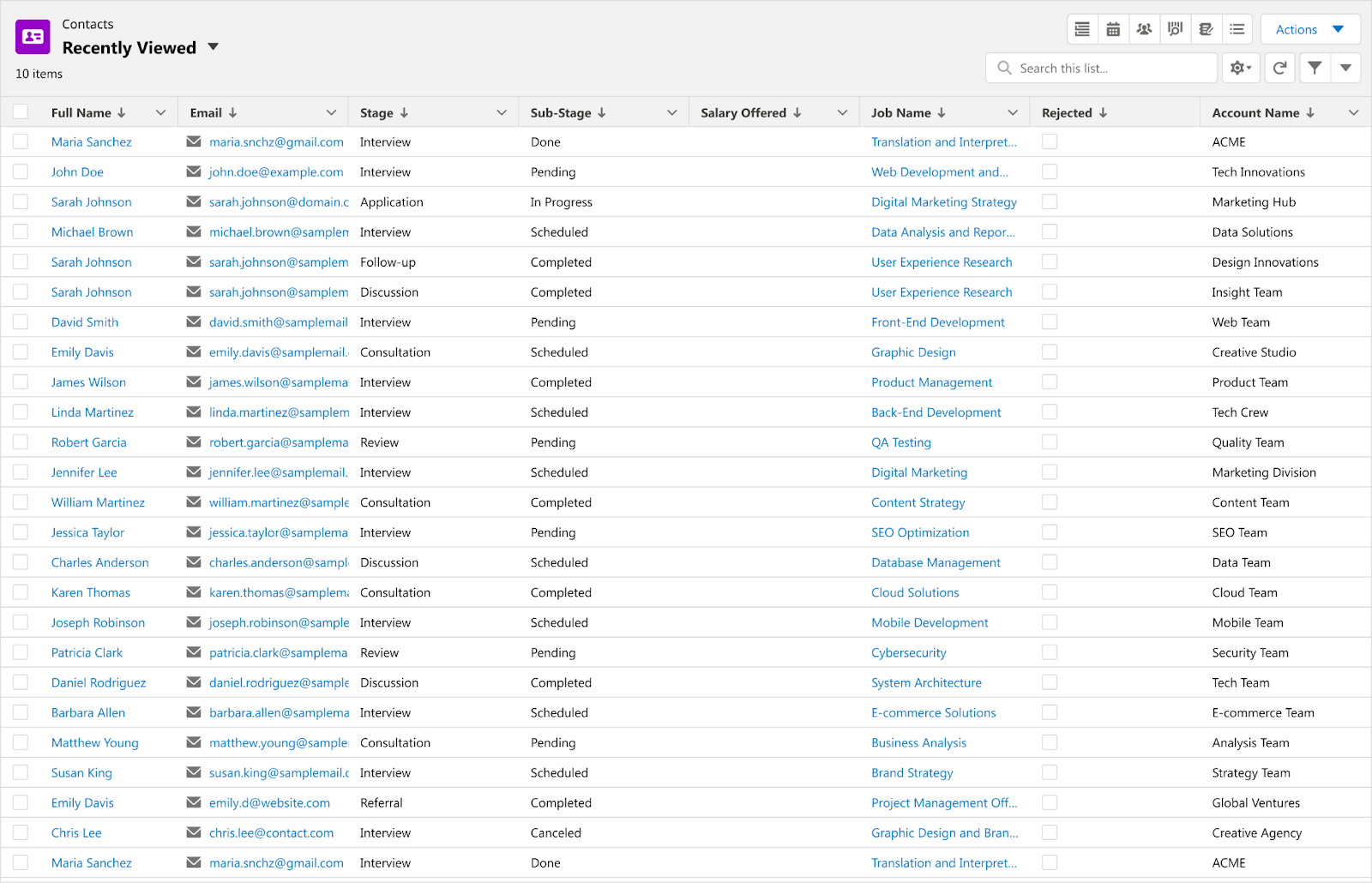
Omnitable example configured for the contact object
Introducing Omnitable
A prime example of this philosophy is Omnitable, our universal table experience for the Bullhorn Recruitment Cloud. Since introducing Omnitable, we’ve seen an 88% performance boost in table load times across our platform.

Omnitable offers a dynamic alternative to traditional static tables, providing users with enhanced flexibility and functionality. With Omnitable, users can:
- Find information faster: Users can run quick filters, column searches, custom sorts, and named filters to quickly locate what they need.
- Work more efficiently: Features like in-line editing, text clipping/wrapping, customizable columns, and adjustable row heights allow for faster data interaction and updates.
- Seamlessly access data: A full-screen view and respect for Salesforce’s “compact” view make it easier to work with large datasets. Similarly, customers can choose to layer in a separate “record preview” component (also called contextual data viewer) to enable quick access to object data without leading the table.
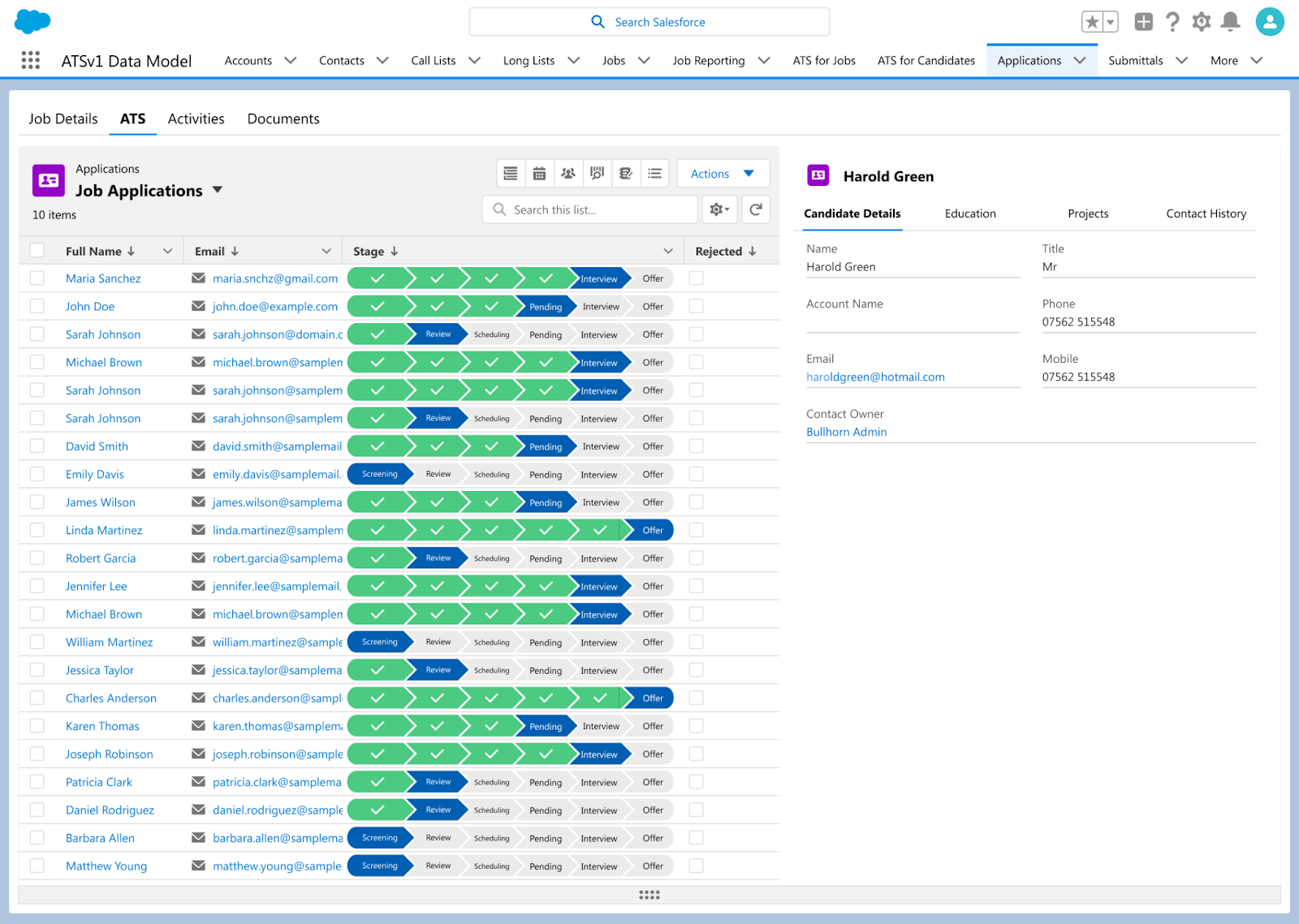
Omnitable configured with the record preview component
In addition to UI improvements, Omnitable gives administrators advanced configuration options. Admins can now fully configure which actions are enabled with each and every Omnitable setup. Similarly, admins can now integrate custom actions (such as a custom “update status” action) into workflows and eliminate manual steps. Perhaps most importantly, actions in Omnitable are now wrapped in Salesforce Flows, which allows agencies to build and design their own simple, flow-based logic around Recruitment Cloud packaged actions.
With Omnitable, work in Bullhorn Recruitment Cloud becomes truly seamless. Users experience consistent actions and a familiar layout everywhere they go. The same actions are available whether navigating a specific workflow or working with different record types so that recruiters can move quickly and confidently through tasks, boosting productivity.
Furthermore, because we are continuously adding new functionality with each release, clients get a tool that evolves with the product without requiring a new implementation. This iterative development process is a key advantage of modular design, allowing us to deliver value to our customers more quickly and efficiently. By finding this balance, we can offer the best of both worlds: the speed and stability of a mature product, combined with the flexibility of a custom-built solution.
The future is modular
Ultimately, this middle path between custom builds and rigid products offers a powerful path forward for software development. It allows companies like Bullhorn to deliver solutions that are both highly customizable and quick to implement. By finding this “sweet spot,” we can empower our customers with the tools they need to tackle their unique business challenges, without the long waits and hefty price tags associated with traditional custom development. This balanced approach allows for precise customization while leveraging the speed and efficiency of a well-designed product.