





















Weekly Insights
Mar 31, 2026
Employers seek emotional intelligence and vision
Intuitive traits like reactivity and emotional intelligence surged in Q4 2025, up 49% and 8% respectively, as employers prioritize adaptability and interpersonal awareness. Meanwhile, show courage and non-verbal communication saw some of the steepest drops at -67% and -43%, respectively. Employers are favoring workers who can collaborate effectively in a team and read the room.
Mar 24, 2026
White collar job postings cut in half since 2023
Job openings in finance, IT, and public administration have fallen more than 50% since Q1 2023, though the impact varies by region. New York and Minneapolis were hit hardest, with declines of -69% and -66% respectively, while southern markets like Austin have proven more resilient, down just -36%. A brief mid-2025 rebound across most cities has since reversed,with Q1 2026 confirming the downturn is continuing.
Mar 17, 2026
Internship hiring slows as finance pulls back sharply
Internship hiring has slowed multiple industries since 2023, reflecting a more cautious approach to early-career recruiting. Declines have been particularly pronounced in sectors such as finance, IT, and healthcare; finance and insurance internship openings have dropped nearly 60% from Q1 2023. Finance has historically relied on internships to build pipelines for entry-level analyst roles, making the drop especially significant. Despite the broad pullback, manufacturing continues to offer the highest number of internship opportunities, underscoring the sector’s ongoing need to build skilled talent pipelines.
Mar 10, 2026
Administrative support relies heavily on temporary workers
Employers, wary of economic uncertainty, have been relying increasingly on temporary and other contingent workers to run their businesses, while maintaining the flexibility to quickly scale their workforce up or down if conditions change. But what industries have created the most temporary and contract roles in the first 10 weeks of the year? Administrative support roles dominate by a large margin, but retail, IT, and even education are also turning to contract workers.
Mar 3, 2026
Healthcare hiring is concentrated in clinical roles
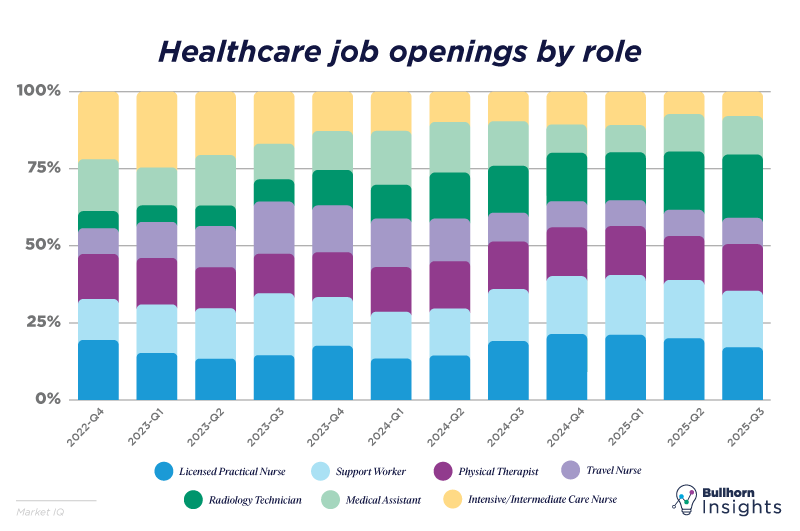
Despite mounting burnout and administrative challenges, non-clinical job openings in areas like HR, IT, and management, are down more than 30% since Q2 2022. Meanwhile, clinical job openings across nursing, therapy, and direct care roles are up roughly 5% over the same period, with clinical roles now accounting for nearly two-thirds of healthcare openings. The healthcare sector is focusing on care delivery over infrastructure and securing patient-facing talent.
Feb 24, 2026
Remote roles still represent a significant part of the job market
After peaking at 13% of all job openings Q2 2022, the share of remote roles steadily declined through 2023 and much of 2024, bottoming out at 9% in early 2025. A brief rebound in mid-2025 pushed remote roles higher but the gains have since reversed, with levels still below the 2022 peak. While remote work is no longer expanding at the pace seen during the pandemic, it remains a significant factor for job seekers, pushing employers to balance return-to-office mandates with flexibility.