





















Run with the bold: What you missed at the Engage Boston 2026 keynote
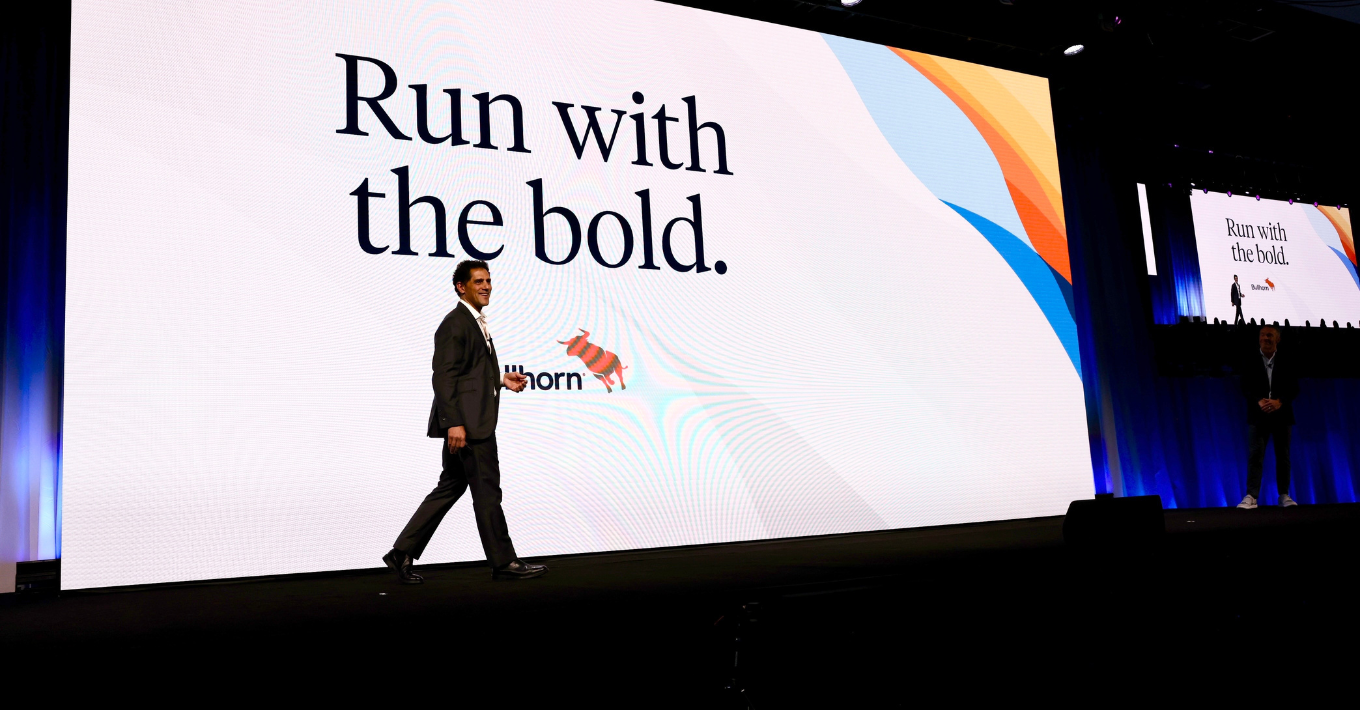
Over a thousand staffing professionals gathered for Engage Boston 2026, and Bullhorn founder and CEO, Art Papas, wasted no time setting the tone. His opening keynote delivered a clear message to the industry: AI isn’t here to replace your people. It’s here to unleash their full potential.
Joined on stage by Bullhorn’s Chief Innovation and Labs Officer, Jason Heilman, Papas walked attendees through the market forces reshaping staffing, debuted a wave of new Amplify capabilities, and challenged leaders to rethink the entire operating model of staffing, using AI not to shrink teams, but to automate low-value work, redirect recruiter capacity to strengthen customer service, and drive growth that was previously impossible under a headcount-constrained model.
Watch it all on the Engage Boston 2026 keynote and content hub. Highlights.
Three market forces reshaping the staffing industry
Papas urged the audience to step back and consider the broader forces at play, forces that should inform how staffing leaders think about AI before defaulting to the obvious “do more with less” playbook.
Market force 1: AI-driven productivity. The results are undeniable. Bullhorn’s early Amplify adopters have seen massive gains: a 40% increase in submissions, a 65% improvement in submission-to-placement ratios, a 23% jump in gross profit, and 200 hours saved per week at one firm alone, freeing recruiters to focus on building relationships instead of pushing paperwork. These aren’t intangible benefits; they represent enormous, measurable business value created by weaving AI throughout the recruitment process.
Market force 2: Overwhelming volume and fraud. AI doesn’t just help the good guys. Papas shared how automated job-application tools now allow candidates to spam 1,500 applications daily, flooding recruiters with unqualified, and sometimes fraudulent, applicants. What feels like a high-volume problem today is only the beginning. Staffing firms need AI not just for productivity, but as a frontline defense against a rising tide of bots and bad actors.
Market force 3: Margin pressure and talent pipeline disruption. Bullhorn’s own data shows a 10% margin compression over the last twelve months, and the pressure is accelerating. At the same time, Papas raised a question the industry needs to grapple with: if firms stop hiring junior recruiters because AI handles the entry-level grind, who becomes the next generation of sales talent? Without a pipeline of people learning the craft today, firms risk having no one ready to lead tomorrow.
The grind vs. high-value work
One of the keynote’s most compelling segments reframed how staffing firms should think about their people. Papas broke the recruiter’s job into two halves: “the grind” (data entry, screening, cold outreach, resume formatting) and the high-value work of negotiating, coaching, and closing.
The data tells a stark story. In 2017, about 41% of new recruiter hires were still on the job two years later. By 2024, that number had dropped to 35%. The grind is getting worse, and it’s driving recruiter turnover to new highs.
Papas emphasized that Amplify’s digital workers should handle the grind so human recruiters can focus on the work that actually drives revenue and that actually makes people want to stay in the profession. These AI-powered digital workers, built into the Amplify platform, ramp instantly, work around the clock, and have zero turnover.
Amplify in action: From sales prospecting to candidate care
Jason Heilman then took the stage to show how more than 200 staffing firms are already using Amplify to solve some of staffing’s biggest operational challenges, automating repetitive work so recruiters and account managers can focus more of their time on the activities that drive revenue, placements, and stronger customer service.
AI-powered sales prospecting.
Planet Group shared how they used Amplify to find targeted prospect lists, identify decision-makers, and generate personalized outreach, all in under a minute. The system pulled from both the open web and years of data the team had built inside Bullhorn, connecting the dots between the two in ways no single tool had done before.
“I can’t go back to the way I was working before.”
– Planet Group, Bullhorn Amplify Pioneer
Heilman then showed how Bullhorn has graduated those conversational workflows into a structured prospecting tool. Sales reps can now search for look-alike companies, find talent-matched prospects, or re-activate dormant clients, all backed by a database of 60 million company profiles, 500 million contacts, and 800 million resumes.
Amplify everywhere. A key theme was that Amplify now follows users wherever they work, not just inside Bullhorn. Whether a rep is researching new prospects, getting a Teams notification about a booked meeting, reviewing a prep sheet before a call, or on a live Zoom conversation, Amplify is there capturing context, surfacing relevant data, and updating records. After a sales call, it pulls out key points, action items, new information about the contact, and even creates job openings directly in Bullhorn from what was discussed.
Recruiting tools and AI screening. Recruiters from TriStarr shared how Amplify transformed their workflows. When a new job comes in, Amplify immediately surfaces ranked candidates with detailed explanations of why each is a strong fit. One recruiter described how she asks Amplify to break down unfamiliar jobs “as if I were a five year old.” TriStarr reported cutting new-recruiter ramp time from six months to roughly two months.
“If you took Amplify away, it would be like taking away oxygen that humans need to breathe.”
– TriStarr, Bullhorn Amplify Pioneer
Heilman also highlighted Amplify’s AI screener, which now processes nearly 100,000 screens per month. Candidates across industries, job types, and wage levels rate the experience an average of 4.5 out of 5 stars, whether the screening happens via voice or text and across multiple languages.
Resume preparation. What used to be a fifteen-to-thirty-minute manual task, reformatting a candidate’s resume to match a client’s template, is now handled automatically. Amplify pulls in context from screens, conversations, and interactions to build the strongest possible submission, formatted exactly to the agency’s standards.
Fighting fraud and protecting revenue
Heilman dedicated a significant portion of the demo to Amplify’s new Verify capability, essentially a “bouncer” at the front door of every application. The system detects bot behavior, VPN masking, and suspicious patterns that human recruiters would never catch, even with unlimited time. Trust signals follow candidates throughout the process, from application, through onboarding and document verification, to ongoing assignment check-ins.
On the back-office side, Bullhorn introduced AI-powered auditing capabilities. Instead of hard-coding compliance rules, back-office teams can now describe what they want to check in plain language (pay rate versus bill rate mismatches, overtime coding errors, minimum wage violations) and Amplify runs those checks on every transaction. Papas shared an anecdote from a customer who once overpaid a candidate by $20,000 because of a keying error, a mistake this system is designed to catch before it becomes costly.
The pioneer data: Proof that bold pays off
Perhaps the most persuasive moment of the keynote came when Papas returned to share data from Bullhorn’s Amplify pioneers. Despite facing the same 20% decline in job orders as the rest of the market, firms that kept their headcount steady or grew while using Amplify saw a 40% increase in placements per recruiter compared to non-Amplify users.
The key insight: these firms didn’t use AI to cut staff. They used AI to remove the administrative grind that slows recruiters and salespeople down, freeing them to focus on the high-value work closest to revenue, including building relationships, moving faster with clients and candidates, improving service delivery, and ultimately winning more business and making more placements.
And now they’re asking for the next step: AI embedded directly into the workflow that tells recruiters and sales teams what action to take next to drive placements, revenue, and stronger customer outcomes. Amplify is delivering exactly that, fundamentally changing what it means to succeed.
Run with the bold
Papas closed with a challenge to the room. When a novel technology arrives, most people fixate on productivity and cost reduction. But the Amplify Pioneer customers who took the stage at Engage told a different story. They didn’t use AI to cut staff. They invested in their teams, leaned into Amplify, and came out winning. That’s what bold leadership looks like.
Bullhorn’s invitation to the staffing world: run with the bold.