




















AI is here for middle office: How Amplify is eliminating the grind
The middle office has always been where complexity lives. Timesheets, payroll, compliance checks, invoicing. It’s detailed, consequential, and relentless. A $200 overtime rate entered as $20. A duplicate timesheet upload that paid 47 people twice. A minimum wage table that nobody remembered to update. These aren’t hypotheticals. They’re the stories behind the weekly checklists that middle office teams have been running for years.
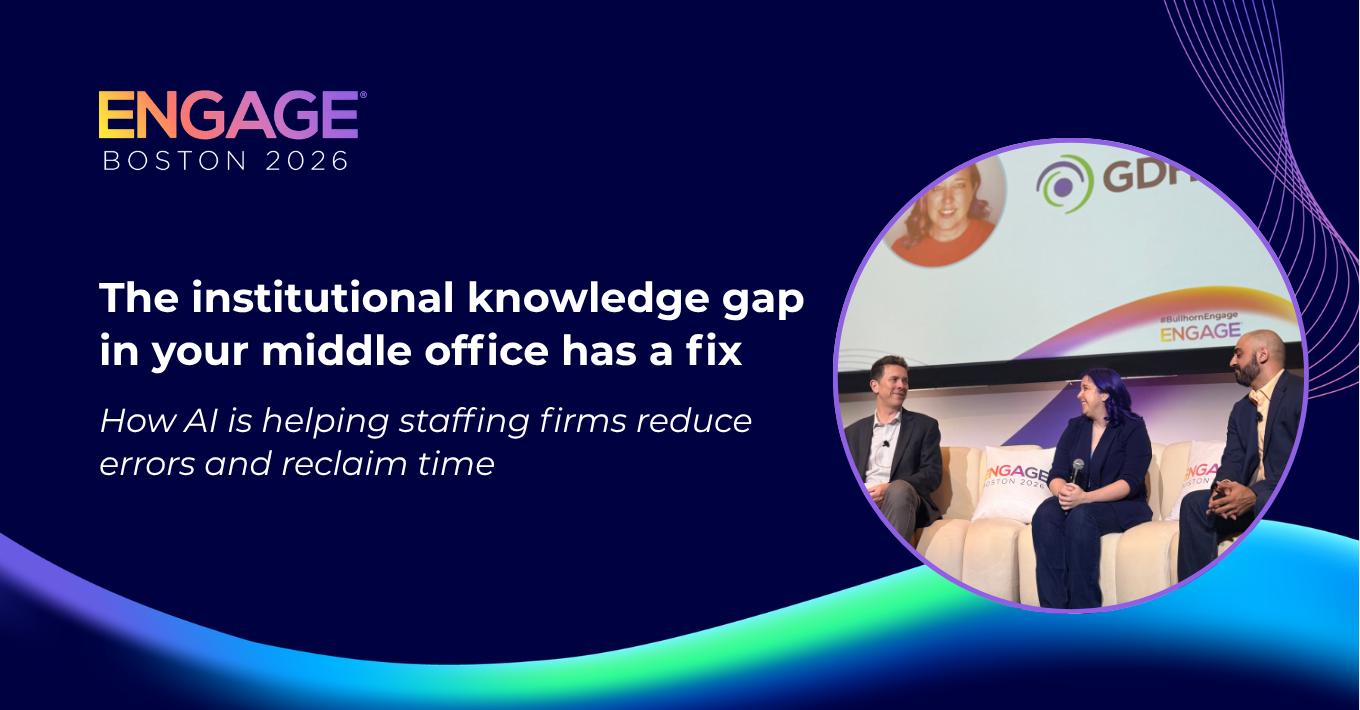
At Engage Boston, Bullhorn’s Tim Sebel, VP of product, Middle Office, and Shahab Midanaky, senior product manager, Middle Office, walked through a year’s worth of middle office updates and made a bigger announcement: Amplify is now in the middle office.
Here’s what they covered.
The weekly grind that Amplify is built to solve
Ask any middle office team to describe their week, and you’ll hear the same structure. Monday is timesheet chasing. Tuesday is approval chasing. Wednesday is payroll reconciliation. Thursday is invoicing. Friday is compliance prep for next week. Repeat.
It’s work that is, as Sebel put it, “simple but detailed, and repetitive but consequential.” Errors carry real financial costs, real legal exposure, and real damage to candidate and client relationships. And yet most of the time spent isn’t on finding and fixing issues, it’s on the manual process of looking for them.
There’s also the tribal knowledge problem. Every middle office team has a version of what Sebel called “the Jacob file,” a process or spreadsheet built by someone who left years ago, that everyone runs every week, nobody fully understands, and that nobody dares to change. That institutional fragility is exactly what Amplify is designed to address.
Amplify Chat: Answers in minutes, not half a day
Amplify Chat is available now for middle office use cases. Recruiters and operations staff can ask plain-language questions directly in the platform like which placements haven’t submitted time this week, which of those are in their first week, how many haven’t logged time in three weeks.
The practical impact goes beyond convenience. Sebel shared an example from a Bullhorn customer whose business flagged a potential turnover problem at a specific client. Pulling together the data to investigate, normally a half-day exercise across Excel, reports, and data exports, took five minutes in Amplify Chat. The recruiter came back to leadership with a clear answer and the data to support it.
Amplify Audit: Replacing the checklist with AI
Instead of running manual checklists and reports to catch payroll and billing errors, you write audit rules in plain language and let the AI run them across every placement, timesheet, payable charge, and billable charge in your system. No code. No services engagement required to build it. No black box that nobody can touch.
The audit rules are written in natural language, which makes them easy to update and change as your business evolves. Build something with a services partner, and it’s fixed the moment it’s finished. With Amplify Audit, your team can refine and expand rules on their own as needs change.
The examples Sebel walked through showed just how flexible the audit can be. The audit can be set up to confirm that pay is below the bill rate and that California placements have meal break penalty earn codes on the rate card. A minimum wage check can run a live web search to find the current local minimum wage and confirm the placement is compliant. More complex rules can compare a placement’s rate card against similar active placements at the same client, or flag any timesheet where hours are more than a certain percentage above the three-week average.
Results come back clean, showing what passed, what failed, and the reasoning behind each outcome.
The roadmap takes Amplify Audit further. The next phase will allow audits to run automatically in the background, with results writing back to fields and statuses in the system, so a placement that fails an audit can be flagged before it ever reaches payroll. Amplify Audit is in early adoption now, with general availability planned for Q3.
From the field: How GDH put Amplify Audit to work
A compelling moment of the session was when Molly Brasel, a middle office leader with 12 years of experience at GDH, a global workforce solutions provider specializing in IT staffing and professional services, joined the stage to share her team’s experience with Amplify Audit.
GDH got access through the early adopter program. Brasel’s reaction to the initial walkthrough was immediate.
“My jaw dropped, I think, about the time you showed the checking the minimum wage. And I never lifted it up from there.”
She had set aside a full day to test the product and get up-to-speed. She didn’t need it.
“We had it up within about an hour, and I had it over to my compliance specialist, and she’s been running with it ever since.”
GDH started with 12 audit checks. Within weeks, they had 30. Brasel said she receives messages daily from her compliance specialist requesting new ones.
The time savings are concrete. Her compliance specialist was previously spending roughly 30 minutes per placement on compliance verification, cross-referencing the placement record, the candidate record, the job, location details, and state websites. With Amplify Audit, that same check takes about 90 seconds.
The adoption surprised even Brasel. She expected some resistance, as middle office teams run on trust, and handing verification work to an AI agent is a meaningful shift. Instead, her team’s feedback was unambiguous.
“I get messages every day saying, ‘I love this.’ ‘It’s better than chocolate.’ ‘It’s better than naps’. ‘Please do not take this away from me.'”
Looking ahead, Brasel is focused on expanding GDH’s use of Amplify Audit beyond placement checks to billable and payable charges, and on getting better data faster across departments.
“They’re integrating it directly into every stage of your process to make sure you’ve got that validation.”
Amplify Extract: From data entry to data verification
Paper time cards aren’t going away. Emails, scanned images, spreadsheets, and the occasional napkin with scribbled hours still land on middle office desks every Monday morning. Amplify Extract is built to handle all of it.
The feature ingests any format, including multi-page images, spreadsheets, and photos, and uses AI to identify the candidate, the placement, and the transactions. Confidence meters flag anything the system isn’t certain about, so the person reviewing knows exactly where to focus. The result is a shift from manual data entry to faster, less error-prone, and significantly more manageable data verification.
Coming alongside Amplify Extract is a chat-based time-entry feature. The system will learn when individual candidates typically submit time, reach out proactively around that window, and collect their hours in natural language. It handles the full workflow, from meal and rest breaks, cost reason fields, and attestations. It can mark a timesheet as “did not work” if the candidate reports no hours. And if someone responds that they stopped working at that client months ago, it flags that for cleanup, too.
Amplify Extract is with early adopters, and is coming soon.
Middle office work has always been too important to get wrong and too repetitive to get right every time at scale. Amplify is changing that equation. Amplify Chat is live now. Amplify Audit is in early adoption with GA in Q3. Amplify Extract is with early adopters and coming soon.
Bullhorn has been in the business of reducing operational friction for staffing firms for 25 years. Amplify in the middle office is the next step in that work, and it’s available now.
Ready to see Amplify in action? Learn more here.