




















Unlock new revenue streams: The diversification blueprint for staffing firms
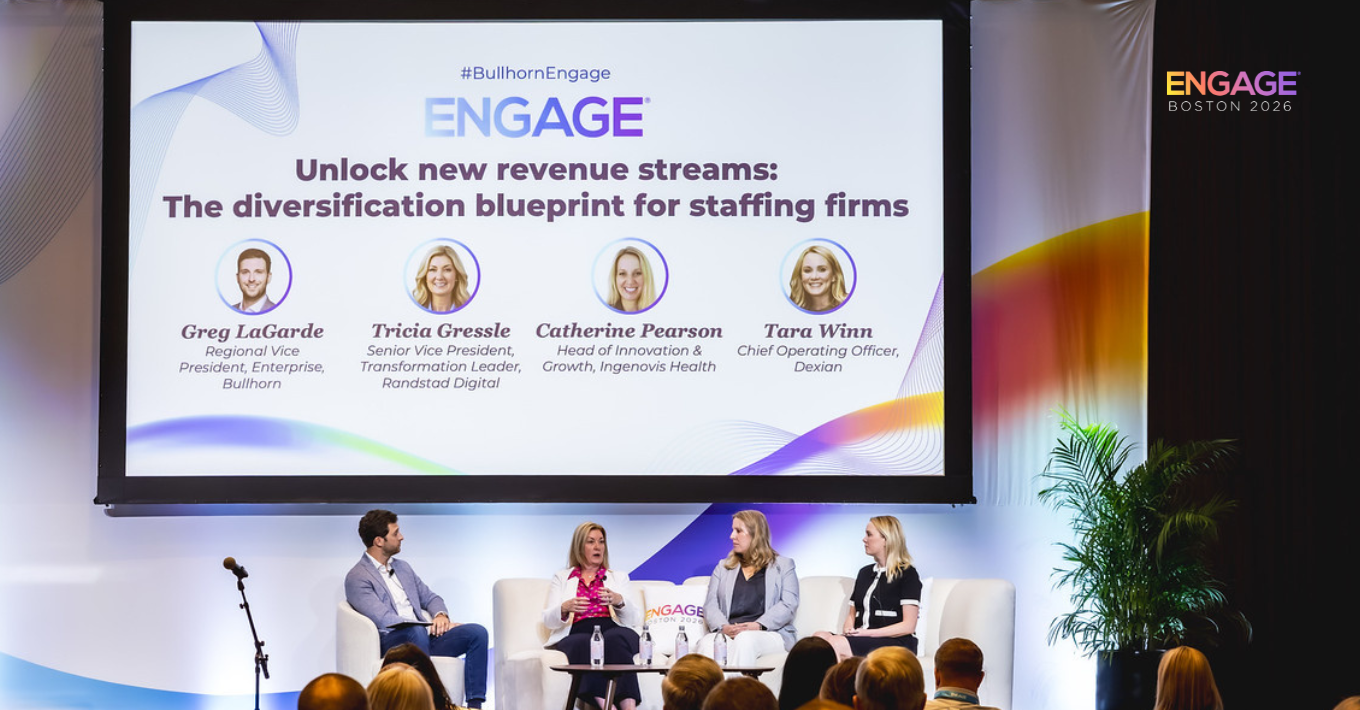
Diversification sounds straightforward until you’re the one responsible for executing it. At Engage Boston 2026, Gregory LaGarde, regional vice president of enterprise accounts at Bullhorn, led a conversation with three leaders who are doing exactly that. Tara Winn, chief operating officer at Dexian, Catherine Pearson, head of innovation and growth at Ingenovis Health, and Tricia Gressle, senior vice president and transformation leader at Randstad Digital, each brought a different vantage point and a candid account of what’s working, what isn’t, and what they’d do differently.
Here’s what they covered.
Redefining what diversification actually means
For years, diversification in staffing meant adding a vertical or launching a new service line. That definition has expanded considerably.
At Dexian, the shift is away from headcount-based volume staffing and toward capability-based solutions, including global capability centers, channel sales partnerships with technology firms, and digital workers built on AI acquisitions made two years ago. Staffing will remain a core part of the business, but it won’t be the only engine driving growth.
Randstad Digital is moving across a similar frontier, selling nearshore capabilities, consulting services, and direct-to-customer offerings through a digital marketplace, while ensuring the portfolio isn’t over-indexed on any single industry. When one sector softens, another is able to carry the weight.
At Ingenovis Health, diversification is as much about focus as expansion. With margin compression across travel nursing and shifting reimbursement rates from CMS and Medicare, the focus has been on identifying where revenue is actually coming from, where it’s leaking, and where subspecialty opportunities like cardiovascular staffing represent defensible, higher-margin growth.
The point all three leaders landed on was the same. Revenue isn’t disappearing. It’s moving. The firms that follow it are the ones building for the next three years, not the next quarter.
Bold moves and the risks worth taking
Dexian acquired two small AI firms 18 months ago. At the time, it felt like a distraction to many inside the organization. Today, those acquisitions underpin the firm’s ability to bring digital workers to market. The investment took two years and a sustained tolerance for uncertainty. It paid off.
Randstad Digital went through two ATS migrations in nine months, a pace that pushed the organization hard and created real change fatigue. But it also moved the firm to a tech architecture that can actually support where the business is going. Getting the stack right was the prerequisite for everything else.
Ingenovis has learned a version of the same lesson the harder way. An early AI investment made on the strength of a personal relationship rather than a rigorous evaluation didn’t deliver. Moving past it required honesty about what wasn’t working and the willingness to start over. Shorter contract cycles and better desk-level data have since become a priority.
The common thread is that waiting for a perfect plan costs more than moving quickly. As Pearson put it, you build the plane while it’s already in the air. What matters is having confidence in your team and enough understanding of the business to make real-time decisions when the ground is shifting.
Change management is where most firms underestimate the work
Picking a technology or strategy is the easy part. Operationalizing it is where the real effort lives.
Randstad Digital has embedded change agents inside each leader’s organization. Those individuals know what’s on the roadmap, what’s changing, and what the benefit will be before anything rolls out. They also test everything first at the team level, which means every team has someone who has used the product and can speak to its value from experience rather than from a training deck. In some cases, the firm has deliberately removed old workflows from the system to prevent teams from reverting to habits the business is trying to move past.
Dexian has built its change management philosophy around the difference between a fixed mindset and a growth mindset. Leaders who wait for requirements to arrive rather than going out to find new opportunities are the ones creating drag. Winn described it plainly. If a market review reveals a leader has no answer to what they’re doing differently with AI to adapt, that’s a fixed mindset, and it’s a signal that something needs to change before the business can move forward.
The underlying principle, across all three firms, is that shielding sellers from change and asking them to succeed in a market that has already changed are goals that work against each other. The sellers who cling to familiar practices are the ones falling behind. The goal is to de-risk the transition without preventing it.
What data makes possible
Clean, structured data came up in every thread of this conversation, not as a technical requirement, but as a strategic one.
Randstad Digital went through an extensive taxonomy and skills classification effort after moving to a platform that had less structured data than its predecessor. The output of that work is now the foundation for understanding what customers are actually buying, where talent supply is tight, and which categories are most exposed to AI-driven displacement.
At Ingenovis, the push is toward granularity. General healthcare staffing is increasingly difficult to compete in on margin alone. The opportunity is in subspecialties, specific job types, and the ability to price accurately because the data supports it. That level of precision also drives better decisions about which business to say no to. As Pearson noted, what you decline is as important as what you pursue.
The consensus advice for firms earlier in this journey was direct. Start cleaning your data now. Don’t wait until you’re ready to implement AI or launch a new service line. The firms that skipped this step have had to go back and do it anyway, under more pressure and with less time.
One thing to do, one thing to avoid
LaGarde closed the session by asking each panelist for a single recommendation, and the answers were worth remembering.
Gressle said look at your data. Don’t underestimate how long it takes to clean, classify, and structure it. The firms that have done this work can now see their business clearly enough to make better strategic decisions. The ones that haven’t are guessing.
Pearson said make sure your core business is operationally sound before you diversify. Expanding into new service lines while the foundation is unstable just dilutes resources without creating value. Get the core right, then layer on.
Winn said don’t cannibalize yourself while you’re changing. Bold is the right posture, but discipline and focus are what keep you from undermining the revenue streams that fund your transformation.
Ready to start your AI journey and unlock new growth opportunities? Click here to get started today.