




















How top companies across industries are winning with AI
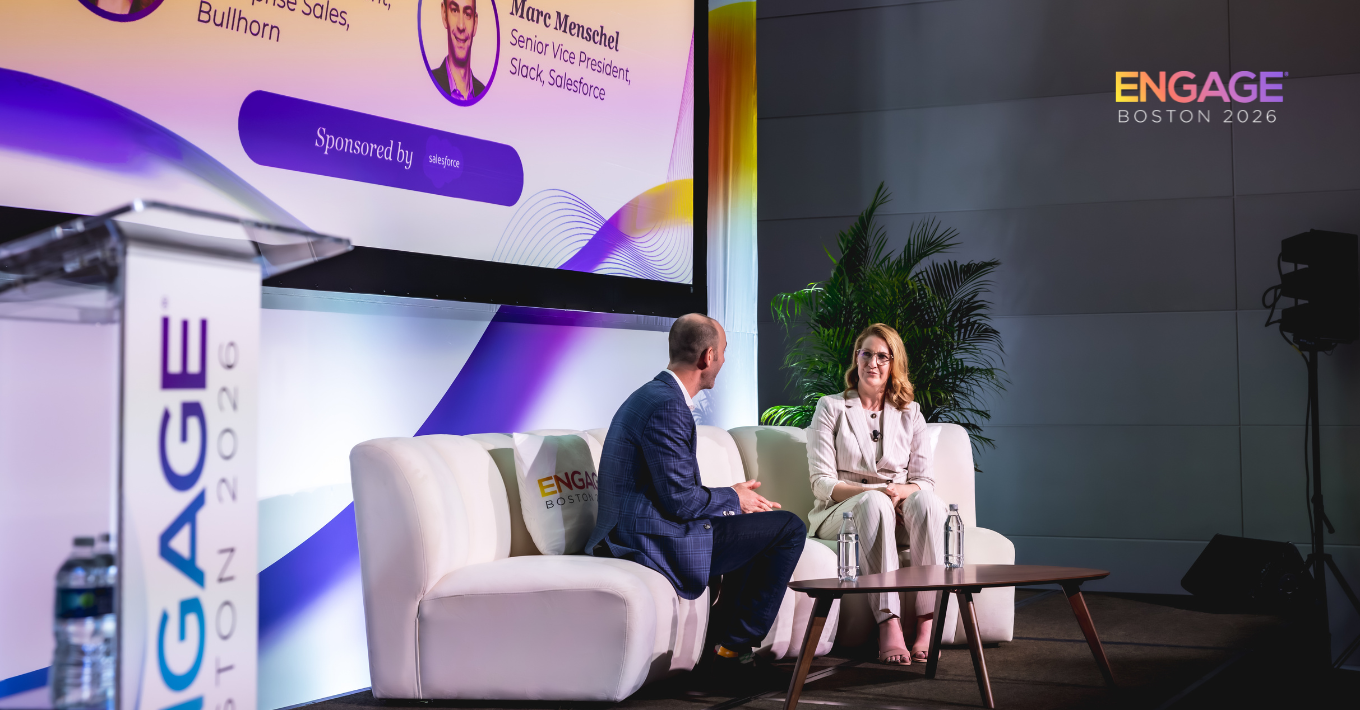
The pressure to move fast on AI is real. So is the pressure to show results. At Engage Boston 2026, Gretchen Keefner, SVP of enterprise sales at Bullhorn, sat down with Marc Menschel, head of sales at Slack, Salesforce, for a candid conversation about what AI adoption actually looks like across industries outside of staffing. Menschel works daily with some of the most innovative companies in the world, and the patterns he sees in what works and what doesn’t translate directly to the decisions staffing leaders are making right now.
Here’s what they covered.
What separates the firms seeing results from the ones that aren’t
Menschel was direct from the start: no single industry is getting this right consistently. What he does see is a set of behaviors that separate organizations making real progress from those stuck in experimentation.
The firms seeing results start by understanding what they are actually trying to accomplish before they deploy anything. They run pilots tied to specific outcomes, not broad mandates to use AI. They pick trusted partners rather than building everything themselves. And they question what exactly do AI tools replace and what they can unlock from it.
Real examples of ROI from outside staffing
Salesforce’s own journey with AI is instructive, partly because it includes some early failures. When they first rolled out AI to help.salesforce.com, the experience wasn’t what customers wanted. They fixed it, and by the end of last year 68% of visitors resolved their issue without ever speaking to a human, with customer satisfaction nearly doubling in the process. The lesson Menschel drew from it: assumptions about how customers want to interact are often wrong, and asking is more useful than guessing.
The second example was more immediate. Salesforce had approximately 53,000 leads considered completely cold, contacts who had enquired but never been followed up with. Rather than assign human SDRs to work leads that didn’t justify the cost, they deployed an AI SDR agent. In under one week it generated 25 closed deals and $2.5 million in revenue.
Southwest Airlines took a similar approach to customer service. By using AI to route and triage incoming calls more effectively, they brought average wait times down from four minutes to 45 seconds, and measured the impact in revenue from customers who could now book rather than wait on hold.
The common thread across all three examples is the same. Each started with a clear process problem, reimagined how that process should work, and then applied AI to the reimagined version rather than the existing one.
Why DIY is failing and what to do instead
One of the most consistent patterns Menschel sees across the enterprise is the failure of organizations trying to build their own AI solutions. This isn’t limited to small firms. It is happening at some of the largest technology companies in the world. They are still buying from platforms rather than building from scratch, because the time and resources required to build something a trusted partner has already built don’t make sense.
For staffing firms, the implication is direct. The data is already in Bullhorn. The compliance and security layers are already in place. The trust is already established. Building something adjacent to that from scratch isn’t innovation. Partnering with a platform that has already done the work and continues to iterate is.
A study from MIT found that 90% of AI pilots fail. Menschel’s read on that number was measured: failure is part of the process, and learning from it is how organizations get better. What matters is that pilots are tied to real business outcomes and measured against the right things. Hours saved only matter if that time goes into something that generates value. The question to ask at the start of any pilot is simple: what is the actual impact on the business if this works?
The talent case for AI
One point Menschel returned to several times was the effect of AI on employee experience, and it’s one that often gets lost in the conversation about productivity and cost.
When organizations remove repetitive, low-value tasks from employees’ days, satisfaction goes up. A large mobile retailer with annual turnover above 90% started investigating why people were leaving. Pay and benefits were factors, but so was something simpler: frustration with repetitive tasks that felt like a waste of time. When they started addressing those tasks through automation, retention improved.
Staffing firms are seeing the same dynamic. More than one firm at Engage shared that employee turnover has moved in a positive direction since giving their teams AI tools. The recruiters doing more valuable work are staying longer.
What to watch and where to start
On the question of whether firms that feel behind can catch up, Menschel was clear. Every day of delay makes it harder, but the window is still open.
His practical advice was consistent with what has come up throughout Engage. Start with one use case, make sure the underlying process is sound, and measure against revenue impact rather than activity metrics. Picking partners who are keeping up with compliance and regulation matters too, because the pace of change makes it impossible to do that alone.
Ready to start your AI journey? Click here to get started today.