




















Tech Talk: Bullhorn Recruitment Cloud Front Office & Search Experience
Bullhorn Recruitment Cloud is moving from a place where data is stored to a place where action is taken, and the Front Office updates delivered over the last 12 months are what make that shift possible.
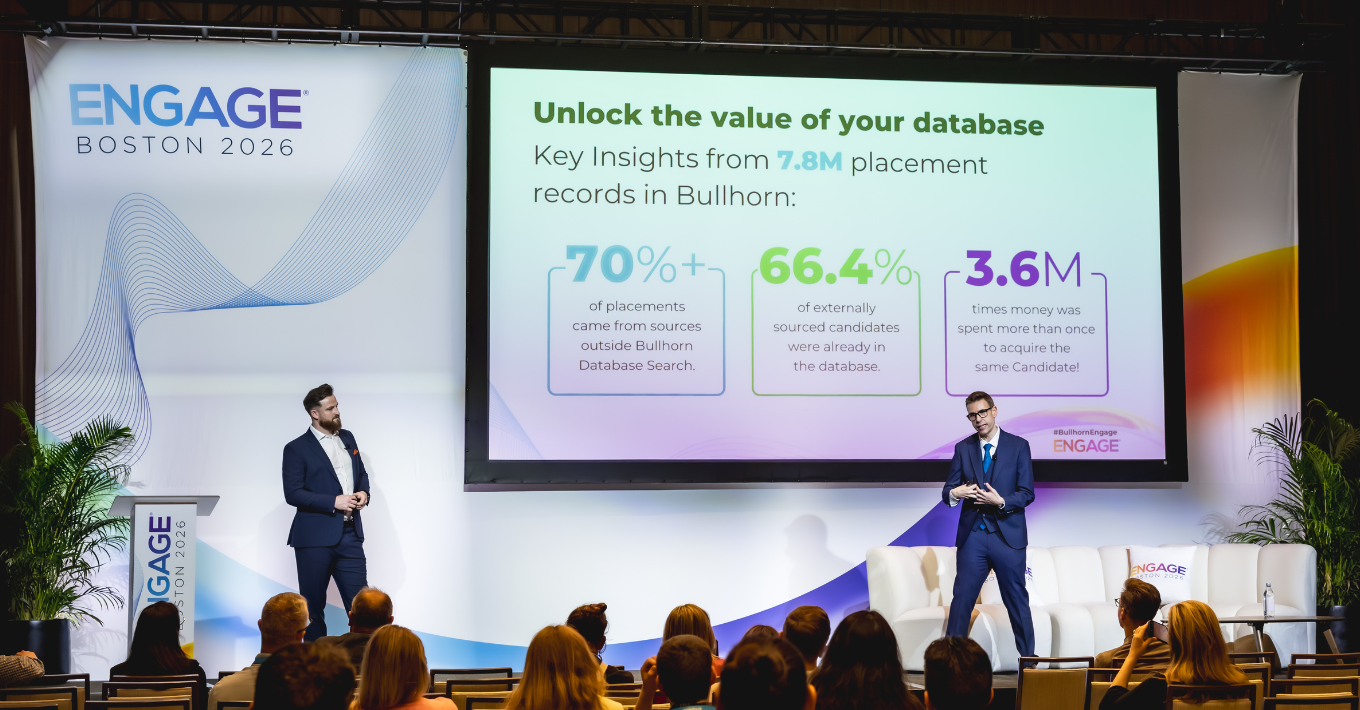
At Engage Boston 2026, Bullhorn’s Michael Isinger, senior principal solution consultant, and James Waters, product manager, walked through what’s been delivered, what’s coming in the next six months, and what firms should be adopting now to get AI-ready.
Here’s what they covered.
The search problem hiding in plain sight
Recruiters spend 14.6 hours per week on average just trying to find the right talent according to Bullhorn’s GRID research. That’s nearly two full working days every week consumed by search alone, and most of what they’re looking for is already sitting in their database.
Seventy percent of placements at Bullhorn customers came from sources outside the Bullhorn database. Of those externally sourced placements, 66% involved candidates who were already in the database and simply couldn’t be found, representing $3.6 million spent acquiring the same candidate more than once.
The investment in making a database findable and searchable is the one that pays back over time, and it’s the foundation every capability in this session was designed to support.
A faster, more consistent recruiter experience
Omnitable is a new list view that delivers a consistent, Excel-like experience across every object in Recruitment Cloud, from the ATS to call lists to interview scheduling. It loads large datasets quickly, surfaces related data like last activity directly in the list view, and removes the need to click through to find context on every call.
Paired with Omnitable is Record Preview, a slide-in panel that lets recruiters view candidate details, Amplify summaries, resumes, and activity history without leaving the list they’re working in. Everything lives in one configurable view, tailored by admins to surface the right information for different teams, job types, and business lines. Together they keep recruiters in the flow of work rather than pulling them out of it every time they need to act.
Getting the data right at the point of intake
Every AI capability in Recruitment Cloud depends on one thing: data that is clean, structured, and consistently recorded.
Good data starts at the point of intake, and the Candidate Data Editor is built around that idea. When a resume is uploaded, recruiters can immediately see what was parsed, compare it against the original document, and correct anything before it enters the system. Coming next is a pass and preview capability that lets recruiters review and augment parsed data before it hits the database rather than cleaning it up after the fact.
Power Notes links a single note to multiple records simultaneously, giving AI full context across candidate, job, and account without duplicating activity or losing the association between them. Admins can define subjects and templates to guide note-taking, ensuring the data going in is structured consistently and searchable later.
Compliance as a competitive advantage
Action Checkpoints are configurable rules that prevent recruiters from advancing a candidate to the next stage until required steps are complete. A background check not done before an offer goes out gets flagged automatically, either as a warning or a hard stop. Compliance becomes part of the workflow rather than something that relies on individual recruiters remembering every client-specific requirement.
Off-Limits prevents contact or submission of candidates to specific clients, with automatic expiration built in so candidates roll back into availability at the right time. In a shared database, the risk of someone innocently calling the wrong candidate is real and the consequences can be significant. One compliance mistake can cost a firm its biggest account. Off-Limits removes that risk systematically rather than relying on institutional knowledge that doesn’t always travel with new hires.
Amplify Search and Match comes to Recruitment Cloud
Amplify Search and Match is coming to Recruitment Cloud with a new matching algorithm and a modern search experience designed to replace the hours currently spent building Boolean searches.
The matching engine blends three models.
- Semantic Match analyzes job description text and extracted skills. Skill inference surfaces candidates who fit but might not have the exact keyword on their resume.
- Outcome-based Matching ranks candidates based on which skill combinations have historically led to successful placements across the Bullhorn customer base.
- Match Scores are transparent, showing recruiters exactly why a candidate ranked where they did rather than delivering a number with no explanation behind it.
The search interface itself is built for flexibility. Recruiters can configure which columns they see, search across any custom field they’ve set up, and even search the content of notes logged against a candidate, so a detail mentioned in a conversation months ago doesn’t get lost. Natural language search adds another layer on top of that. Rather than building a query field by field, recruiters can describe what they’re looking for in plain language, and the system translates that into a structured search automatically.
Every capability in this session serves the same goal. Getting more value out of the database firms already have, making it more searchable, and making it more ready for AI to do its best work. The talent is already there. The goal is making sure recruiters can find it.
Click here to learn more about Bullhorn Recruitment Cloud.