



















An ATS tracks candidates through the hiring process, from sourcing and resume parsing to interviews and placements. A CRM tracks your client relationships, sales pipeline, and business development activity. Most staffing firms need both to run effectively, which is why Bullhorn combines ATS and CRM into a single platform. With everything in one place, your recruiters and sales team can work from the same data without switching between systems.
What is an Applicant Tracking System (ATS)?
Agencies manage many jobs at a time and will receive a high volume of resumes for just one job ad. An applicant tracking system is a software application that helps recruiting agencies organize these resumes and candidates for hiring purposes.
As implied in the name, an ATS tracks potential candidates through the hiring process and aims to make this easier for the recruiter while keeping the candidate informed of the status of their application.
An ATS also automates an agency’s recruiting operations and provides a central repository for collecting candidate information—including resumes and applications. Using automation and screening functionality, an ATS helps recruiters narrow the applicant pool and highlights the top candidates for the job. It does this by using artificial intelligence-type algorithms that analyze the applicant and match their background to the job description.
At its core, an ATS helps you better manage every stage in the recruiting process, from posting a job opening to collecting applications and hiring, all while delivering greater overall efficiency and streamlining your hiring process.
An applicant tracking system can sometimes be confused with recruiting software, but there is a difference. Click below for a more detailed overview.
Why Do You Need an Applicant Tracking System?
94% of recruiting professionals say their applicant tracking system has positively impacted their hiring process.
Finding and placing the right talent is becoming more difficult in a market impacted by talent shortages. An ATS can help recruitment agencies and organizations find, hire, and retain strong candidates. A good ATS has the power to overhaul your entire recruiting operation into the most productive, profitable, and efficient business it can be. With proper implementation, they increase recruiter productivity, save time, and provide organization and structure for your recruiting operations. Agencies that use an applicant tracking system report more placements and more productive time than agencies that don’t.
How Do Applicant Tracking Systems (ATS) Work?
Applicant tracking systems track your candidates’ activity, automating all stages that would otherwise require manual data entry. A good ATS will track all activity from the candidate’s resume in your inbox through final placement (and beyond), freeing up your recruiters to focus on building relationships. Because the applicant tracking system captures all of this data in real-time, you can also use it for real-time reporting to learn how to improve your processes.
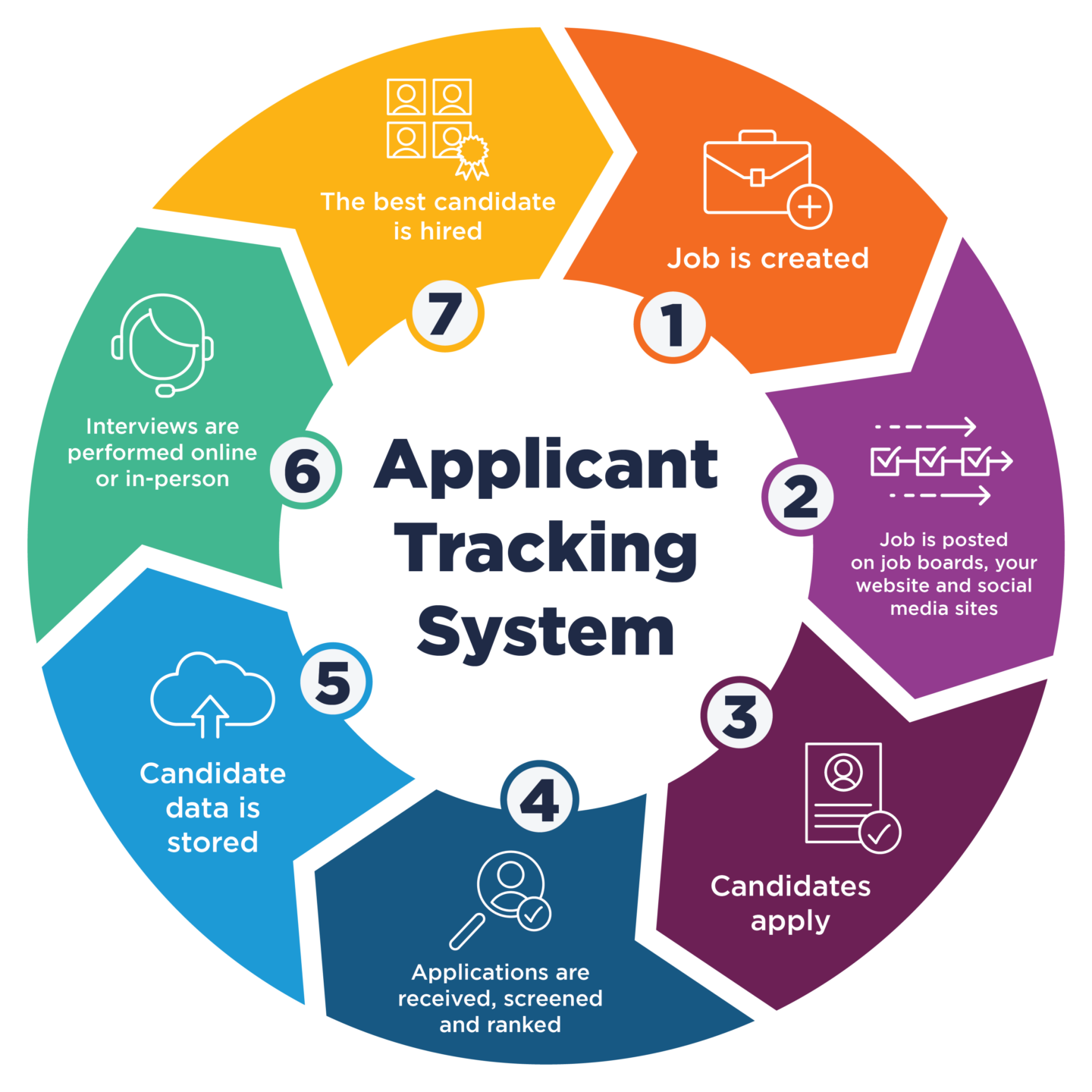
There are seven main stages in the recruiting process that an applicant tracking system will help agencies complete more efficiently:
1. Create the job
2. Post the job on job boards, your website, and social media sites
3. Allow candidates to apply where the job was posted
4. Receive applications as well as screen and rank those applications
5. Store candidate data
6. Interview candidates online or in-person
7. Hire the best candidate
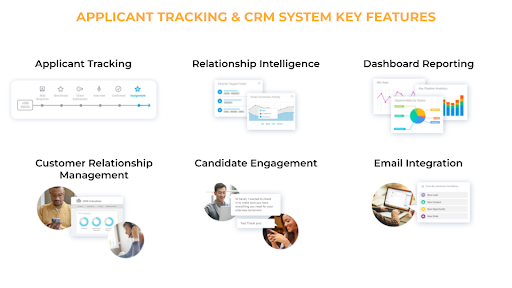
Features in an Applicant Tracking System & CRM
Each ATS may vary based on software provider, but a good ATS that can integrate with a CRM typically offers the following:
Applicant Tracking: Centralize your candidate management, jobs, and tasks streamlining the recruitment process and optimizing team productivity.
Integration with Your CRM System: Break silos between account management and recruiting and gain visibility into your customers’ changing needs with a mobile CRM purpose-built for recruitment.
Email Integration: Automatically upload resumes, add notes, easily create tasks from your Outlook or GMail and automatically track all emails in your ATS.
Dashboard Reporting: Transform your team’s activity into actionable business insights with configurable reports tailored to your specific goals and KPIs.
Relationship Intelligence: Track all email activity associated with a particular candidate record and update that record in real-time, offering a complete view of your candidate interactions and relationships.
Candidate Engagement: Allow job seekers to easily find and apply to your open positions – then leverage mass mailing to engage with the top candidates.
Who Uses Applicant Tracking Systems?
Most large corporations and almost all recruiting agencies use an applicant tracking system to help them with the hiring process. The job applicant won’t know that their application is managed through an ATS as they will submit their application on a job board, website, or social media site. Only the end user will see the ATS interface. Typically, the end user will be the recruiter who uses the system to track and manage candidates through the recruitment process. If the applicant tracking system offers reporting tools, Recruiting Managers, Directors and CEOs often use them to get an overview of overall and individual performance.
Top Benefits of an Applicant Tracking System
There are many benefits to agencies using an applicant tracking system to manage their recruitment process, including:
- Maximizing recruiter performance with clear workflows and easily accessible information, making faster placements and increasing margins.
- Providing a better candidate experience, increasing retention and redeployment rate.
- Creating a single source of truth for all candidate information, enabling recruiters to connect with a candidate in real time to increase engagement and retention.
- Making better business decisions leveraging key metric reporting from the desk- to executive-level.
What an ATS looks like for a small staffing agency
For smaller staffing firms, an ATS replaces the spreadsheets, disconnected inboxes, and manual tracking that limit how many jobs each recruiter can realistically manage. When Growing HVAC adopted Bullhorn’s ATS & CRM, founder Michael Johnson saw a 60% increase in business year-over-year because his recruiters stopped duplicating outreach and started working from a single, shared pipeline. Bullhorn’s small agency software brings the same ATS and automation capabilities used by the world’s largest staffing firms into a package built for growing teams.
How to choose the best ATS for your business
The Best ATS Software of 2026
Manage candidates and clients in a single platform. With Bullhorn’s mobile-first ATS and CRM, your team stays aligned, productive, and focused—no context switching required.
How Much Do Applicant Tracking Systems Cost?
Most ATS providers offer various packages based on a business's size and complexity.
The Future of Applicant Tracking Systems
Applicant Tracking Systems have come a long way over the past 15 years and continue to improve and evolve. When they were first introduced to the market, they supported simple, routine tasks. Now they’re an integral part of a recruiter’s job and can integrate with other powerful systems that allow firms to automate, report, and so much more.
The future of the applicant tracking system will likely be about fine-tuning the existing functionalities and features. It will use enhanced artificial intelligence and automation, and focus on simplifying the recruiter and candidate process in further. The ATS will continue to center around:
- Improving the candidate, client and recruiter experience.
- Providing a complete digital transformation of businesses where technology will maintain most administrative tasks.
- Integrating with other systems without needing multiple logins, tabs or screens (a unified digital experience).
ATS FAQs
ATS software automates the tasks that eat up your recruiters’ time: resume parsing, job posting, interview scheduling, and candidate follow-ups. Instead of manual data entry at every stage, the system captures activity automatically and moves candidates through your pipeline. Bullhorn takes this further with email integration and automation tools that trigger outreach based on real-time activity, so your team spends less time on admin and more time making placements.
A recruitment database is where your staffing firm stores all candidate information, including resumes, skills, certifications, and placement history. It gives recruiters a centralized, searchable system for matching candidates to open roles. Bullhorn’s ATS functions as a recruitment database with AI-powered search and match built in, making it easy to redeploy proven talent and surface the best candidates from your existing pool in seconds.
ATS software replaces manual, repetitive processes with a single platform for managing candidates, jobs, and client communication. Features like resume parsing, workflow automation, and built-in reporting keep your team aligned and productive. Bullhorn customers see the results firsthand: 24% more placements per head, 16% faster time to fill, and 47% higher redeployment rates.
AI helps recruiters work faster by analyzing candidate data, surfacing the best matches for open roles, generating job descriptions, and automating outreach. It takes the manual effort out of sourcing and screening so your team can focus on building relationships. Bullhorn Amplify brings AI into every step of the recruiting workflow. Firms using it report 36% more placements, 51% more submissions, and 22% higher fill rates.
Absolutely. A good ATS ensures that strong candidates don’t get lost after their first interaction with your firm. By maintaining a searchable database of every candidate in your pipeline, your team can quickly resurface qualified talent for new opportunities. Bullhorn’s ATS & CRM makes this even easier with AI-powered matching and automated nurture campaigns that keep passive candidates engaged, so your talent pool gets stronger with every placement.
Yes. Staffing firms using an ATS report significantly more placements and more productive time than firms that don’t. Bullhorn customers see 24% more placements per head and 16% faster time to fill. Growing HVAC, a small specialized agency, achieved 60% year-over-year growth after consolidating its recruitment pipeline into Bullhorn’s ATS & CRM. Learn more about Bullhorn for small agencies.
The best ATS for a growing agency is one that combines applicant tracking and CRM in a single system, so your sales pipeline and candidate database live in one place. Bullhorn’s platform is used by more than 10,000 staffing firms globally and is designed to scale from small teams to enterprise operations without requiring a system migration. See pricing details.
Yes. Bullhorn offers packages designed for small and growing staffing agencies, with the same core ATS, CRM, and automation tools available at every tier. Small agencies using Bullhorn report 28% more jobs filled and save hours of manual admin per recruiter each week. Explore Bullhorn’s small agency software.