




















Streamlining middle-office implementation: Less time, lower cost, greater value
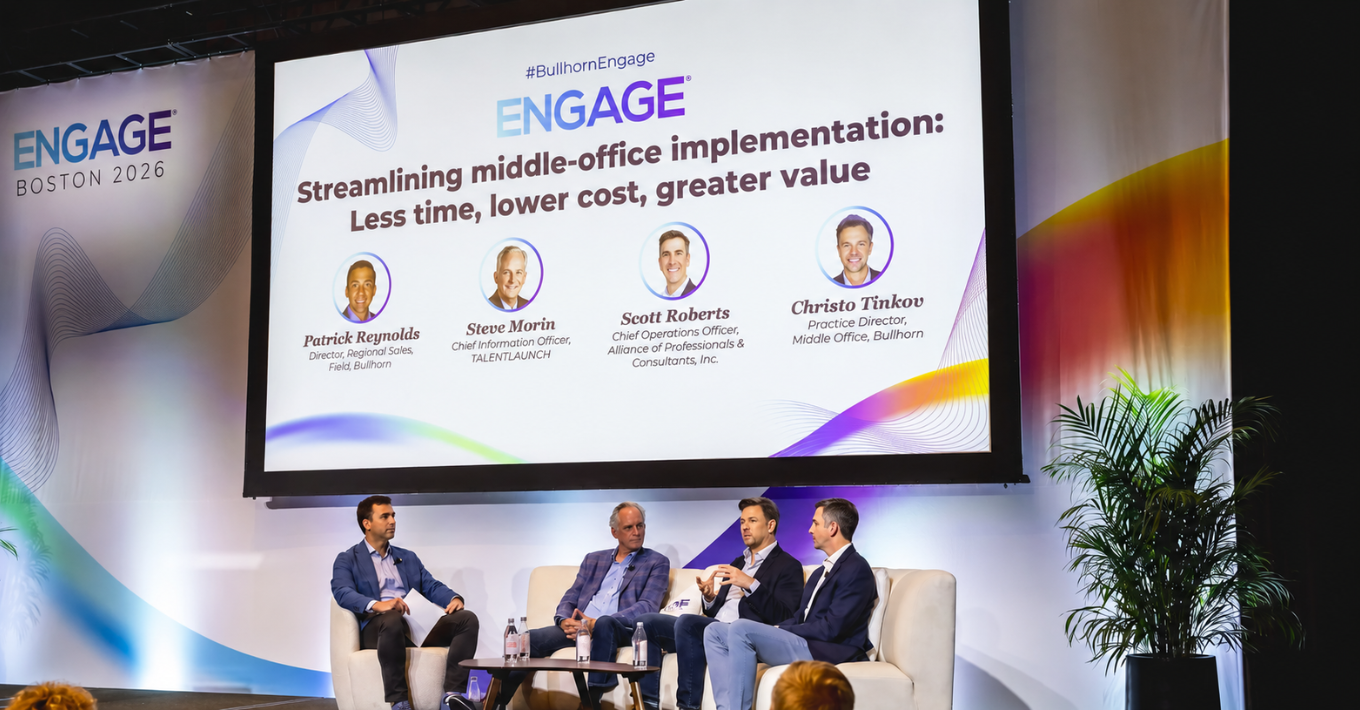
Middle-office implementations are rarely just technology projects. At Engage Boston 2026, Patrick Reynolds, director of regional sales at Bullhorn, moderated a conversation with practitioners who have done the work firsthand. Steve Morin, chief information officer at TalentLaunch, Scott Roberts, chief operating officer at Alliance of Professionals and Consultants (APC), and Christo Tinkov, practice director of professional services at Bullhorn, covered the preparation, the pitfalls, and the results of going live on Bullhorn One.
Here’s what they covered.
Why firms made the move
The middle office is where the financial and reputational stakes of staffing operations are highest. Billing errors erode client trust. Late or incorrect payments damage relationships with talent and create compliance exposure. Time spent reconciling invoices in spreadsheets or manually formatting reports for individual clients is time that cannot go toward growth. When these functions are running on systems that no longer fit the business, the cost shows up everywhere.
For TalentLaunch, the existing platform had become a constraint on growth. Running eight brands on a legacy system that had become a ceiling on what the business could do next. Morin made the case to invest even during a softening market. Waiting for better conditions would have meant waiting too long.
For APC, the pressure came from three specific places. Timesheets, expenses, and invoices. The firm had outgrown its homegrown timesheet portal, had no real expense management system beyond Excel and email, and was hiring report writers just to get invoices formatted the way clients required. The workforce they were placing had shifted from purely hourly workers to a mix of daily, weekly, monthly, and piece-rate arrangements. The tools had not kept pace.
The complexity most firms underestimate
Tinkov was direct about the most common misconception going in. Firms tend to treat a middle-office implementation as an IT project. It is not. It is a change management exercise in disguise, and the organizations that approach it with the wrong mindset are the ones that run into trouble.
The front office feels the impact more than most teams anticipate. Workflows change. Dependencies shift. Data that lived in disconnected systems now has to meet a much higher standard of consistency. Two versions of the same company record, three versions of the same candidate, 10 slightly different versions of the same client location. Those permutations multiply quickly, and when bad data enters a connected system, the integration starts to break down.
The other thing Tinkov flagged was spreadsheets. Before an integrated middle office is in place, Excel becomes the default for almost everything, including racking time, managing expenses, and formatting invoices. The most common request the Bullhorn pay and bill team hears from customers is still about Excel. No matter how well-designed the system, getting people to let go of the workarounds they have relied on for years is the final mile of adoption, and it is often the hardest.
“A lot of our customers tend to think that this is more of an IT implementation. They’re not going in with the right mentality that it really is a change management exercise in disguise.”
— Christo Tinkov, practice director of professional services, Bullhorn
Roberts added a useful reframe on bad data. When you ask an accounting team whether their data is clean, the answer is almost always yes. They know people are getting paid correctly and invoices are going out. What they do not always recognize is that critical information lives in people’s heads rather than in the system. Processes that exist because someone just knows to do it that way for a particular client are not documented anywhere. Those hidden dependencies have to surface before go-live, not after.
Governance and project structure
TalentLaunch ran four simultaneous project tracks, covering Bullhorn Automation, Talent Platform, Bullhorn One, and a payroll provider migration, all within a twelve-month window. Morin and the CFO co-owned the program. The payroll manager was pulled off her day-to-day responsibilities to focus on it full time. A former field operator led enablement across all brands. The governance structure included tight check-ins, sprint reviews, and steering committee meetings throughout.
When slippage hit one of the four tracks near the end, the team made the decision not to force a deadline they had set at the beginning of the project. They reset expectations, socialized the change across the field and corporate teams, and moved forward with a revised plan. Choosing to make that call rather than pushing through a date that no longer served the project was part of what made the overall program land well.
APC worked with an implementation partner and ran the project with Roberts and the controller as internal leads. The accounting team carried the heaviest lift, learning a new system while continuing to run daily operations and preparing the data that would go into it. Roberts’s advice was to pull stakeholders into the process earlier than might seem necessary. At APC, the legal team was not even a Bullhorn user before the implementation. Now they are in the system setting up billing profiles at contract signing, which eliminates downstream delays that used to create invoice backlogs.
Testing is where corners get cut
Tinkov was specific about where implementations go wrong most often. When the data cut from a legacy payroll provider arrives late and the project is behind schedule, the temptation is to compress user acceptance testing from four to six weeks down to two or three days. That is a mistake.
A Bullhorn One environment involves at minimum five distinct user personas. Account managers, recruiters, compliance staff, payroll, and billing. Getting from company setup through contact, job, placement, rate card, timesheet, and export to payroll and billing requires every one of those personas to test their piece of the workflow in sequence. That cannot be done adequately in two days.
Parallel testing is the stage where the system is run against actual production data from the legacy environment to verify that pay and bill calculations match. Tinkov noted that 90 to 95 percent accuracy is a realistic and acceptable target, largely because legacy systems often carry a small percentage of incorrect calculations that have been running undetected for years. What matters is not just the accuracy rate but the ability to explain every difference before go-live.
TalentLaunch added an extra month to the timeline specifically to get testing right. The result was a go-live with no payroll issues. What they learned, though, is that go-live is not the finish line for testing. It is a transition from structured testing to real-world validation, and that requires just as much intentional support.
Morin’s framing was that even exhaustive pre-go-live preparation does not eliminate the need for post-go-live support. The team ran office hours three times a week for the first two months after cutover, giving field users a place to get answers and hear from colleagues who were adopting the system well. The goal was not perfection on day one. It was building enough confidence in the system that people would engage with it rather than retreat to their old habits.
What the other side looks like
APC invoicing used to take eight hours every two weeks. After going live on Bullhorn One, it takes two to three hours. Monthly invoicing dropped from four hours to under one. The accounting team also stopped receiving the constant stream of questions they had fielded for years. Has this person submitted their time, can you edit that entry, has the invoice gone out? That information is now visible in the system. The interruptions have largely stopped.
For TalentLaunch, one of the most significant outcomes was the effect on their AI readiness. The implementation forced the kind of data cleanup that is a prerequisite for getting value from Amplify. The momentum of the project became an opportunity to address a weakness that would have limited what AI could do for the business. That work continues, but the foundation is now in place.
Both teams described an ongoing iteration process rather than a finished implementation. TalentLaunch runs a standing forum called Bullhorn Elevate, a regular meeting where field leaders surface feedback from their users and the corporate team listens, responds, and refines. The goal was to adopt the system close to out of the box, move fast, and then improve from there rather than spending months trying to build a perfect configuration before go-live.
Ready to start your AI journey with the right data foundation in place? Click here to get started today.