




















Job openings rise in five of six industries: May’s hiring data for recruiters
As summer approaches, the U.S. job market is sending staffing leaders some of the clearest signals in months. After a strong April, hiring momentum has continued to build across most industries, and the mix of skills and candidate profiles employers are searching for is shifting in ways that matter for how recruiters source, screen, and present candidates.
Bullhorn Insights’ Job Market Trends data tracks millions of U.S. job postings through Bullhorn’s Market IQ database and follows changes in hiring demand by industry, skill, and education level. May’s data is one of the more encouraging months we’ve seen in a while, though the data rewards a closer look beyond the headline numbers.
Here’s what stood out, and what it means for recruitment heading into the second half of 2026.
Job openings keep climbing across most of the market
After a strong surge in April, job openings continued rising in May, with most industries posting gains of 2 to 3% during the month. Five out of six industries tracked saw openings increase, which is a broad-based signal of momentum rather than growth concentrated in one corner of the market. For staffing leaders who have been watching cautiously after a difficult stretch, that kind of breadth matters.
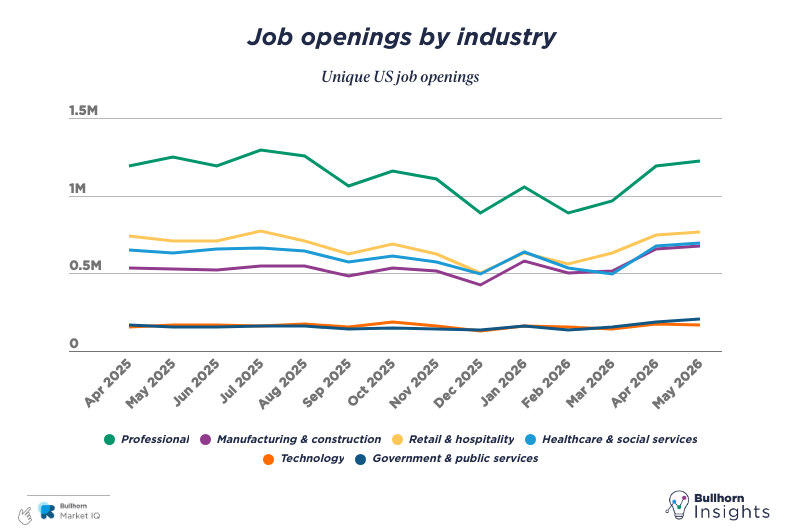
Government job opportunities were the standout performer, up 12% in May. Manufacturing continues to tell one of the strongest year-over-year stories in the data, with openings up 28% compared to May 2025. That kind of sustained gain reflects genuine employer investment in the sector, not just a short-term bounce off a low base. For firms with manufacturing clients or candidates, the pipeline looks meaningfully stronger than it did a year ago.
The one exception was IT, where openings declined 3% during the month. That pullback is worth noting but shouldn’t be overstated. IT roles remain well above where they were in March, so the monthly dip reads more like a pause after a period of strong growth than a reversal in direction. Employers in the sector are still hiring; they just appear to be doing so more selectively than they were a month ago.
Taken together, the industry picture heading into summer is one of broad but uneven momentum. Most of the market is moving in the right direction, and the firms best positioned to benefit are those that have maintained active pipelines and client relationships through the slower months earlier in the year.
Employers are putting coordination and trustworthiness at the top of the list
The skills data from May offers one of the more interesting signals in recent months. Coordination jumped to the top of the list of emerging skills in job postings, a focus on fundamental workplace competencies that has been relatively rare in the data lately. Alongside coordination, trustworthiness and leadership are also among the most in-demand skills, continuing a trend of employers prioritizing personal characteristics alongside technical qualifications.
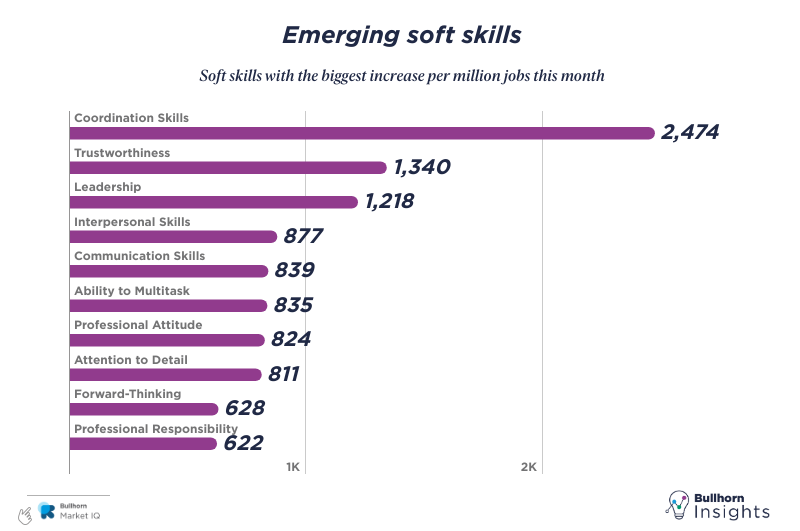
What this tells recruiters is that employers are thinking carefully about fit and reliability, not just capability. In a market where teams are leaner and the cost of a wrong hire is higher, the ability to work well with others, follow through on commitments, and be counted on is carrying more weight in hiring decisions than it has in recent years.
Associate’s degree holders see the biggest gains, but the picture is mixed
Education-level data from May shows that job openings increased across all education levels, but the gains were not evenly distributed. Candidates with an associate degree saw the largest increase of any group, up 8% during the month. That’s an encouraging signal for a segment of the talent pool that has faced a genuinely difficult market, though the longer-term picture requires some caution.
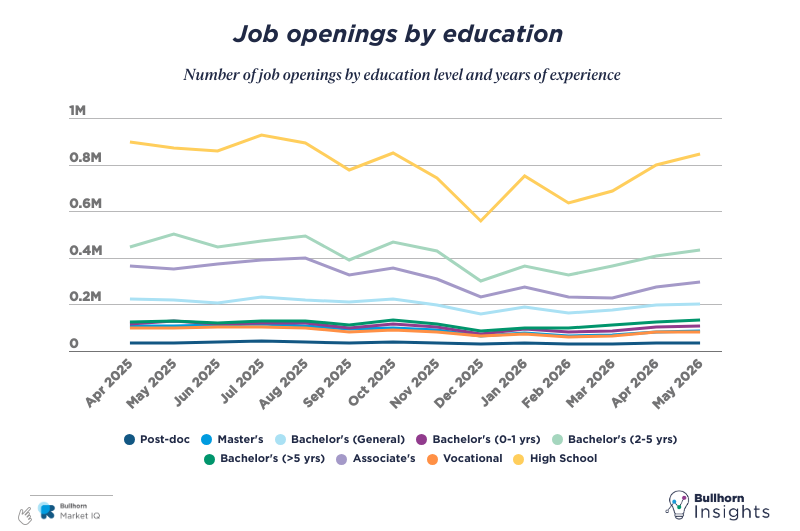
Associates degree roles are still down 15% compared to May of last year, so the monthly improvement is real but hasn’t yet translated into year-over-year growth.
The one group that has seen openings increase both month-over-month and year-over-year is candidates with a bachelor’s degree and five or more years of related experience. That combination of formal education and a proven track record continues to be what many employers gravitate toward when they’re being selective about headcount.
Roles for candidates coming straight out of college were up around 2% in May, the smallest increase of any group. The entry-level market is improving, but it remains the most competitive segment, and the gap between early career openings and the rest of the market is still a real challenge for new graduates.
A market with real momentum, and some nuance worth watching
The overall picture heading into summer is stronger than it’s been in several months. Most industries are adding openings, manufacturing is posting particularly strong year-over-year numbers, and employer confidence appears to be building after a cautious start to the year. But the skills and education-level data point to an employer base that is becoming more deliberate about who they hire.
Coordination, trustworthiness, and proven experience are rising in importance. Recruiters who can surface those qualities effectively in the candidates they represent will find this market more rewarding than the headline numbers alone might suggest.
Explore the latest Job Market Trends on Bullhorn Insights and check back at the start of every month for fresh data and analysis.