






















What staffing leaders need to know: August 2026 hiring outlook and job market trends

Together, Bullhorn’s latest Hiring Outlook and Job Market Trends August data paints a picture of an uneven hiring market.
Permanent hiring remains resilient while temporary job orders are slowing. Most industries saw fewer job openings in August, but manufacturing and construction were the exceptions to that trend. Within these growing sectors, roles like drivers, mechanics, production staff, and non-residential construction workers are seeing the strongest demand.
Across the broader market, employers are also shifting what they prioritize. Analytical thinking and leadership are emerging as the top skills employers are seeking, and compensation is rising fastest in construction, engineering, and warehouse roles.
For staffing leaders, August’s data points to where hiring demand is clustering and where the opportunity is heading into Q4.
Permanent hiring holds up as temporary hiring slows
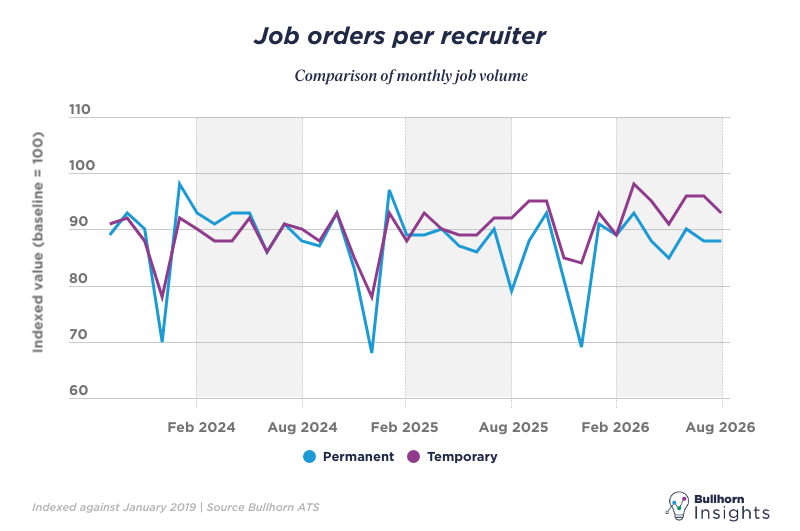
Our data shows a clear difference between permanent and temporary hiring. While permanent job orders were largely unchanged from July, when looking at it year over year, the permanent pipeline is nearly 11% above August 2025.
Permanent hiring may have plateaued, but it hasn’t lost ground. With the pipeline still nearly 11% above last year, companies continue to show a willingness to hire permanent talent despite a more cautious market.
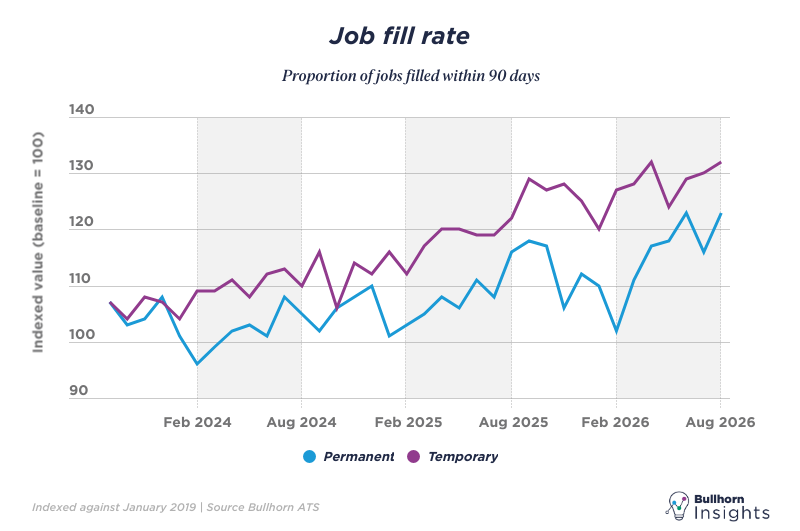
The permanent fill rate also remained strong. It was 7% higher than last year and returned to the same level as July. Submissions per order were unchanged, showing that the number of candidate submissions per opening remained steady.
Temporary job orders moved in the other direction, falling 4% in August, which is a slightly larger decline than the typical late-summer dip. The change stands out because temporary job orders had been running 4% to 5% above last year for most of 2026.
Even with the August decline, temporary job orders were still 1% above August 2025. So while temporary hiring lost some of its momentum during the month, activity remained slightly ahead of last year.
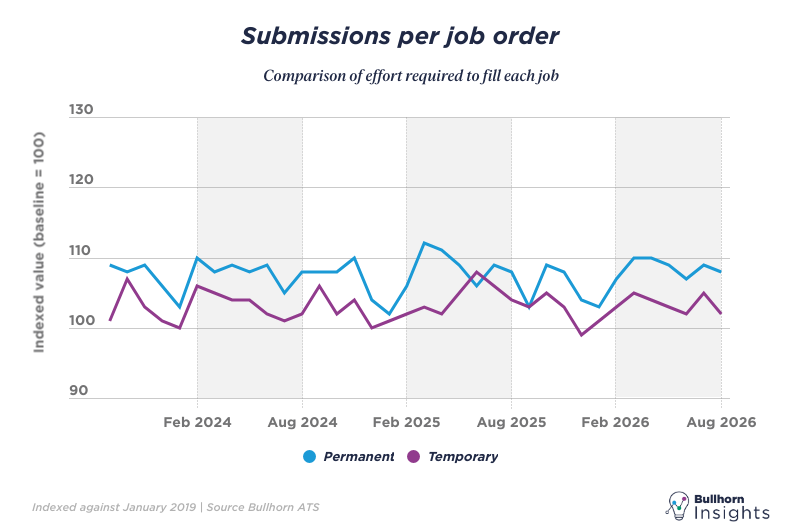
Recruiter activity remained steady throughout August, with the recruiter effort index, temporary fill rate, and submissions per order all holding flat. The stability suggests recruiters are maintaining productivity and placement efficiency despite broader signs of softness in the temporary hiring market.
Job openings slow across most industries, while manufacturing and construction grow
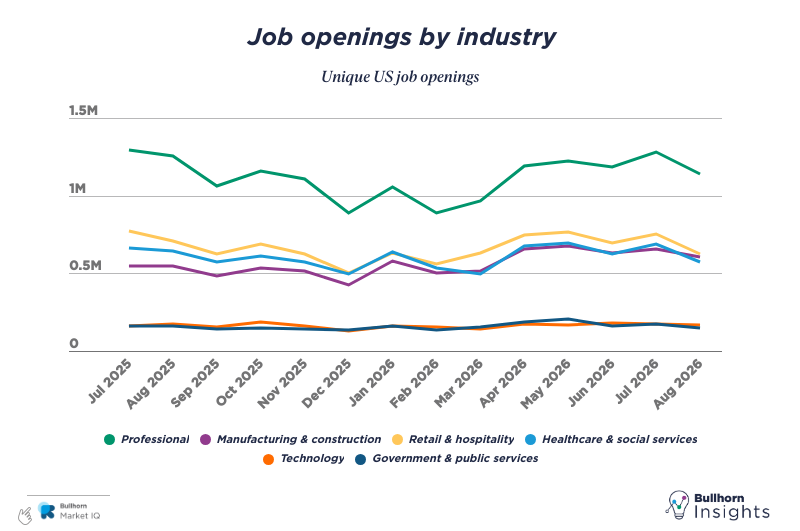
The broader job market data shows another layer of change. After stronger job-opening activity in July, most industries saw fewer job openings in August, with many slightly below last year.
But the slowdown isn’t broad-based: manufacturing and construction continued to add job openings, signaling that demand is shifting toward industries tied to physical infrastructure and investment. Within these industries, the strongest demand was concentrated in non-residential construction and hands-on commercial roles such as drivers, mechanics, and production staff. The continued strength in these industries also aligns with the rapid buildout of AI data centers, suggesting that AI’s impact on hiring is extending beyond tech roles to the workers needed to build and operate the infrastructure behind it.
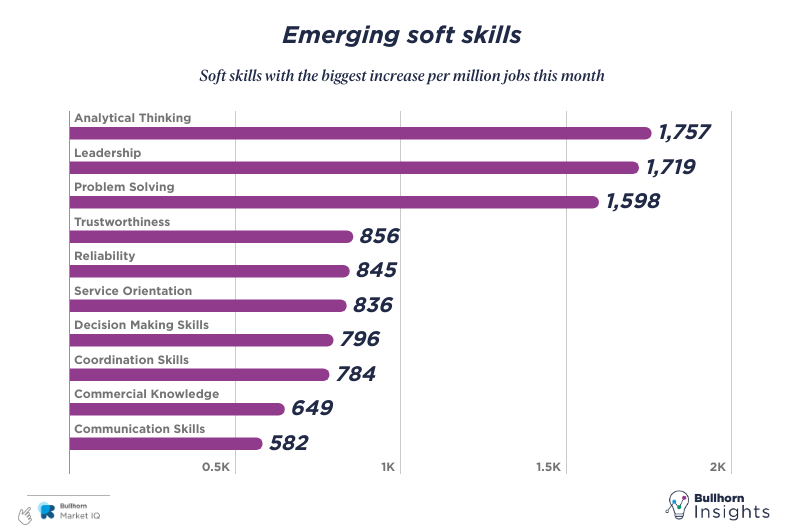
The types of skills appearing in job openings also shifted in August. Analytical thinking and leadership were among the top skills employers were looking for. This represents a shift from previous months, when personal traits such as trustworthiness and friendliness were more prominent.
The shift suggests employers are placing greater emphasis on demonstrable, job-specific capabilities as they define what they need from their workforce. Personal traits remain important, but the August data points to a growing focus on skills that directly translate to problem-solving, decision-making, and performance on the job.
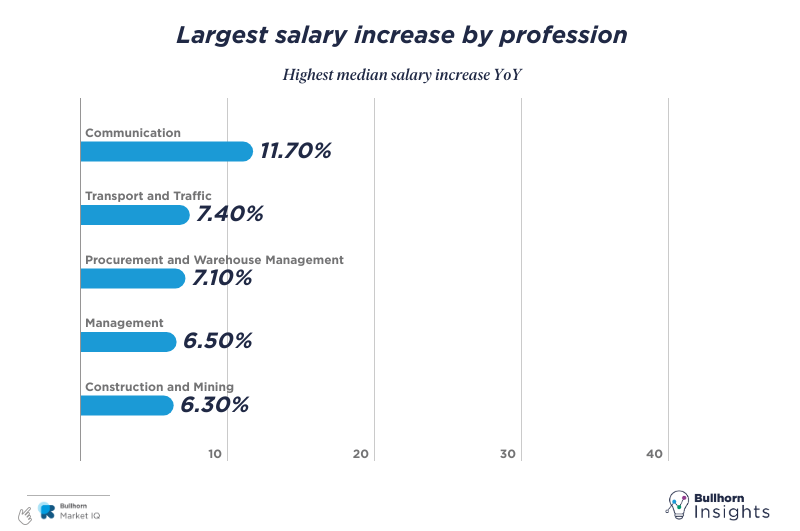
Salary growth also varied by job category. Construction, engineering, and warehouse roles were among those with the fastest-growing salaries in August. Management and legal roles also saw rising compensation.
The overlap between rising demand and rising pay is particularly notable in construction and engineering. It suggests employers in these fields are competing more aggressively for talent as hiring demand remains strong, while wage growth in warehouse roles points to continued pressure for workers in hands-on, operational positions.
What staffing leaders should watch next
Heading into the fall, the strongest areas of momentum are manufacturing and construction, particularly non-residential construction and hands-on roles such as drivers, mechanics, and production staff.
For staffing leaders, the next few months will show whether these pockets of growth will expand outside of these growing industries or remain concentrated in a smaller group.
Check back with Bullhorn Insights at the start of each month for the latest Hiring Outlook and Job Market Trends data to help you stay ahead of the market.