




















The new economics of candidate acquisition
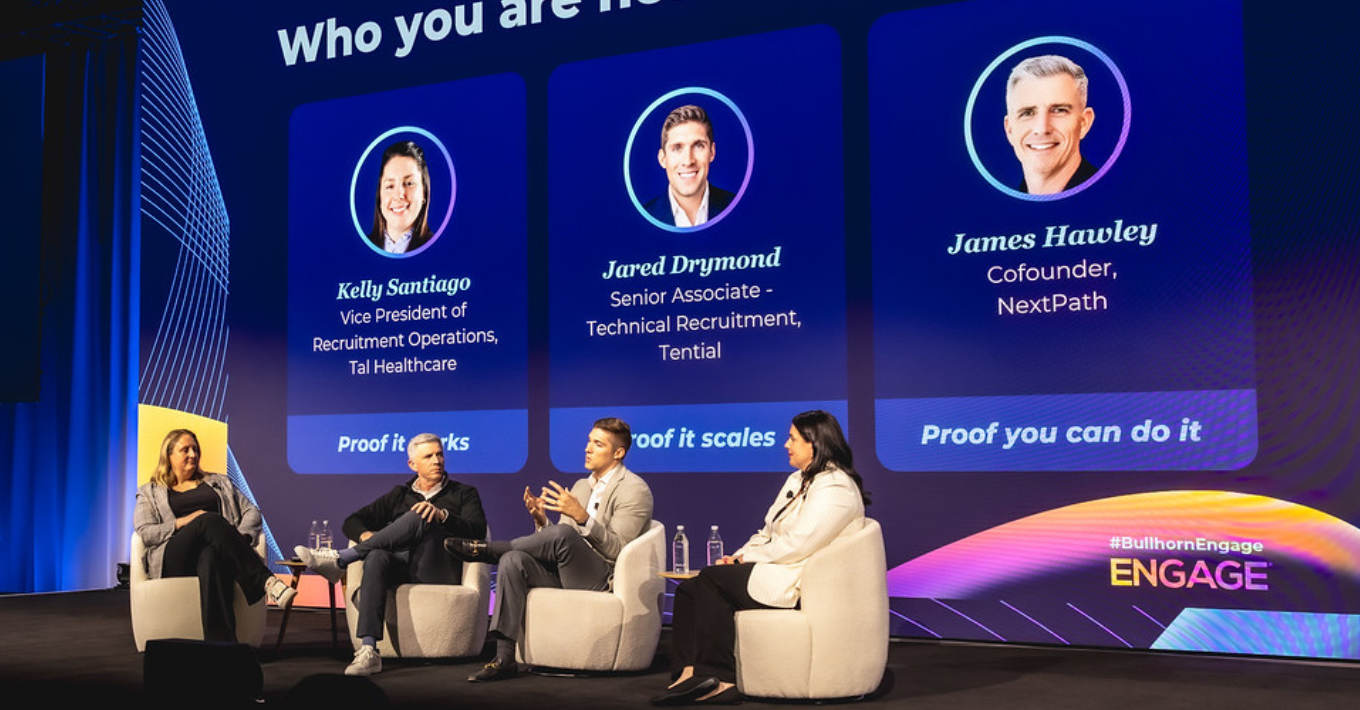
At Engage Boston 2026, Bullhorn Sales and Strategy Director, Laura Bumby, opened the session with a reframe. The biggest candidate acquisition problem in staffing isn’t sourcing. It’s the cost of the people doing the sourcing. SG&A runs at roughly 20% of revenue across the industry. Junior recruiter turnover sits at around 30% annually. New hires take anywhere from six to twelve months before they meaningfully contribute to the business. And sitting underneath all of that is a candidate database most firms are underutilizing.
Laura led the conversation with three staffing leaders at different points in their Amplify journey: Kelly Santiago, VP of recruitment operations at Tal Healthcare, Jared Drymond, senior associate of technical recruitment at Tential, and James Hawley, co-founder of NextPath.
Here’s what they shared.
The hidden cost structure most firms aren’t looking at
For most of staffing’s history, the answer to capacity challenges has been to add more people. More recruiters to work more jobs, more coordinators to handle more admin, more hires to chase more growth. The cost of that model (turnover, ramp time, and candidate databases full of people no one ever contacts), has compounded quietly in the background.
For Santiago at Tal Healthcare, the database problem was visible and concrete. Applicants were flowing in and going dormant. Recruiters working closest to revenue were rejecting candidates and moving on without engaging. Not because those candidates had nothing to offer, but because they weren’t the right fit for the open role in front of them. Candidates who might have been perfect for a different position, or for a hard-to-fill search the team hadn’t yet connected them to, were falling out of the funnel entirely and taking their goodwill with them. The brand damage was real, and the revenue sitting untouched in the database was, too.
Amplify changes where recruiters enter the workflow. Digital workers absorb the top-of-funnel grind like screening, sourcing, data entry, and resume formatting, so that by the time a recruiter picks up a candidate, the groundwork is already done.
That means candidates who aren’t right for the open role don’t just get rejected and forgotten. They get screened, their information gets captured, and that data becomes useful the next time a relevant search opens up.
Tal Healthcare: Rebuild the workflow, don’t just add AI to it
Tal Healthcare came into Amplify with a meaningful head start. Years of deliberate automation work meant clean data, organized workflows, and a team already comfortable using technology. That foundation made it possible to move quickly.
Rather than layering AI onto existing processes, Santiago and her team rebuilt workflows from scratch. The job opening process is one of the clearest examples. Previously, opening a new role required an operations team member to build the job description, someone to generate screening questions, and the director of client success to provide talent insights. The process involved two or three people and could take 30 minutes to several hours depending on availability. Now, Amplify generates the job description, talent insights for the recruiter, market feedback for the account manager, and screening questions in minutes.
That instinct proved out quickly. A candidate came through the screener who wasn’t a fit for the role they’d applied to, but the screening summary revealed they were open to relocating. Tal had a difficult search in Albany that the team would never have considered that candidate for. With the insight from the screen, they brought the candidate to the client as a creative option in a talent-short market. The client interviewed them immediately.
“We were potentially missing out on these placements without gathering that information.”
— Kelly Santiago, VP of recruitment operations, Tal Healthcare
One assumption Santiago’s team tested early was whether physicians would engage with an AI screener. They built two separate screening experiences, one for physicians and one for everyone else, expecting a meaningful difference in response rates. There was none. Satisfaction scores held consistent across all candidate types at around 4.5 out of 5.
Tential: Earn internal trust before scaling
Drymond and the team at Tential took a more measured path. Rather than moving fast across the whole team, they started with a small pilot, expanded to a few more recruiters, then rolled out to the broader team. The concern wasn’t external. It was internal trust. Rolling out something that didn’t work, even once, would mean spending significant energy rebuilding confidence before adoption could move forward.
One of the clearest proof points came from a deliberate constraint. Leadership removed LinkedIn from recruiters for a month. Using only the Amplify screener and their existing database, Tential’s recruiters held their own against colleagues who had the full suite of job boards available. Two years earlier, that would have felt impossible. But more importantly, the recruiters knew it, too. Seeing it in their own numbers made the case in a way no training session could.
To sustain adoption, Drymond’s team made prompt usage a tracked performance metric, 20 prompts per week per person, sitting alongside pre-screens and interviews in individual performance dashboards. They opened an internal Teams channel called Amplify Pioneers where the team shared wins, failures, and prompts. Early posts were mostly about things that didn’t work. Having the Amplify team respond publicly, so everyone could see the answers, turned those posts into shared learning. A super users of the week program across screener and prompt categories recognized the team members driving adoption forward.
NextPath: What a rocky start actually teaches you
Hawley bought Amplify for FOMO. His words. The early experience at NextPath was rocky. Things weren’t ready, adoption was slow, and the team struggled to find a foothold. The first rollout mistake was going too wide too fast.
The turning point came when Amplify Chat launched. Hawley spent a weekend exploring it, and couldn’t stop. His CFO noticed, because the emails that would normally have landed in her inbox didn’t. He’d used Amplify to handle them. From that point, NextPath’s usage went up, and stayed up.
The approach Hawley now recommends is to start with the people who are willing to try it, let them build momentum, and let the skeptics watch. When resistant team members see peers moving up leaderboards and working more efficiently, the question shifts from why would I use this to how do I get access.
Tal Healthcare named their screener agent Talia. NextPath named theirs Alice. Both teams found that giving the agent a name made adoption feel more like gaining a colleague than surrendering process to a machine.
“Staffing has always been people-powered and that is not changing.”
— James Hawley, Co-founder, NextPath
From searching for candidates to farming the database you already have
The shift all three organizations described is the same at its core. Staffing firms have spent years searching for candidates externally while sitting on databases full of people who already interacted with their company and team. Amplify makes farming that database viable at scale. The screening agent is a big part of how.
The screening agent meets candidates where they are, on weekends, during night shifts, and on work breaks. Physicians completing screens between rounds. IT contractors responding at times when no recruiter would be available. Every applicant gets a response, and the recruiter inherits a ranked, screened shortlist rather than a stack of unread applications.
Amplify Chat adds another layer. Hawley described using it to surface foreign nationals in the NextPath database with specific visa statuses, salary notes from unstructured fields, and availability details, pulling together a qualified list for a difficult role in minutes. No job board can reach into notes and match across that many variables at once.
Three starting points emerged consistently across Santiago, Drymond, and Hawley’s organizations: enrich data and job descriptions to build a strong foundation, deploy the screener to handle applicant volume at the top of the funnel, and use Amplify Chat for research and candidate ranking. Each builds on the last, and none of them require a recruiter to keep doing the work that was eating their day before.
Ready to start your AI journey? Click here to get started today.