




















The new scorecard: How staffing leaders measure success in an AI world
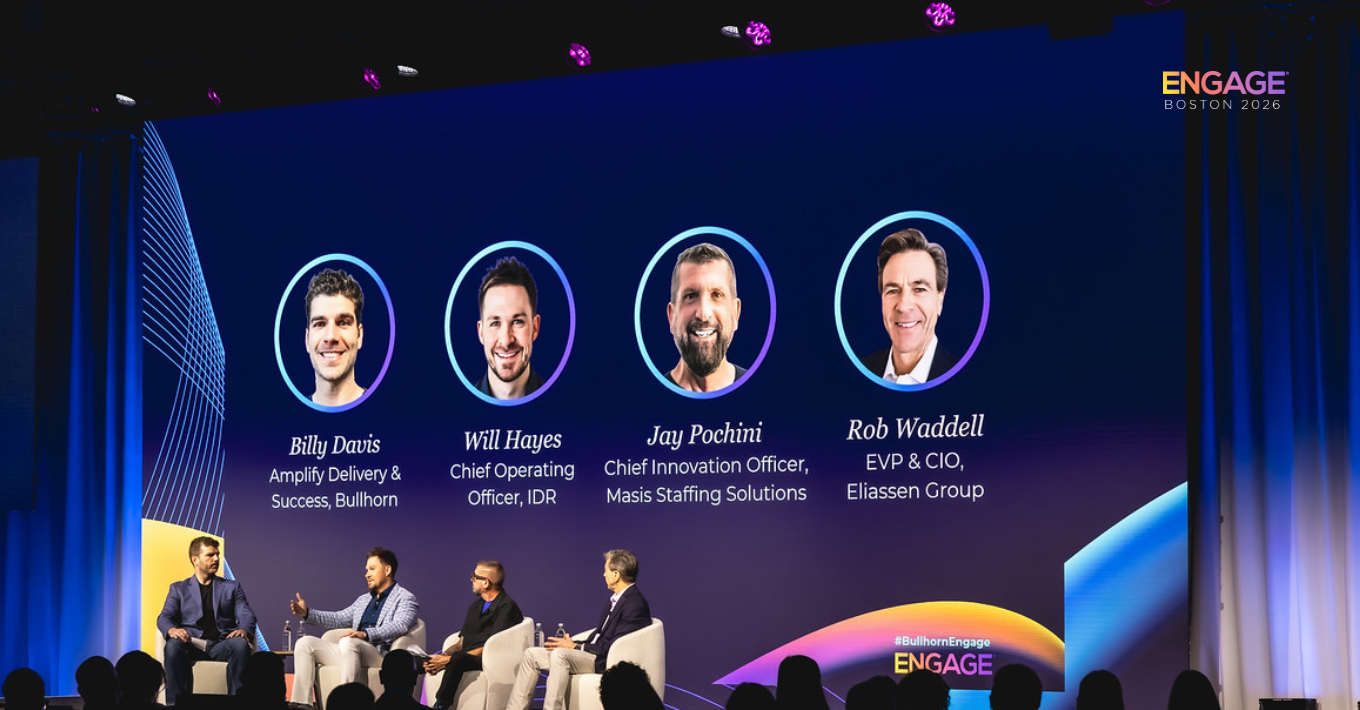
Billy Davis, Amplify delivery and success manager at Bullhorn, led a conversation on how AI is changing the way staffing firms operate and measure success with three executives who are building those new frameworks in real time: Will Hayes, COO of IDR, Jay Pochini, chief innovation officer at Masis Staffing Solutions, and Rob Waddell, EVP and CIO at Eliassen Group, each with multiple years of AI adoption behind them and hard-won lessons to share.
Here’s what they covered.
Start with the foundation: Data, buy-in, and a shared vision
Before any measurement framework can work, the underlying data has to be usable. The consistent advice from all three leaders: don’t try to clean up everything at once. Going back decades into a candidate database to fix old records is a distraction. Starting with the most recent year of data and letting AI work through the rest is a faster, more practical path forward.
Governance and change management need to come before the tools, not after. Firms that get too far down the track without establishing policy and communicating clearly end up making uncomfortable changes mid-rollout. Getting stakeholders involved early, surveying them, understanding their concerns, and building those insights into the rollout approach made adoption significantly smoother.
Masis Staffing Solutions runs what Pochini calls Summit Series sessions, which are top-down calls where leadership walks the whole organization through what they’re doing with AI, why, and what’s expected. Getting that buy-in and excitement established early is what makes the rest of the adoption process work.
Measuring beyond time savings
Time savings is the obvious first metric, and it matters. But firms that stop there are measuring only a fraction of what AI is actually doing for the business.
Eliassen Group’s approach is to tag every Amplify workstream in the database so the team can track AI’s influence from the first candidate touch all the way through to placement. The goal is to build toward genuine A/B testing, comparing AI-assisted outcomes against non-assisted ones, so the data can speak to revenue impact, deal value, and EBITDA contribution, not just hours recovered.
At IDR, Hayes tracks submission sources at the job level to understand exactly how many placements are coming from the database versus external sources. The broader philosophy he shared was worth sitting with: viewing AI investment as a five-to-seven year business transformation changes how the numbers look. Tools that seem expensive in the short term become easier to justify when you take a longer view and measure them against the legacy systems they eventually replace.
Making AI essential, not optional
Adoption doesn’t happen by accident. All three leaders had made deliberate moves to embed AI into the daily workflow rather than leaving it as an optional extra.
IDR cut job boards entirely. It was a significant call for a company their size, but the results were clear. Database utilization for placements went from 4% to 51%. More than half of placements now come directly from Bullhorn, driven by recruiters who learned how to use the system well because they had to.
Masis Staffing Solutions gamifies adoption. Real-time placement dashboards make success visible across the team, tapping into the competitive nature that tends to run deep in staffing. When people can see results happening around them, they want in.
Eliassen Group’s approach was to invite users into the testing process early. When recruiters and account executives help test a tool before it rolls out, they take ownership of it. They become the champions who bring the rest of the team along, because the tool was partly theirs to build.
The question all three leaders are now asking their managers to ask their teams: what are you doing with the time AI is giving back to you?
The metrics that are actually changing
The shift in what gets measured is as significant as the shift in how work gets done.
New hire ramp time is one of the clearest indicators. IDR has cut the professional staffing ramp from roughly six months to two months. Minimizing job board training from the onboarding process simplifies everything, but the bigger shift is what that time gets replaced with. Instead of walking new recruiters through multiple platforms, managers can focus on the conversations that actually close candidates. New recruiters learn one system, get on the phone faster, and start contributing sooner.
Eliassen Group is profiling account executives across 23 dimensions using AI, something that wasn’t possible before. That data is being used to understand what elite performers are doing differently and to bring emerging leaders up to that standard faster. The A/B testing infrastructure they’re building will eventually show not just who is performing, but how much of that performance is being driven by AI assistance.
Screening agent metrics are maturing, too. Early on, the question was how many screens were sent. Now the question is how many screened submissions converted to placements, and what that says about candidate quality coming through the agent.
The shift that signals real maturity is when managers stop fielding questions about how to use the tools and start fielding questions about what else they can do.
When the flywheel kicks in
When AI adoption reaches critical mass across an organization, innovation stops coming only from leadership. It starts coming from everywhere. Department heads run performance reviews that would have been impossible without AI to process the data volume. Recruiters build their own prompts to solve problems no one anticipated. Account executives use AI mid-call to recall details that close deals faster.
“That innovation is now happening across 90% of your organization, and that’s when it gets really fun.”
— Will Hayes, COO, IDR
The measurement framework that matters at that stage is less about tracking individual tool usage and more about tracking what the organization is capable of doing that it couldn’t do before.
Ready to start your AI journey? Click here to get started today.